Explained: Why is India paying Elon Musk's SpaceX to launch GSAT-20?

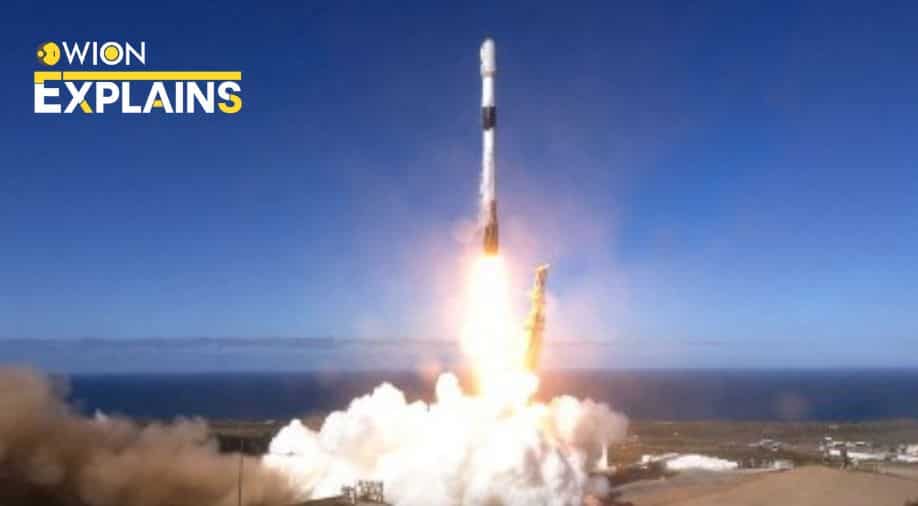
Falcon 9 explained
Over the last 25 years, the government-run Indian Space Research Organisation (ISRO), via its commercial arm, has launched more than 430 satellites for foreign customers and earned millions in foreign exchange. ISRO's PSLV and LVM3 are capable and reliable launch vehicles that have delivered success after success by orbiting satellites of foreign governments, academic institutions, startups and private firms. Then why has the Indian Government now signed a contract with American firm SpaceX to launch its own satellite? Why couldn't it be done in-house? Read on to know more.
On Wednesday (January 3), the government-run NewSpace India Limited (NSIL), which is ISRO's commercial arm, had announced that its newest communication satellite GSAT-20 would be flying on American firm's SpaceX's Falcon9 rocket. This is the first time that the Indian Government's satellite would be flying on Elon Musk's rocket. However, smaller satellites made by Indian private firms and startups have been launched by the Falcon 9.
Built by the Indian Space agency ISRO, the 4.7 ton GSAT-20 craft is a high-capacity communication satellite that is meant to offer broadband services, including In-flight and Maritime Connectivity (IFMC) services. Nestled in an orbit that's almost 36,000 kms above the earth, GSAT-20's services would cover the entire Indian mainland and also the Andaman & Nicobar, Lakshadweep archipelagos.
Watch: Gravitas | Space wars: China's counter to Musk's Starlink
According to NSIL, GSAT-20 (renamed as GSAT-N2) is a high-throughput satellite that operates in the Ka-band of the spectrum. It added that bulk of the 48 Gbps capacity on-board the satellite had been secured by Indian service providers. However, the names of these firms have not been revealed.
The NSIL has announced signing of a launch contract with SpaceX. The satellite is expected to be launched in the second quarter of 2024. The satellite is fully owned, operated and funded by NSIL. Presently, NSIL owns and operates 11 communication satellites that are in orbit.
Launcher and payload capacities
Think of rockets as cargo-carrying vehicles. Each one has its own specifications and capabilities. In the ascending order of how much payload can be delivered to Low-Earth Orbit (approx 500 km above the earth), ISRO's rockets can be classified thus: SSLV (500kg), PSLV (1750kg), GSLV (6000kg), LVM3 (8000kg).
There are various orbits at higher altitudes than the Low-Earth Orbit (LEO). For placing a craft in higher orbits or transfer orbits, the rocket would have to be more powerful, use efficient propulsion systems and deliver more velocity to the satellite.
Typically, communication satellites are launched into space at an orbit that is 170km x 36,000 km (also known as Geosynchronous Transfer Orbit or GTO). India's GSLV and LVM3 rockets are designed and reliably proven to deliver payloads into such a highly elliptical (egg-shaped) orbit.
While the GSLV can deliver around 2250 kg to GTO, the LVM3 can deliver 4000kg to GTO. However, GSAT-20, the latest communication satellite being built by ISRO weighs 4,700kg. Hence, it is beyond the payload capacity of India's operational rockets. This operational limitation and inability to lift such payloads to the desired GTO orbit, is why the Indian government has chosen a foreign rocket for carrying out the same task.
India's most preferred foreign launcher
For several decades, India has been relying on the European Arianespace rockets to orbit the communication satellites that weigh much more than 4000 kg. Since the 1980s, the Arianespace rockets have launched multiple Indian communication satellites, on a commercial basis. Launched in 2023, GSAT-24 was the 25th Indian satellite to be placed in orbit by an Arianespace rocket. However, with the retirement of the Ariane 5 rocket and the delay in the development and launch of its successor vehicle Ariane 6, the only other entity offering such services is Elon Musk's SpaceX.
SpaceX Falcon 9
Falcon 9 is a reusable, two-stage rocket designed and manufactured by SpaceX for reliable and safe transport of people and payloads into Earth orbit and beyond. Falcon 9 is the world’s first orbital class reusable rocket and has carried out more than 280 launches to date. The rocket is capable of lifting 22800 kg payloads to Low-Earth Orbit. The reusable nature of the rocket ensures that a significant portion of launch cost is reduced, when compared to expendable rockets (where the used stages of the rocket are ditched at sea or fall over vast uninhabited tracts of land).
India's heavy-lift rockets
For several years, ISRO has been working on a semi-cryogenic engine, one fuelled by special kerosene (termed as 'ISROsene') and super-cooled liquid oxygen. Once ready, this 2000kN engine and its stage (associated components, fuel tanks etc.) will be replacing the current L110 (core stage) of India's largest rocket - Launch Vehicle Mark 3(LVM3). This is meant to significantly add to the lifting power of the enhanced LVM3 rocket and ensure that it can carry 5000kg or heavier payloads into GTO. ISRO surpassed quite a few milestones in testing this engine.
However, in July 2023, owing to an unforeseen technical issue, the Indian Space Agency ISRO terminated the test firing of this engine midway. This is a minor setback in ISRO's journey towards testing and operationalising its maiden semi-cryogenic rocket engine which has been under development for several years. According to ISRO, the maiden test firing was meant to last 4.5 seconds and was aimed at testing the subsystems of the newly-developed semi-cryogenic engine. However, due to an unforeseen variation in test parameters at the two seconds mark, ISRO terminated the test as a precautionary measure.
In any case, it would take a couple of years before ISRO can completely test and operationalise its semi-cryogenic engine and integrate it with the LVM3 launcher. Meanwhile, ISRO is also working on developing advanced rockets that would cater to ISRO's needs of heavy-lift capability, landing astronauts on the moon and similar ambitious interplanetary goals etc. Termed as the Next Generation Launch Vehicle (NGLV), this is a rocket that is meant to be partially reusable and its engines would be powered by Methane and liquid oxygen.
