Explained | What kind of fireworks are allowed across India after SC's ban on crackers?

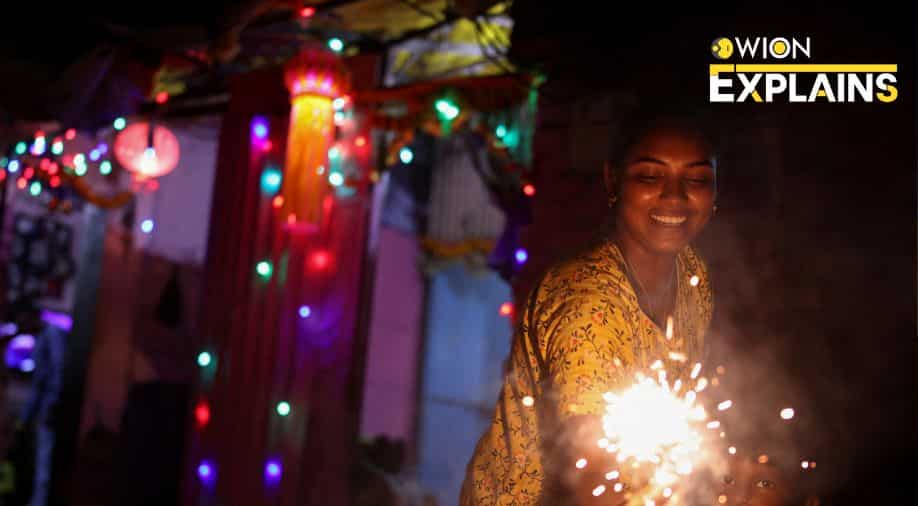
People in India celebrate Diwali, the Hindu festival of lights, with firecrackers.
On November 7, India's Supreme Court gave a clarification over its order to ban firecrackers across the country. The Court stated that the use of firecrackers, which are filled with barium and other banned chemicals, is banned in the entire nation, and not only in the National Capital Region.
The clarification was given by a bench, comprising Justices A S Bopanna and M M Sundresh, when they were hearing an application which was seeking direction to the Rajasthan government for complying with the order of the top court on the on barium crackers and decreasing air and noise pollution.
“At this juncture, no specific order will be necessary in as much as this Court in the course of hearing the petitions has passed several orders, where steps have been indicated to minimise and avoid air as well as noise pollution. Hence the said orders will bind every state in the country, including the state of Rajasthan,” stated a bench of Justice A S Bopanna and Justice M M Sundresh, in its order.
“Therefore, we make it clear that the state of Rajasthan would also take note of this and take all steps to minimise air and noise pollution, not only during the festival season but even thereafter," it added.
The Supreme Court's order came as India is gearing up for Diwali celebrations on November 12. The order raised questions like what type of firecrackers are permitted in the country and what are these firecrackers made of?
What orders have been issued by the Supreme Court on firecrackers?
The apex court in October 2018 placed a ban on the sale and production of all crackers except ‘green crackers’ and also those which have reduced emissions or improved crackers.
The sale and manufacture of ‘joined crackers’ (which are long rows of joined crackers) was also banned and the use of barium salts in firecrackers was not permitted. The court had also stated that their noise levels should remain within permissible limits.
This was reiterated by the October in its order issued on October 29, 2021. In September, the Supreme Court turned down a plea submitted by the firecracker manufacturers’ association which sought permission to the use of joined crackers and to add barium salt along with improved additives in the green crackers.
The use and sale of all types of firecrackers in the National Capital Region was banned by the National Green Tribunal in 2020, which stated that the green crackers would only be allowed in towns and cities where air quality was poor or moderate.
ALSO READ |Directions to regulate firecrackers meant for entire India, not just Delhi: Supreme Court
What are firecrackers made of?
Generally, the firecrackers are made with four primary ingredients — colouring agents, fuel, oxidiser, and binder. An oxidiser is added to the cracker so that it can catch fire, the fuel helps in sustaining it and colouring agents add the colours and sparkles to the crackers, while the mixture is held in place by the binder till the cracker has been spent completely.
Chemicals such as barium are a type of colouring agent, and they were banned by the court because they harmfully impact the health of human beings. These chemicals cause skin allergies, breathing difficulties, irritation in the respiratory tract, and even cancer.
In a cracker, aluminium, magnesium and titanium emit the white colour, while carbon or iron emitorange colour.
Similarly, sodium compounds work as yellow agents, while copper compounds and strontium carbonates emit blue and red colours, respectively. The green agent is barium chlorate barium nitrate or barium monochloride salts.
What are green crackers that cause less pollution?
Former director of the Council of Scientific & Industrial Research’s National Environmental Engineering Research Institute (CSIR-NEERI) Dr Rakesh Kumar, while speaking to The Indian Express in 2018, stated that green crackers have been named so because they “do not contain harmful chemicals” which can cause air pollution.
In the green crackers, the components used in traditional crackers are replaced with others which are “less dangerous” and “less harmful” to the atmosphere.
A network of CSIR labs, which included the Central Electro Chemical Research Institute (CECRI), Indian Institute of Chemical Technology, National Botanical Research Institute and National Chemical Laboratory, had researched the ways of producing green crackers.
WATCH |India: New Delhi puts firecracker ban ahead of Diwali, 3 years in jail if caught bursting crackers
These green crackers release water vapour that works as a dust suppressant and emits less-harmful chemicals. Such crackers are divided into three broad categories SWAS, SAFAL and STAR, which have been defined by CSIR.
SWAS stands for “safe water releaser” and it contains a small water pocket which gets released in the form of vapour after the cracker bursts. This release of vapour suppresses the dust.
STAR, which is known as a “safe thermite cracker”, does not contain sulphur and potassium nitrate, and releases reduced particulate matter at lesser sound intensity.
SAFAL refers to safe minimal aluminium in which aluminium is minimally used and magnesium is used instead. This also emits less noise compared to traditional crackers.
(With inputs from agencies)