December 13, 2001: The day the heart of India's democracy was attacked

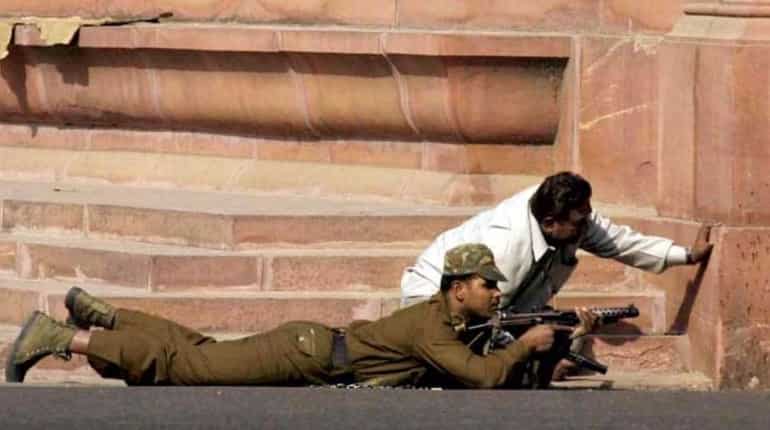
Parliament attack
On that day, the Parliament of India -- the very nerve centre of the country's democracy -- was attacked by terrorists from the Lashkar-e-Taiba and the Jaish-e-Mohammed
December 13, 2001 shook the very foundations of Indian democracy. A group of terrorists belonging to the Lashkar-e-Taiba and Jaish-e-Mohammed sneaked past the security cordon around the Parliament of India. The attack killed six Delhi Police personnel and two Parliament Security Service personnel.
Five terrorists were killed.
The attack left a deep scar on the psyche of the nation. We felt vulnerable but, it also strengthened India's resolve to take the war to the heart of terrorism.
On the sixteenth anniversary of the attack, WION spoke with Radhey Sham Gupta, thethen Special Police Commissioner in-charge of anti-terrorist operations, and Danvir Singh, editor of the Indian Defence Review.
WION: Why do you think an attack was launched on the Indian Parliament?
D Singh: When you look back, you realise the grand sinister design of Pakistan towards India that they have had, or rather they still have.
The attack on our Parliament was of a very high significance. It was designed to send a clear-cut message by Pakistanis to the Indians of their invincibility and ability to strike anywhere at free will with complete impunity.
The proxy war unleashed by them had already started to impact the psychology of the Indian state. Kandahar hijack and our response is the testimony to that argument. In quick succession, Pakistan had managed to seize and maintain the momentum of aggression on India after the Kargil defeat.
They had attacked the Kashmir assembly in November that year killing 38 innocent people. The intention of the enemy in carrying out such audacious attacks was to cripple the nervous system of the state. What could have been a better target other than Parliament which is the centre of gravity of Indian democracy and governance system?
WION: What were your first thoughts when you heard that Parliament has been attacked? What was the immediate action you took?
RS Gupta: I was the Special Police Commissioner in-charge of anti-terroristoperations at that time. My first reaction was to direct resources at the attack location and effectively deal with the terrorists -- arresting and neutralising them. Directions were very clear that in achieving our objective, no harm should be done to the MPs and VIPs at Parliament House at any cost. We were also asked to cause minimum damage on our side, both civilian and police.
Rest of the city was placed under full alert and security of all vital installations was reinforced. All Delhi Police units were placed on full emergency under senior officers. Delhi borders were put on full alert too.
WION: What was the scene at Parliament?
RS Gupta: Commissioner of Police Mr Ajay Raj Sharma had already reached Parliament House to lead the response. I too reached Parliament House shortly thereafter. Parliament House had been surrounded on all sides by police forces and units were involved in exchange of fire with terrorists. All five terrorists were neutralised before they could enter Parliament House and indulge in ashootout. A great role was played by Parliament staff in closing the wooden doors of the main Parliament building in time.Unfortunately, nine people were killed and 16 others injured in the attack by the terrorists.
Investigations were taken up immediately. Delhi Police cracked the case in 48 hours
WION: Can you tell us something about the attack that we came to know of only years later and was not evident then?
D Singh: Well!India realised that no matter how hard they battle with these terrorists and kill them in our own territory, we may continue with our losses in terms of precious human lives and seriously impair our psychology and in turn our will to fight. Thus, succumbing to Pakistani pressures and negotiating the Kashmir issue to their advantage.
We realised after the Parliament attack followed by Operation Parakram that the conventional option may not be a viable option. We had to prevent the attacker much before the LoC and preferably much beyond in Pakistani-held territory itself.
To that effect we did two things: firstly, we increased the pressure on the LoC by escalating artillery fire all across, making the proposition expensive to the Pakistanis both in terms of human and material resources. This forced General Musharraf to his knees literally begging for a ceasefire in 2003.
Secondly, we fenced our Line of Control. This was the game changer. Pakistan is still trying to grapple with this challenge. Today we have an upper hand and we have that initiative. Violence levels have reduced drastically in our favour. Also, the surgical strikes conducted have literally turned the tables. What Pakistan endeavoured by staging an attack on Parliament, we have achieved far much more. Pakistani establishment fears our response. India has changed, and they have realised that well.
WION: How do you think the terrorists managed to get in? What have we done to prevent such future attacks?
RS Gupta: The terrorists were able to enter the Parliament House complex by photocopying a Parliament car-parking label. They had recced the area and watched the entry procedure.
Parliament House security has since been reviewed, studied and strengthened.
WION: What is the most memorable image of that attack which has stayed with you from the event?
D Singh: Images of our CRPF jawans battling with these LeT / JeM terrorists with utmost bravery still linger on and remain totally clear in my memory. It was actually these images that conveyed a message that the terrorists sent by Pakistan who are religiously motivated under the ideology of Islam are in fact no-good fighters, rather they are cowards seen running petrified for cover once cornered.