WeWork's Neumann surrenders control and CEO role following investor revolt

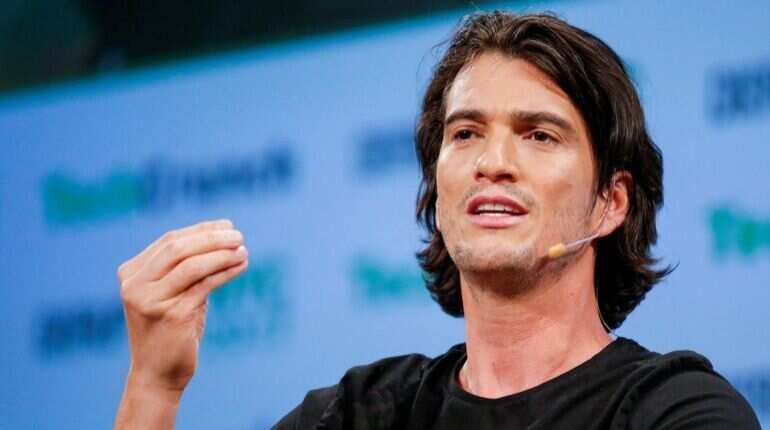
WeWork co-founder AdamNeumannagreed on Tuesday to resign as the Chief Executive and to give up majority votingcontrol, after SoftBank Group Corpand other shareholders turned on him over a plunge in the USoffice-sharing start-up's estimated valuation.
The decision came after WeWork's parent We Company postponed its initial public offering last weekfollowing a push-back from prospectivestock marketinvestors, not just over its widening losses, but also overNeumann's unusually firm grip on the company.
This was a blow for SoftBank, which was hoping for We Company's IPO to bolster its fortunes as it seeks to wooinvestors for its second $108 billion Vision Fund.
SoftBank invested in We Company at a $47 billion valuation in January. Butinvestorscepticism led to it earlier this month considering a potential IPO valuation of as low as $10 billion, Reuters reported.
We Company had vowed to press ahead with an IPO by the end of the year. But there was little sign that IPOinvestorsentiment would change, threatening the value of the stakes held not just by outsideinvestors, but byNeumannas well.
The size ofNeumann's holding has not been disclosed.
What was the venture capital world's biggest upset then morphed into one of corporate America's most high-profile boardroom dramas. SoftBank managed to muster enough opposition toNeumannin a meeting of We Company's seven-member board on Tuesday to convince him to step down. Reuters had reported on Monday thatNeumannhad engaged in talks about changes to hisrole.
"In recent weeks, the scrutiny directed towards me has become a significant distraction, and I have decided that it is in the best interest of the company to step down as Chief Executive,"Neumannsaid in a statement.
Artie Minson, currently the Chief Financial Officer of WeWork's parent We Company, and Sebastian Gunningham, theVice-Chairmanofthe New York-based start-up, will become co-chief executives, the company said.Neumannwill stay on the board as a Non-executive Chairman, the company added.
Minson, a former Chief Financial Officer at theTime Warner Cable who joined We Company in 2015, will oversee its finance, legal, human resources, real estate and public communications. Gunningham, a former executive at Amazon.com Inc, Apple Inc,and Oracle Corpwho joined We Company last year, will take responsibility for product, design, development, sales, marketing, technology and regional teams.
We Company is considering slowing its expansion so it burns through less cash and would require less funding in the absence of an IPO in the nearingteam, Reuters reported on Monday.
"While we anticipate difficult decisions ahead, each decision will be made with rigorous analysis, always bearing in mind the company’s long-term interests and health," Minson and Gunningham wrote in an internal company memo seen by Reuters.
Neumannalso agreed to reduce the power of his voting shares, losing majority votingcontrol, according to the sources. Each of his shares will now have the same voting rights as three We Company common shares, not the 10 common shares previously, the sources said.
Neumann's shares used to have the same voting power as 20 We Company common shares, before he agreed to reduce his grip slightly earlier this month in an unsuccessful attempt to make the IPO more attractive toinvestors.
We Company said on Tuesday it was now evaluating the "optimal timing" for an IPO.
Firm Grip
Neumann, whose net worth is pegged by Forbes at $2.2 billion, developed a cultfollowingamong many We Company employees, vowing to "elevate the world's consciousness" as he sought to establish WeWork as a brand that transcended office sharing.
While hisinvestors were willing to entertain his eccentricities over the decade he led WeWork since its founding in 2010, his free-whiling ways and party-heavy lifestyle came into focus once he failed to get the company's IPO underway.
During the attempts to woo IPOinvestors this month,Neumannwas criticized by corporate governance experts for arrangements that went beyond the typical practice of having majority votingcontrolthrough special categories of shares.
These included giving his estate a major say in his replacement asCEO, and tying the voting power of shares to how much he donates to charitable causes.
Neumannhad also entered several transactions with We Company, making the company a tenant in some of his properties and charging it rent. He has also secured a $500 million credit line from banks using company stock as collateral.
Late Concessions
Followingcriticism by potentialinvestors,Neumannagreed to some concessions without relinquishing majoritycontrol. He agreed to give We Company any profit he receives from real estate deals he hadreached with the New York-based firm.
These changes did little to address concerns about the business model for We Company, which rents workspace to clients under short-term contracts, even though it pays rent under long-term leases. This mix of long-term liabilities and short-term revenue raised questions amonginvestors about how the company would weather an economic downturn.
Neumann, 40, is not the first founder of a major start-up to be forced to step down recently. Uber Technologies Incco-founder Travis Kalanick resigned as the CEOof the ride-hailing start-up in 2017 after facing a rebellion from his board over a string of scandals, including allegations of enabling a chauvinistic and toxic work culture.
Uber replaced Kalanick with an outsider, former Expedia Group IncCEODara Khosrowshahi, and completed its IPO last May.