

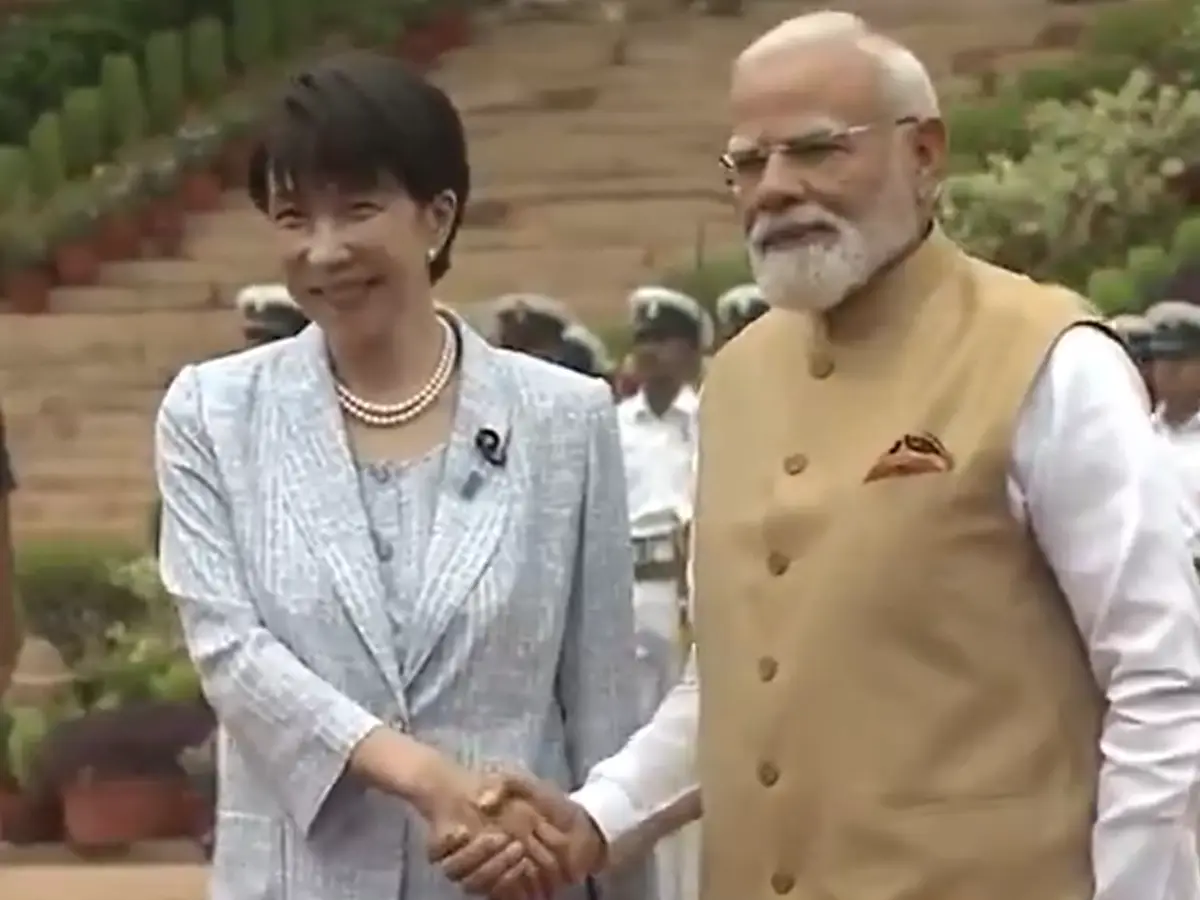
&imwidth=800&imheight=600&format=webp&quality=medium "Watch: PM Modi, Japan PM Sanae Takaichi exchange warm handshake as India-Japan summit begins: What it signifies")
Japanese Prime Minister Sanae Takaichi arrived at the Rashtrapati Bhawan in New Delhi on Thursday (July 2) and received a ceremonial welcome. Indian Prime Minister Narendra Modi welcomed her and introduced her to the members of various ministries. She shared a warm handshake and posed for an official photograph. Takaichi is on an official state visit to India for the 16th India-Japan Annual Summit. The summit is being seen as a significant one as both sides are expected to announce a landmark joint declaration on economic security. It also comes at a time when China is attempting to impose its dominance in Asia Pacific region and after the Iran-US war.
What the handshake signifies?
A warm handshake between leaders is more than a routine greeting and in this case, it shows the deep bond between Japan and India. While a handshake is a symbolic gesture of mutual respect, goodwill and a willingness to engage in dialogue, it also shows personal rapport between leaders. In diplomacy, such moments are often seen as setting a positive tone for high-level talks, signalling openness to cooperation rather than indicating any specific agreement or policy outcome. Historically, handshakes have also been viewed as a sign of peaceful intent and trust, with roots in the custom of showing an empty hand to demonstrate the absence of weapons.

