Vladimir Putin accuses West of trying to cancel Russian culture

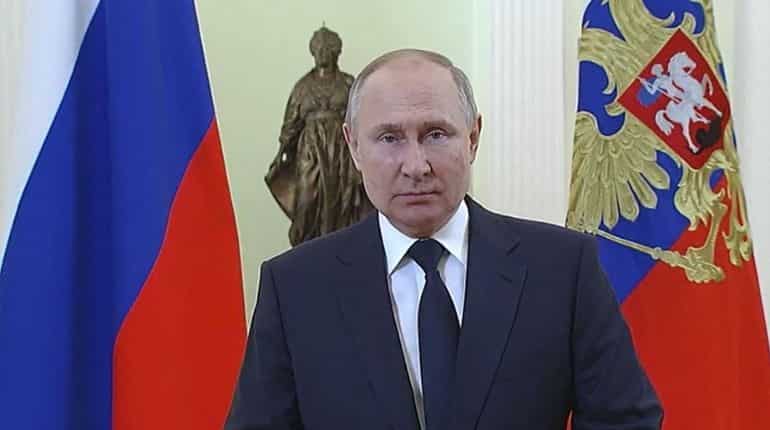
Russian President Vladimir Putin
President Vladimir Putin on Friday said the West was trying to cancel Russian culture, including the works of great composers such as Pyotr Tchaikovsky, Dmitry Shostakovich, and Sergei Rachmaninov.
"Today they are trying to cancel a thousand-year-old country," Putin said during a televised meeting with Russian winners of culture-related prizes.
"I am talking about the progressive discrimination against everything connected with Russia, about this trend that is unfolding in a number of Western states, with the full connivance and sometimes with the encouragement of Western elites," Putin added.
"The proverbial 'cancel culture' has become a cancellation of culture," Putin said, adding that works by Russian composers were being excluded from concerts and books by Russian authors "banned".
"The last time such a mass campaign to destroy unwanted literature was carried out was by the Nazis in Germany almost 90 years ago... books were burned right on the squares," Putin said.
A number of events involving Russian cultural figures who have voiced support for the war have been cancelled, including some involving Valery Gergiev, General director of the St. Petersburg Mariinsky Theatre, who spoke to Putin during Friday's meeting.
Gergiev has been dismissed as chief conductor of the Munich Philharmonic and lost the chance to conduct at Milan's La Scala after he failed to condemn Russia's invasion.
"Not so long ago children's author J.K Rowling was cancelled because she, a writer of books that have sold millions of copies around the world, didn't please fans of so-called gender freedoms," Putin said.
Since Putin sent Russian troops into Ukraine on February 24, the West has piled sanctions on Moscow that have seen Russia increasingly isolated, politically and financially, and extending to spheres such as sports and culture.
Putin has tried to justify attacks on Ukraine saying that his operation aims to “denazify” Ukraine, a country with a Jewish president who lost relatives in the Holocaust and who heads a Western-backed, democratically elected government.
The Holocaust, World War II and Nazism have been important tools for Putin in his bid to legitimize Russia’s moves in Ukraine, but historians see their use as disinformation and a cynical ploy to further the Russian leader’s aims.
World War II, in which the Soviet Union lost an estimated 27 million people, is a linchpin of Russia’s national identity. In today’s Russia, officials bristle at any questioning of the USSR’s role.
Some historians say this has been coupled with an attempt by Russia at retooling certain historical truths from the war. They say Russia has tried to magnify the Soviet role in defeating the Nazis while playing down any collaboration by Soviet citizens in the persecution of Jews.
On Ukraine, Russia has tried to link the country to Nazism, particularly those who have led it since a pro-Russian leadership was toppled in 2014.
“In terms of all of the sort of constituent parts of Nazism, none of that is in play in Ukraine. Territorial ambitions. State-sponsored terrorism. Rampant antisemitism. Bigotry. A dictatorship. None of those are in play. So this is just total fiction,” said Jonathan Dekel-Chen, a history professor at Jerusalem’s Hebrew University.
What’s more, Ukrainian President Volodymyr Zelensky is Jewish and has said that three of his grandfather’s brothers were killed by German occupiers while his grandfather survived the war. That hasn’t stopped Russian officials from comparing Zelensky to Jews who were forced to collaborate with the Nazis during the Holocaust.
(With inputs from agencies)