UAE carried out strikes on Iran amid Gulf war escalation? Here's what report claims

&imwidth=600&imheight=450&format=webp&quality=medium "UAE carried out strikes on Iran amid Gulf war escalation? Here's what report claims")
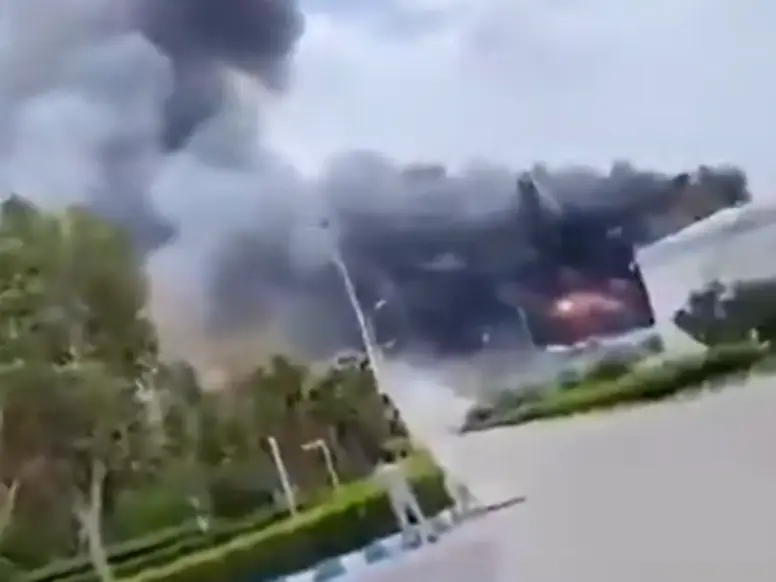
Screenshot from the video Photograph: (X (@Osint613))
UAE reportedly launched covert strikes on Tehran after massive Iranian attacks, marking a major shift in Gulf regional security dynamics
The United Arab Emirates has carried out military strikes on Iran, according to people familiar with the matter, who told The Wall Street Journal, positioning the Gulf monarchy as an active participant in a war in which it has become one of Iran’s primary targets. Armed with advanced Western-made fighter jets and sophisticated surveillance systems, the UAE appears increasingly willing to deploy military force to protect its economic interests and expanding influence across the Middle East. Among the reported operations was a strike on a refinery located on Iran’s Lavan Island in the Persian Gulf. Sources said the attack occurred in early April, around the time President Donald Trump announced a cease-fire following a five-week air campaign. The strike triggered a massive fire and disrupted much of the refinery’s production capacity for several months.
Iran acknowledged at the time that the refinery had been hit in what it described as an enemy attack and responded with a barrage of missiles and drones targeting the UAE and Kuwait. According to one source, the United States did not object to the strike because the cease-fire had not yet fully taken hold. The source added that Washington quietly welcomed participation from the UAE and other Gulf nations willing to join the military campaign. The UAE Ministry of Foreign Affairs declined to comment directly on the allegations but referred to earlier statements asserting the country’s right to respond militarily to hostile actions. The Pentagon also declined to comment, while the White House reiterated that President Trump retains every option at his disposal and said the US maintains maximum leverage over Iran.
“It’s significant to have a Gulf Arab country as a warring party that struck Iran directly,” said Dina Esfandiary, Middle East analyst and author of a book on the rise of the UAE. “Tehran will now aim to further drive a wedge between the UAE and other Gulf Arabs who are trying to mediate an end to the war.” Before the conflict escalated, Gulf nations publicly stated they would not allow their airspace or military bases to be used for attacks. However, after hostilities intensified, Iran launched waves of missile and drone attacks on Gulf cities, energy facilities, and airports in an effort to increase political and economic pressure on countries supporting the campaign. The UAE became Iran’s primary regional target, facing more than 2,800 missiles and drones, more than any other nation, including Israel.
The attacks severely disrupted the UAE’s aviation sector, tourism industry, and real estate market, while also triggering layoffs and furloughs. Gulf officials said the war has fundamentally altered Abu Dhabi’s strategic thinking, with Iran now increasingly viewed as a destabilizing force threatening the UAE’s economic model and reputation for stability. Since then, the UAE has emerged as one of the Gulf’s most confrontational states toward Tehran and has continued extensive military cooperation with the United States throughout the conflict, according to people familiar with the matter.
Speculation surrounding the UAE’s involvement intensified in mid-March after footage surfaced showing a fighter jet over Iran that analysts said did not appear to belong to either Israel or the United States. Open-source researchers later pointed to images allegedly showing French Mirage fighter jets and Chinese Wing Loong drones, both operated by the UAE, being used during operations inside Iran. Although the UAE’s military power is far smaller than that of the United States, analysts say its air force is highly capable. The country operates Mirage aircraft and advanced F-16 fighter jets, supported by aerial refueling systems, surveillance drones, and command-and-control platforms.
Abu Dhabi additionally moved against Iran’s financial networks by shutting schools and clubs in Dubai linked to Tehran and restricting visas and transit access for Iranian citizens, limiting one of Iran’s longstanding economic lifelines amid Western sanctions. Iran has repeatedly accused the UAE of actively supporting the US and Israeli military campaign. Following the destruction of much of Iran’s air-defense systems by U.S. and Israeli forces, analysts say conducting combat missions over Iranian territory became significantly less risky.
Disclaimer: WION takes utmost care to accurately and responsibly report ongoing conflicts in West Asia involving Israel, Iran, the US, Gulf nations, and non-state actors like Hezbollah, Hamas, Houthis, Islamic State, and others. Claims and counterclaims, disinformation and misinformation are being made online and offline. Given this context, WION cannot independently verify the authenticity of all statements, social media posts, photos, and videos.

