

&imwidth=800&imheight=600&format=webp&quality=medium "Trump baffled after Canada says it would recognise Palestine, raises 'trade deal': Here's what he threatened")
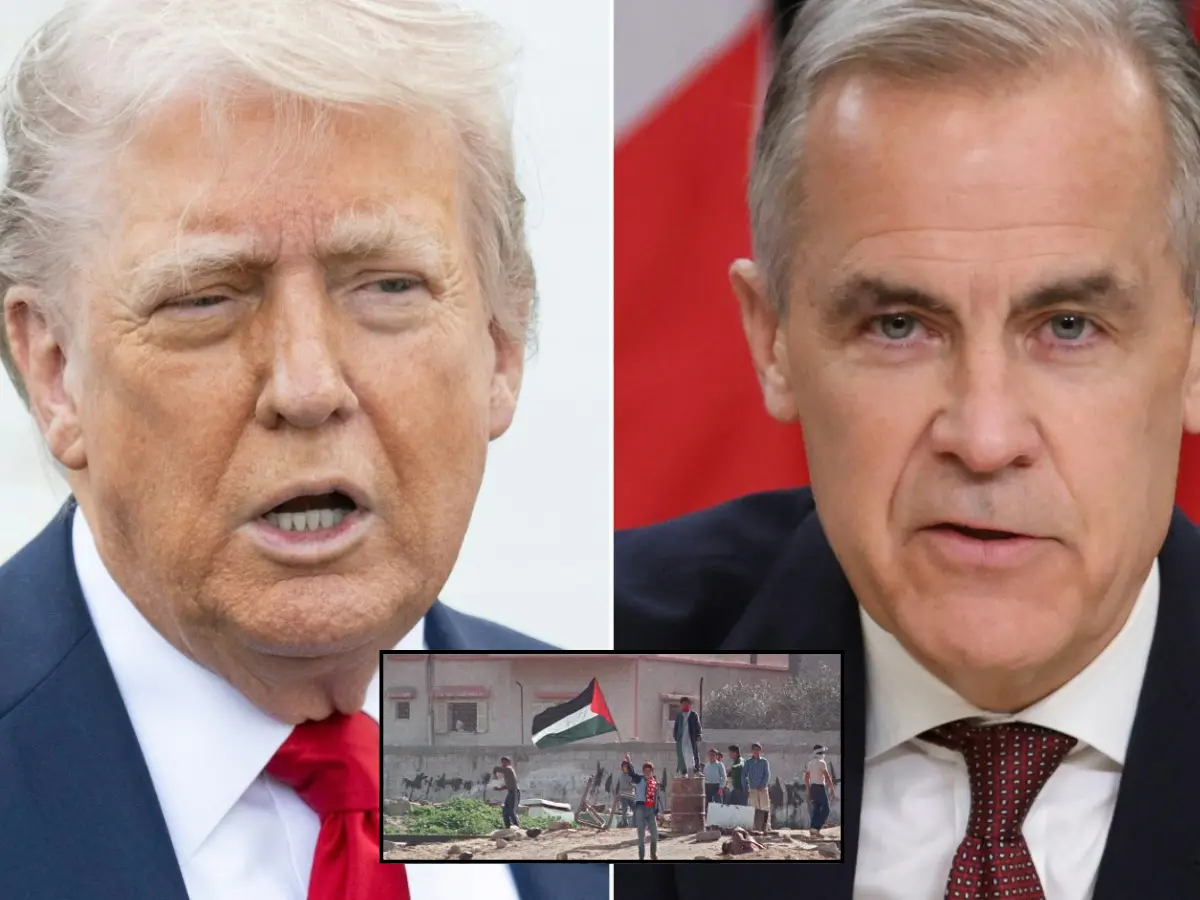
In what may be called a domino effect, many nations, including the United Kingdom and Canada, have announced that they are willing to recognise Palestine, after French President Emmanuel Macron delivered a diplomatic bombshell. The latest in the list of countries is Canada, and that was enough to draw the attention of US President Donald Trump. In a post on Truth Social, Trump expressed his disappointment and hinted that doors for a trade deal might be closed for Canada after it decides to recognise Palestine. In March, Trump imposed 25 per cent tariffs on Canada's steel and aluminium, weeks later, the same on automobiles. In June, he doubled steel and aluminium duties. Now he is threatening to tax copper at 50 per centstarting August 1. He has also said that if Canadian PM Mark Carney is not able to strike a trade deal with US, then America will impose a 35 per cent tariffs on all goods from Canada.
Canada, UK, France and Malta to recognise Palestine
Canada will officially recognise a Palestinian state at the United Nations in September, Prime Minister Mark Carney announced on Wednesday, citing recent reform commitments by the Palestinian Authority (PA) and emphasising the need to preserve the possibility of a two-state solution. "Canada has long been committed to a two-state solution, an independent, viable and sovereign Palestinian state living side by side with the State of Israel in peace and security,” Carney said during a press conference alongside Foreign Minister Anita Anand.
This came after French President Emmanuel Macron announced that France will recognise the state of Palestine at the United Nations General Assembly in September this year. In a letter to Palestinian Authority President Mahmoud Abbas, Macron emphasised the urgency of ending the war in Gaza and protecting civilians, describing his decision as a crucial step toward achieving lasting peace in the Middle East. Macron also reaffirmed France’s support for an immediate ceasefire, the release of Israeli hostages, the delivery of humanitarian aid to Gaza, the disarmament of Hamas, and long-term development efforts for a future Palestinian state.
Following France's move, British Prime Minister Keir Starmer announced that the UK would recognise a Palestinian state in September unless the Israeli government takes substantive steps to end the war and humanitarian crisis in the Gaza Strip, and meets several other conditions, including recommitting to a viable peace process. Joining these countries, Malta also announced its decision to recognise Palestine at the UN General Assembly’s meeting on a two-state solution to the conflict on July 29.
How many countries have recognised Palestine so far?
On November 15, 1988, PLO Chairman Yasser Arafat declared Palestine an independent state, naming Jerusalem as its capital. In the aftermath, over 80 nations, primarily from the Global South, including regions across Africa, Asia, Latin America, and the Arab world—extended recognition. Between the late 1980s and early 1990s, nearly 20 additional countries followed suit, with another 12 joining between 2000 and 2010, mostly from Africa and South America. By 2011, all African states except Eritrea and Cameroon had recognized Palestinian statehood.
A milestone came in 2012 when the UN General Assembly voted 138–9 (with 41 abstentions) to elevate Palestine's status to that of a non-member observer state. Sweden became the first EU member in Western Europe to recognise Palestine in 2014. More recently, on May 22, 2024, Norway, Ireland, and Spain formally recognised Palestine, prompting diplomatic backlash from Israel. Slovenia joined on June 4, while Malta and Belgium are still considering recognition. None of the G7 countries has recognised the state of Palestine. The Holy See, the governing body of the Catholic Church and Vatican City, which holds UN observer status, has also recognised Palestine.

