Swedish museum displays first-ever Al sculpture influenced by Michelangelo

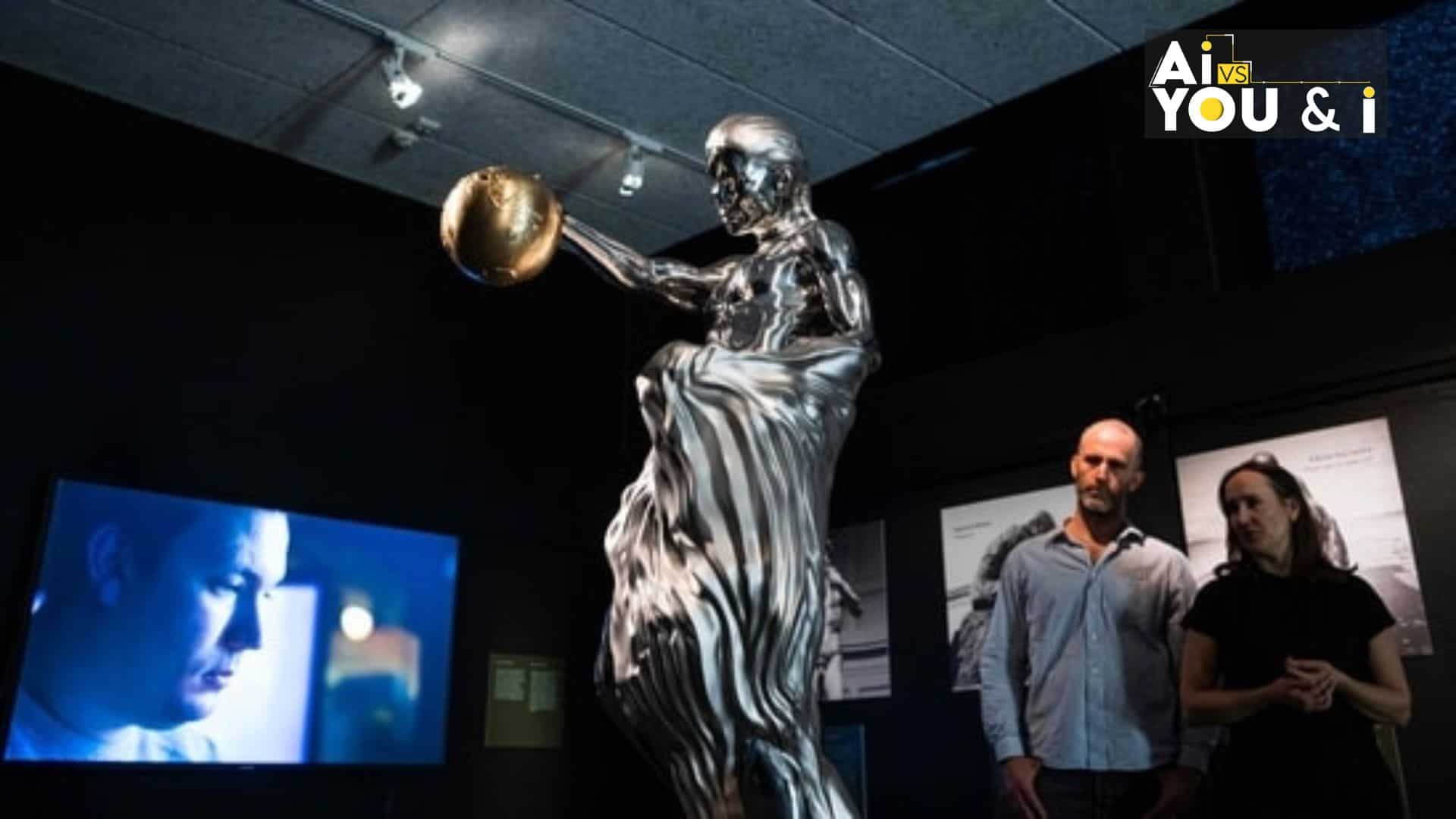
AI sculpture
A sculpture known as "the Impossible Statue" is currently on display at a Swedish museum thanks to the training of artificial intelligence (AI) by a historical dream team of five famous sculptors, including Michelangelo, Rodin, and Takamura.
"This is a true statue created by five different masters that would never have been able to collaborate in real life," said Pauliina Lunde, a spokeswoman for Swedish machine engineering group Sandvik that used three AI software programmes to create the artwork.
The stainless steel statue challenges conventional ideas about creativity and art by showing an androgynous person with a swath of cloth covering the lower half of the torso while holding a bronze globe in the other.
The monument, which is 150 centimetres (4 feet 11 inches) tall and weighs 500 kilogrammes, is on display in Stockholm's National Museum of Science and Technology.
Also watch |AI designs a sculpture marrying Michelangelo, Rodin and Takamura
Who were the sculptors?
Five renowned sculptors—Michelangelo (Italy, 1475–1564), Auguste Rodin (France, 1840–1917), Kathe Kollwitz (Germany, 1867–1945), Kotaro Takamura (Japan, 1883–1956), and Augusta Savage (US, 1892–1962)—who each made their imprint on their era—were chosen with the intention of combining their respective styles.
"Something about it makes me feel like this is not made by human being," Julia Olderius, in charge of concept development at the museum, told AFP.
Visitors will notice the strong Michelangelo-inspired physique and Takamura-inspired globe-holding hand.
A large number of pictures of the five artists' sculptures were fed to the AI by Sandvik's engineers in order to train it.
The programme then put out numerous 2D renderings that it thought captured the main ideas of each of the artists.
"In the end we had 2D images of the sculpture in which we could see the different masters reflected. Then we put these 2D images into 3D modeling," Olderius said.
"I don't think you can define what art is. It's up to every human being to see, 'this is art, this is not art'. And it's up to the audience to decide," Olderius said.
Olderius expressed optimism despite the controversy surrounding AI's potential impact on the art field.
"I don't think you have to be afraid of what AI is doing with creativity or concepts or art and design," she said.
“I just think you have to adapt to a new future where technology is a part of how we create concepts and art.”
(With inputs from agencies)
WATCH WION LIVE HERE: