Singapore Airlines horror: What is clear air turbulence and how is climate change making it worse?

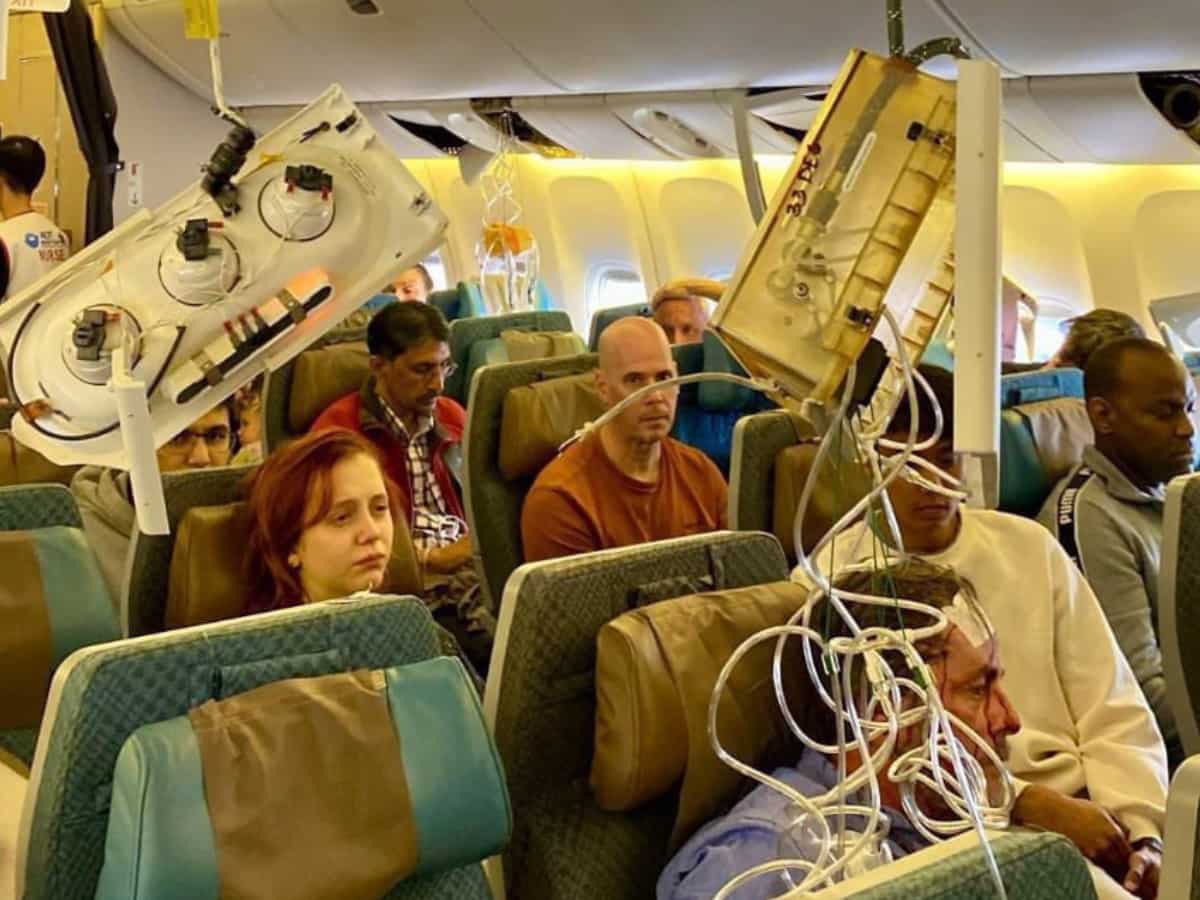
Passengers on Singapore Airlines aircraft
The scary scenes from a Singapore Airlines commercial flight that surfaced Tuesday (May 21) left everyone dumbfounded. The heavy turbulence in the London-Singapore flight led to the death of at least one person and injuring 30 other passengers onboard.
The pilots were found unable to assess the potential turbulence coming towards the commercial carrier, leading to one of the most horrifying flight incidents in the history of aviation.
As per experts, what the pilots of the airlines meet with is called 'the invisible danger of the skies'- the clear air turbulence or CAT.
CAT is a very rare, but highly fatal phenomenon that is hard to gauge in advance and goes completely undetected by radar systems.
What is clear air turbulence (CAT)?
Generally, fatalities caused by turbulence are incredibly rare on international flights. Pilots are usually able to give warnings in most cases of turbulence to ensure all passengers and crew members are buckled up.
However, when it comes to clear air turbulence, it is one of the most dangerous types.
Usually, any type of turbulence is caused due to the meeting of air at different temperatures, pressures or velocities.
During CAT, a turbulent movement of air masses takes place in the absence of any visual clues, such as clouds, and is caused when bodies of air moving at widely different speeds meet each other.
The atmospheric region most susceptible to CAT is the high troposphere at altitudes of around 7,000–12,000 metres (23,000–39,000 ft) as it meets the tropopause.
Here, CAT is most frequently encountered in the regions of jet streams. At lower altitudes, it may also occur near mountain ranges.
Is climate change causing more turbulence?
As per one study from the University of Reading, CATs have increased 55 per cent since 1976 over the North Atlantic and the main culprit for this is climate change.
Scientists at Reading University said their research showed that higher temperatures as a result of the climate crisis were leading to significant increases in turbulence across transatlantic flights.
The jet stream is sandwiched between the warm troposphere and the cool stratosphere, the increasing temperature differential means increasing wind shear.
While climate change is decreasing wind shear in the troposphere as temperature differentials decrease, the opposite is true for the lower stratosphere, which is where aeroplanes fly to avoid atmospheric drag.
“We have global warming in the troposphere, but we have global cooling in the stratosphere,” Ramalingam Saravanan, professor and department head of atmospheric sciences at Texas A&M University, tells Popular Mechanics.
An increase in carbon dioxide cools the stratosphere, and it does it in such a way that it increases vertical shear and cruising altitude tends to be in the stratosphere.
After looking into climate data over more than 40 years, the scientists found that severe turbulence, that is, the injury-causing kind, increased by 55 per cent.
Thankfully, only 0.1 per cent of the atmosphere contains this extreme level of turbulence, but even the more frequently encountered light and moderate turbulence saw significant increases up to 17 per cent and 34 per cent respectively.
(With inputs from agencies)