Residents flee fourth major Texas petrochemical fire this year

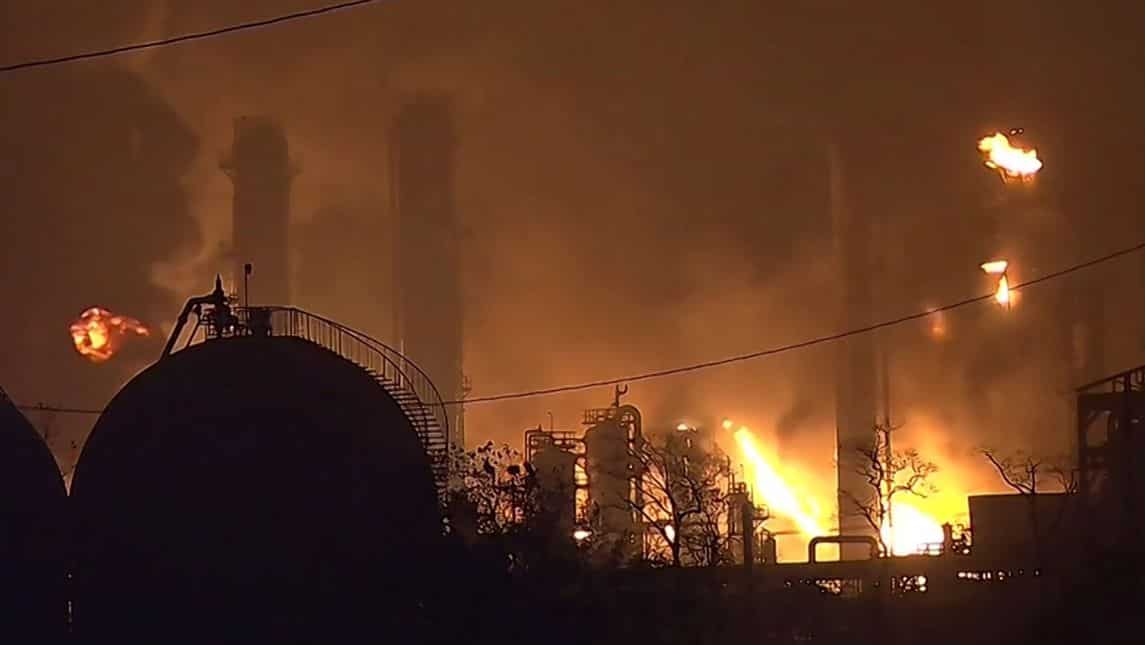
Petrochemical Fire
Three workers were injured andresidentsof four towns were told to evacuate after explosions on Wednesday at aTexaspetrochemicalplant, the latest in a series of chemical plant accidents in the region.
An early morning blast at a TPC Group complex in Port Neches,Texas, was followed by a series of secondary explosions that shattered windows and blew locked doors off their hinges.
About 60,000 people within a four-mile (6.4 km) radius of the facility was ordered to leave after a distillation column blew up about at 2 p.m. (2000 GMT) It was uncertain whenresidentswould be able to return, Jefferson County chief executive Jeff Branick said.
Branick ordered the departures on the eve of the Thanksgiving holiday out of fear heat from thefirewould ignitepetrochemicaltanks at the site.Firefighters were spraying water on the spherical tanks containing butane and other fuels to keep them cool, officials said.
The mandatory evacuation covers Port Neches and Groves, and portions of nearby Nederland and Port Arthur,Texas, officials said. State police would patrol the communities to prevent looting, Branick said.
The plant sits on a 218-acre (88.22-hectare) site located about 90 miles (145 km) east of Houston. It processespetrochemicals used to make synthetic rubber and resins, and a gasoline additive. TPC is nestled among several other chemical complexes that were not affected by the flames.
Peyton Keith, a TPC spokesman, saidfireofficials were determined to let thefirein a butadiene processing unit burn itself out, and were attempting to keep the flames from spreading. He could not say when thefirecould be extinguished.
A smoky plume visible from miles (km) away released volatile organic compounds that can lead to eye, nose and throat irritation, shortness of breath, headaches and nausea, pollution regulatorTexasCommission on Environmental Quality (TCEQ) said. No impact to water was reported.
Toby Baker, TCEQ executive director, criticized the "unacceptable trend of significant incidents" in the region and pledged to review the state's compliance efforts.
The fiery blast caused extensive damage to operations at the TPC site and followed otherfires atpetrochemicalproducers and storage facilities inTexas.
A March blaze at a chemical storage complex outside Houston burned for days and was followed a month later by another at a KMCO LLC plant northeast of Houston that killed one worker and injured a second. Afireat an Exxon Mobil Corp chemical plant in Baytown,Texas, in July, injured 37.
People more than 30 miles (48 km) away from the complex were shaken awake by the 1 a.m. CT (0700 GMT) explosion, sources familiar with thefire-fighting and rescue operations said.
The blast collapsed a roof over the plant's control room, sending workersfleeing, and damaged itsfire-fighting system. The suppression system was restored later in the day, Keith said.
Some homes close to the plant also sustained heavy damage, and police went door-to-door early in the morning to check ifresidentswere injured, said the Jefferson County Sheriff's Office.
One of the three injured workers was flown by helicopter to a Houston hospital. All three were treated and released, Keith said.
The plant employs 175 people and routinely has 50 contract workers on site.
"We cannot speak to the cause of the incident or the extent of damage," the company said.
TPC processespetrochemicals for use in the manufacture of synthetic rubber, nylon, resins, plastics and MBTE, a gasoline additive. The company supplies more than a third of the feedstock butadiene in North America, according to its website.
"Right now, our focus is on protecting the safety of responders and the public, and minimizing any impact to the environment," TPC Group said on its website.