Putin set to assume fifth term as Russian president after landslide victory

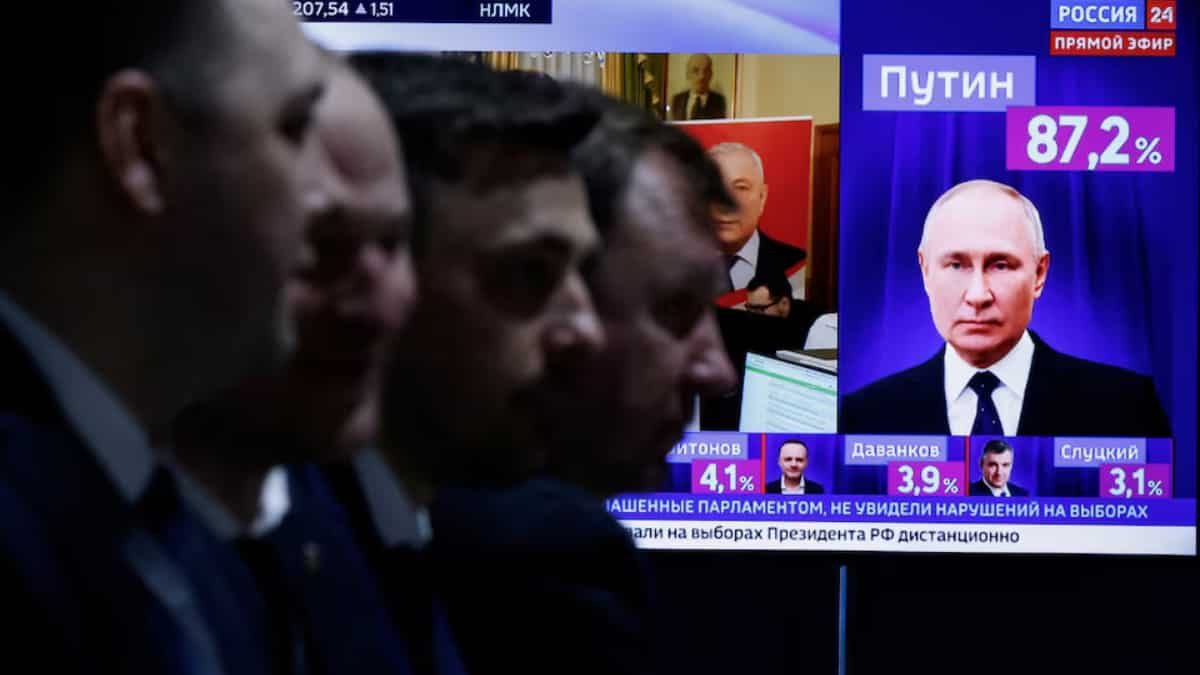
Men sit near a TV on the final day of the presidential election in Moscow, Russia, March 17, 2024
Russian President Vladimir Putin claimed a landslide victory in the country's presidential elections extending his rule till 2030.With more than 80 per cent of the votes counted by 1 am (Moscow Time), Putin was leading the race with an estimated 87.15 per cent of total votes polled.
Putin's closest opponent, the Communist Party's Nikolay Kharitonov is expected to come in second with 4.2 per cent votes of total votes polled. The voter turnout across Russia topped 74 per cent, the country's Central Election Commission said.
In a speech at his campaign headquarters on Sunday evening, Putin attempted to denounce the Western criticism of the elections and told his supporters that the West's reaction was on "expected" lines.
"What did you want, for them to applaud us? They’re fighting with us in an armed conflict … their goal is to contain our development. Of course, they are ready to say anything," he said.
The United States had previously described elections in Russiaas "obviously not free nor fair".
Putin had been defending his presidentialrecord in the face of war in Ukraine launched by him in February 2022 and sentiments across Russia over the death of prominent Russian dissident Alexei Navalny last month in a prison. Both these factors loomed large in Putin's latest address,currently being dubbed as his 'victory speech'.
Putin's first reaction over Navalny's death
For the first time since the death of Alexei Navalny, Putin said he had approved the exchange of the Kremlin critic for Russian prisoners in the West shortly before his death.
"Unfortunately, what happened happened," he said. "I agreed under one condition: we swap him, and he doesn’t come back. But that’s life."
'Everything is possible': Putin on conflict with NATO
Putin claimed he was securing the border from recent raids by pro-Ukrainian military units and said that his main tasks as president would be "strengthening defence capacity and the military".
Asked about the potential for a direct conflict with NATO, he said: "I think that everything is possible in the modern world … everyone understands that this would be one step from a full-scale third world war. I don’t think that anyone is interested in that."
Russia elections: Putin claims landslide in 'new' territories
Putin gained 94.12 per cent of the votes in Luhansk and over 95 per cent in the Donetsk region, sometimes collectively referred to as the Donbas region that Russia now claims as its own in the wake of the war in Ukraine.
The Russian state media reported that theresults from the Republics of Tyva,Khakassia, and Yakutia, the regions of Zaporizhzhia, Kherson, and Khabarovsk, and from Chukotka Autonomous Region also show Putin leadingwith roughly 90 per cent of the vote.
Putin's victory comes despite the war in Ukraine whose cumulative impact— in most Western capitals—was expected to result in the crippling of the Russian economy.
But by promoting manufacturing at home, sourcing the imports from 'friendly' countries, and gradually decreasing the discounts on oil exports, Putin managed to keep the Russian economy standing despite unprecedented Western sanctions in the wake of the war in Ukraine.
By 2029, Putin's tenure will have surpassed that of Joseph Stalin, who ruled the Soviet Union for 29 years. By 2030, Putin will have the longest tenure of any Russian leader since Catherine the Great in the late 1700s.