
&imwidth=800&imheight=600&format=webp&quality=medium "'POJK not part of Pakistan': Local leader warns Islamabad, hinting at alternative roads to India")
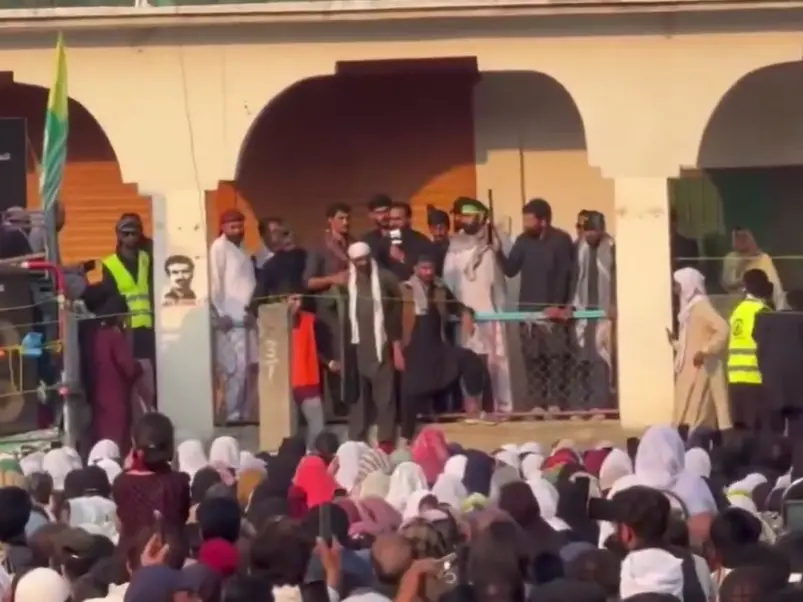
A massive public uprising in Pakistan-occupied Jammu and Kashmir (PoJK) has escalated into a direct challenge against Islamabad’s control. An indefinite strike and sit-in near the Line of Control (LoC), which began on June 9, has intensified into one of the largest anti-government movements the region has witnessed in recent history.
Addressing thousands of demonstrators gathered at Rawalakot's Eidgah Ground, prominent Joint Awami Action Committee (JAAC) leader Sardar Aman Khan delivered a blistering warning to the Pakistani establishment. Accusing the state of imposing a calculated food blockade to starve out the continuous civilian protests, Khan explicitly warned that Islamabad’s high-handedness could completely backfire."Our women and children have been sitting in protest at the ceasefire Line," Khan declared. "They say they will stop food supplies to Kashmiris. I say we do not need your rations. You need us."

As he continued, Khan said, “Kashmir will not accept any dictator. Kashmir is not part of Pakistan.”
Watch video here:
Khan cautioned that if the blockade continues, residents may look for "alternative roads" for survival, directly signalling a shift toward India. "Don’t let it come to a point where the remaining routes are opened, and then you are forced to plead with us and beg us to stay," he warned.
The protests, initially sparked by demands for wheat subsidies, fair electricity tariffs, and infrastructural rights, have evolved into a wider movement for autonomy and freedom from Pakistani exploitation. Despite heavy internet blockades, state-sponsored crackdowns, and a declared ban on the JAAC, tens of thousands of residents continue to hold their ground, asserting that PoJK is not the property of Pakistan.
What triggered the protest?
- Electoral Quotas: The Joint Awami Action Committee (JAAC) is demanding the abolition of 12 state assembly seats reserved for refugees living outside the region in mainland Pakistan, arguing it allows Islamabad to rig local outcomes ahead of the July 2026 elections.
- The Judicial Flashpoint: On June 7, 2026, the region's Supreme Court ruled these seats constitutionally protected, blocking executive removal and triggering a massive "long march" and shutter-down strikes.
- Economic Undercurrents: Persistent anger over hyperinflation, high electricity tariffs, and flour shortages.
- Terrorism Designation: On June 5, 2026, Islamabad officially banned the JAAC under anti-terror laws, drawing severe criticism from international rights bodies.
- Casualties: Severe clashes in Rawalakot, Kotli, and Mirpur claimed at least 11 lives which included protesters and police. And over 70 people were injured.
- Defying Islamabad: Local leaders are using the region's ambiguous constitutional status to declare they are "not part of Pakistan," stripping Islamabad of legal authority to enforce blockades.

