
&imwidth=800&imheight=600&format=webp&quality=medium "Nobel Prize 2025 in Economic Sciences: Joel Mokyr, Philippe Aghion and Peter Howitt awarded")
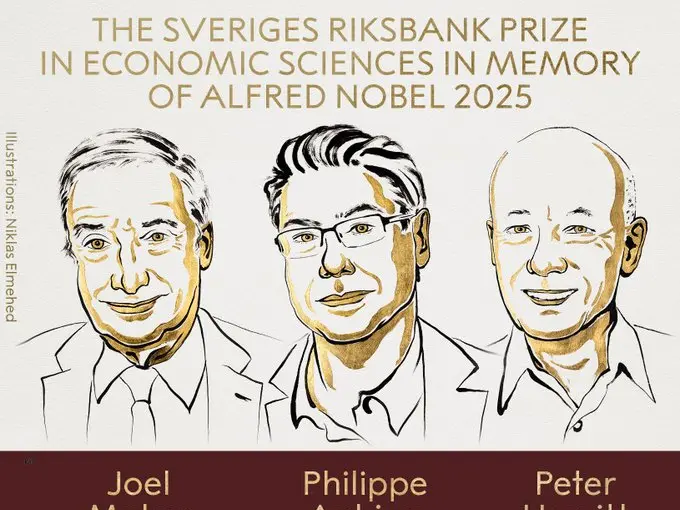
On Monday (October 13), the Nobel Prize in Economic Sciences was awarded to Joel Mokyr, an American-Israeli Israel, Philippe Aghion from France, and Peter Howitt from Canada for their groundbreaking work on how technology influences long-term economic growth. Mokyr, 79, received half of the prize for his research on identifying the necessary conditions that enable sustained economic growth through technological advancements, according to the Royal Swedish Academy of Sciences.
Aghion, 69, and Howitt, 79, shared the other half for their development of the ‘creative destruction’ theory, which examines how economic growth is driven by innovation that displaces older technologies with newer, more efficient ones. John Hassler, the chair of the Nobel committee, explained that their work addresses the fundamental question of how technological innovation fuels economic growth and what is required to maintain that growth over time.

Hassler highlighted the striking shift over the past two centuries, noting that for much of human history, living standards barely changed from one generation to the next, with economic stagnation being the norm. In contrast, the last 200 years have seen unprecedented growth. Kerstin Enflo, a member of the Nobel committee, emphasised that while the last two centuries of growth have been extraordinary, they still represent a brief period in the context of human history's long stretch of stagnation. She warned that progress should not be taken for granted and that societies need to remain vigilant about the factors that drive and sustain growth.
Mokyr, a professor at Northwestern University, used historical data to explore how technological progress became the key driver of sustained growth, making it a more permanent feature of modern economies. Aghion and Howitt’s work built on this by formulating a mathematical framework to explain “creative destruction” — a process in which new innovations render older products and companies obsolete, driving economic transformation.
When reached for comment, Aghion expressed his astonishment at the award, calling it a huge surprise. He also discussed the potential threats to continued growth, including the rising protectionism and trade barriers, such as those seen during Donald Trump’s presidency. Aghion argued that economic openness is a crucial driver of growth and that any barriers to this openness are detrimental.
He also warned that Europe should not allow the US and China to dominate the global technological landscape, stressing the need for European countries to strengthen their position in innovation. The Nobel Prize in Economics, unlike the original five prizes established by Alfred Nobel’s will, was created in 1968 through a donation from Sweden's central bank, and some critics refer to it as a ‘false Nobel’. However, it follows the same selection process as the other Nobel categories, with winners chosen by the Royal Swedish Academy of Sciences.
This year’s Nobel season also recognised advancements in immunology, quantum mechanics, and molecular architecture. The Nobel Literature Prize went to Hungarian author Laszlo Krasznahorkai, whose works explore dystopian and melancholic themes, while the Nobel Peace Prize was awarded to Venezuelan opposition leader Maria Corina Machado, who dedicated her award to Donald Trump, noting that he had long believed he deserved the honour.
The Nobel Economics Prize includes a diploma, a gold medal, and a cash award of $1.2 million. The laureates will receive their prizes at the official ceremonies in Stockholm and Oslo on December 10, the anniversary of Alfred Nobel’s death in 1896.

