US-Israel-Iran war Highlights: Strait of Hormuz emerges as main disagreement in Islamabad talks: Iranian media

&imwidth=600&imheight=450&format=webp&quality=medium "US-Israel-Iran war Highlights: Strait of Hormuz emerges as main disagreement in Islamabad talks: Iranian media")
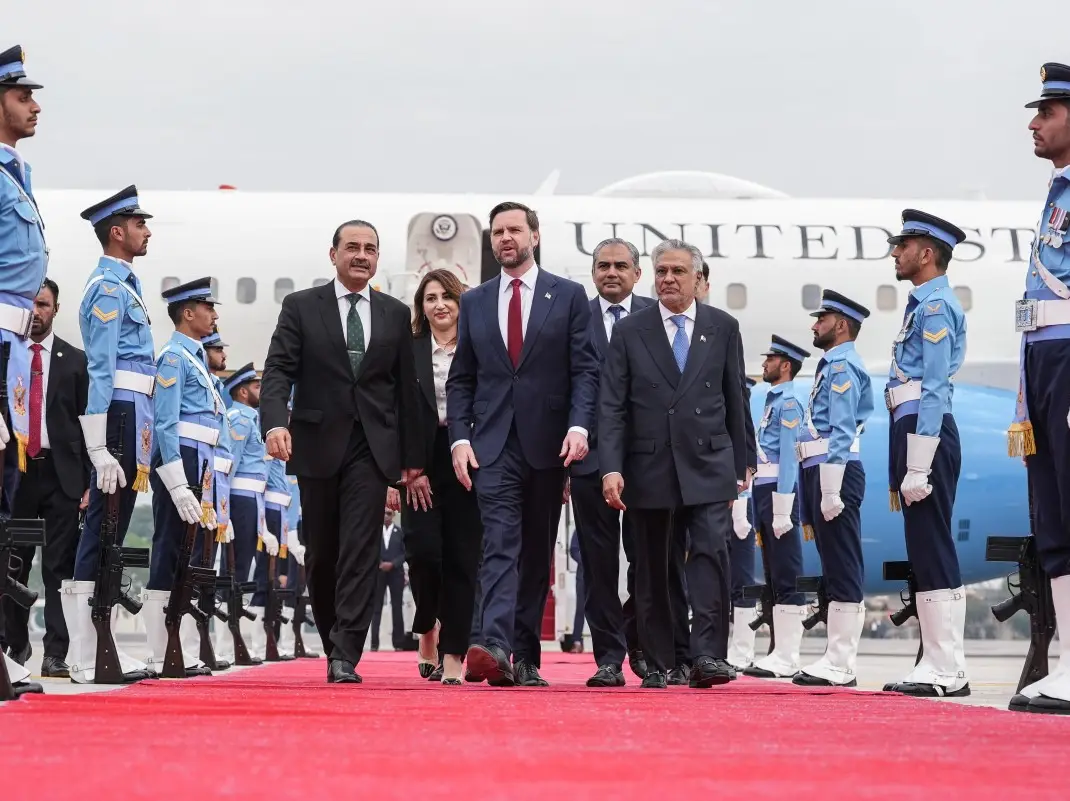
US Vice President JD Vance (C) speaks with Army Chief and Field Marshal Syed Asim Munir (L) and Pakistan's Foreign Minister Ishaq Dar (R) after arriving for the US-Iran peace talks in Islamabad on April 11, 2026 Photograph: (AFP)
US and Iranian delegations are scheduled to meet in Islamabad for peace talks amid a fragile ceasefire. However, conflicting reports emerge regarding the Iranian officials’ departure for the negotiations.
US-Israel-Iran war Highlights: An Iranian delegation arrived in Pakistan late on Friday (April 10) for peace talks with the United States. The group is being led by Parliament Speaker Mohammad Baqer Qalibaf and includes Foreign Minister Mohammad Javad Zarif, along with several senior officials. US Vice President JD Vance also departed on Friday for the scheduled talks in Islamabad, expressing optimism about the outcome of the negotiations.
Vance said that President Donald Trump had set out clear parameters for the discussions, while cautioning Tehran against attempting to mislead Washington.
“If the Iranians are willing to negotiate in good faith, we are certainly prepared to extend an open hand. If they attempt to play us, they will find the negotiating team far less receptive,” he said.
Meanwhile, the fragile ceasefire agreed earlier this week between Iran and the United States appears increasingly uncertain. Reports have suggested that the Iranian delegation may not have left for Pakistan yet to participate in the crucial talks. Iran’s Tasnim News Agency, citing a source, reported that neither Foreign Minister Abbas Araghchi nor Parliament Speaker Mohammad Bagher Ghalibaf had departed for the Islamabad meeting.
Follow WION for all the updates, analysis, and developments on the US-Israel-Iran war
Two rounds of talks have taken place between Iranian and US officials in Pakistan with a third round expected on Saturday evening or Sunday, Iranian state television reported as negotiations were underway in Islamabad.
Lebanon says Israeli strike on country's south kills 8.
US warships transit Strait of Hormuz in mine clearance op: Centcom
Macron says urged Iran president to use Islamabad talks to achieve 'lasting de-escalation'
The progress of talks will decide if the negotiating teams extend their stay in Islamabad, says Iran.
The United States, Pakistan and Iran were holding face-to-face trilateral talks in Islamabad on Saturday, the White House said, as top officials met to try and end the war in the Middle East.
US President Donald Trump said on Saturday that Iran is “losing big” in the conflict as talks in Islamabad kick off.
In a lengthy Truth Social post, Trump said members of the media “love saying that Iran is ‘winning’ when, in fact, everyone knows that they are LOSING and LOSING BIG”.
The trilateral peace talks between the United States, Iran and Pakistan have started in Pakistani capital, Islamabad, said media reports. These are the highest-level talks between Washington and Tehran since the 1979 Islamic revolution.
Vice President J D Vance, who is leading the US delegation, met Pakistani PM Shehbaz Sharif ahead of negotiations. Iranian representatives, including parliament speaker Mohammad Bagher Ghalibaf and Foreign Minister Abbas Araghchi, also met Sharif.
Iran’s first vice-president, Mohammad Reza Aref, warned on Saturday that “there will be no deal” and “the world will face greater costs” if Israeli interests are prioritised in talks in Islamabad.
In a statement on social media, he said, “If we negotiate in Islamabad with representatives of ‘America First,’ an agreement beneficial to both sides and the world is probable. However, if we face representatives of ‘Israel First,’ there will be no deal; we will inevitably continue our defence even more vigorously than before, and the world will face greater costs.”
The White House has denied reports that the United States agreed to unfreeze assets belonging to Iran. The denial follows earlier claims by an Iranian source that Washington had approved the release of funds held in Qatar and other foreign banks.
FUNDS ORIGINALLY FROZEN EIGHT YEARS AGO
The $6 billion, originating from Iranian oil revenues and frozen in 2018 after US sanctions were reimposed, was slated for release in 2023 under a prisoner swap agreement between the United States and Iran. Under the deal, the funds were transferred to accounts in Qatar with strict limits for humanitarian use. However, the money was effectively frozen again by the administration of Joe Biden following the October 7, 2023 attacks on Israel by Hamas.
Saudi Arabia’s Defence Ministry said a military force from Pakistan has arrived at King Abdulaziz Air Base under a joint strategic defence agreement between the two countries. The deployed contingent includes fighter and support aircraft from the Pakistani Air Force.
The Islamic Resistance Movement (Hamas) has welcomed the two-week ceasefire between Iran and the United States, as well as the start of negotiations in Pakistan aimed at ending the conflict. In a statement, the group accused Israel of seeking to reshape the region’s political and geographical landscape to secure dominance.
“We look forward to the success of the efforts exerted by Pakistan, the sponsor of these negotiations, along with other mediating countries, in creating hope for positive outcomes that would enhance stability, work towards reuniting Arab and Islamic nations, and thwart the malicious Zionist goals aimed at creating rift among the components of the [Islamic] Ummah.”
Hamas said Iran’s ‘steadfastness and resilience’ had prevented ‘Zionist-American objectives’, describing it as evidence of what it called the collapse of the Israeli project.
A senior Iranian source said the United States has agreed to release Iran’s frozen assets held in Qatar and other foreign banks. The source told Reuters the move is seen by Tehran as a test of US goodwill and a sign of seriousness about reaching a durable peace agreement. The asset release is also ‘directly linked’ to ensuring safe passage through the Strait of Hormuz ahead of any long-term deal, the source said.
Speaking on condition of anonymity, officials from the region told AP that the representatives from Egypt, Saudi Arabia, China and Qatar are in the Pakistani capital to help facilitate the US-Iran negotiations indirectly.
Iranian delegation met Pakistan's Prime Minister Shehbaz Sharif ahead of crucial negotiations with the United States aimed at ending the ongoing regional conflict. The delegation, led by Mohammad Bagher Ghalibaf and including Foreign Minister Abbas Araghchi, is in Islamabad as part of intensive diplomatic efforts before the high-stakes talks.
Iran’s Foreign Minister Abbas Araghchi has said Tehran is entering Saturday’s negotiations with the United States with ‘deep distrust’, citing attacks carried out during earlier rounds of nuclear discussions. In a statement shared via his office on Telegram, Araghchi warned that Iran would respond if it came under further attack, stating the country would 'fight back'.
He also called for Israeli attacks on Lebanon to stop, adding another layer of tension ahead of the high-stakes diplomatic engagement.
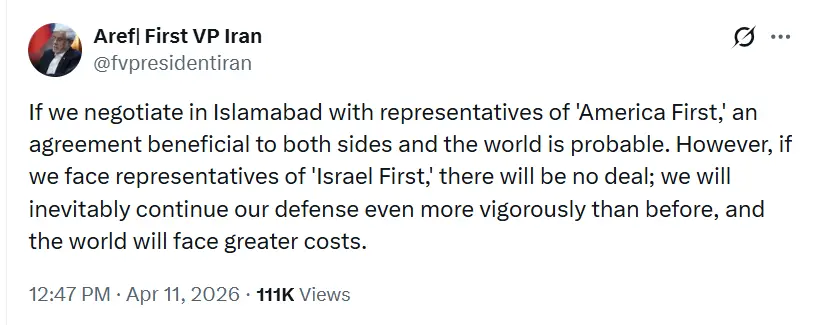
Iran’s First Vice President Mohammad Reza Aref has said that a diplomatic deal between United States and Iran remains achievable if Washington aligns its approach in line with US President’s Donald Trump’s ‘America First’ doctrine. In a social media post, Aref stressed that negotiations would fail if US representatives prioritised what he described as an ‘Israel First’ agenda.
He added that the collapse of talks could lead to heightened global consequences, particularly if hostilities involving the US and Israel escalate again, “the world will face greater costs.”
- Mohammad Bagher Ghalibaf, speaker of the parliament of Iran and head of the delegation
- Abbas Araghchi, foreign minister
- Reza Amiri Moghadam, ambassador to Pakistan
- Ali Akbar Ahmadian, member of the Supreme National Security Council
- Ali Bagheri Kani, deputy to the Supreme National Security Council
- Esmail Ahmadi Moghadam, president of the National Defence University
- Mohammad Jafari, assistant to the secretary at the Supreme National Security Council
- Naser Hemati, central bank governor
- Kazim Gharibabadi, deputy foreign minister
- Majid Takht-e Ravanchi, deputy foreign minister
- Valiollah Nouri, deputy foreign minister
- Esmaeil Baghaei, deputy foreign minister and ministry speaker
- Abolfazl Amouei, member of parliament
- Mohammad Nabavian, member of parliament
Islamabad is set to host the first direct highest-level diplomatic talks since the 1979 Islamic Revolution and the first official face-to-face negotiations since 2015. When US President Donald Trump walked out of the JCPOA, or the Iran nuclear deal, in 2018, Iran's late Supreme Leader Ayatollah Ali Khamenei banned further direct talks.
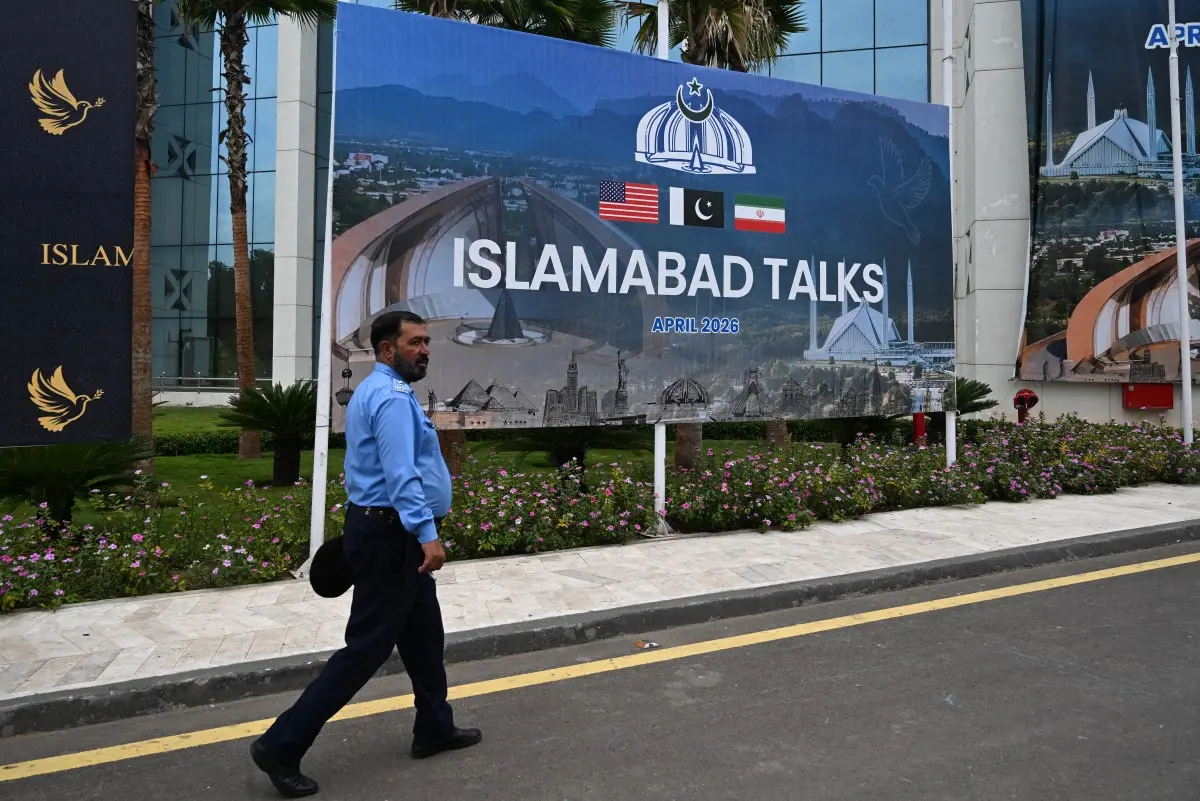
Throughout Islamabad, Pakistani officials have put up posters and banners advertising the peace talks. The banner reads “Islamabad Talks” with flags of the US and Iran on both sides and Pakistan in the middle.
Iran looks to project unity with a large delegation of 71 people. It is made up of negotiators, experts, media representatives and security. Mohammad Bagher Ghalibaf, Iran's Speaker of Parliament, is leading the delegation along with Foreign Minister Abbas Araghchi.
“Given the complexity and high sensitivity of the negotiations between Iran and the United States, the Iranian delegation includes not only the main negotiators but also technical and expert committees for necessary consultations,” reported Iran's state media Tasnim.
US Vice President JD Vance has arrived in Pakistan’s capital, Islamabad, to lead high-level talks with Iranian officials. Vance is heading the American delegation for negotiations aimed at stabilising a fragile ceasefire and de-escalating the ongoing conflict in the region.
The talks, being hosted in Pakistan under tight security, mark one of the highest level direct engagements between Washington and Tehran in decades and are seen as a crucial test for diplomatic efforts to end the war.
Lebanon's health ministry said the death toll from Israeli strikes across the country on Wednesday had risen from 303 to 357, with 1,223 people wounded.
It said the figure was not final and raised the overall toll in Lebanon since war erupted between Israel and Hezbollah on March 2 to 1,953 dead and 6,303 wounded.
Lebanon's State Security agency said that one Israeli strike in the southern city of Nabatiyeh had killed 13 of its personnel. Israel said it had killed 180 Hezbollah militants in Wednesday's strikes, while the Lebanese health ministry said that day's attacks alone killed 357 and wounded 1,223 more, noting the count was still provisional as rubble is still being removed.
Lebanon's presidency said Friday a meeting will be held at the US State Department on Tuesday "to discuss declaring a ceasefire and the start date for negotiations between Lebanon and Israel under US auspices," according to a statement.
The statement said the date was agreed to during a first telephone call on Friday evening between the Lebanese and Israeli ambassadors to Washington, and the US ambassador to Lebanon.
Israel's US ambassador Yechiel Leiter told his Lebanese counterpart in Washington that he "refused to discuss a ceasefire with the Hezbollah terrorist organization", according to a statement after a meeting.
Israel "agreed to begin formal peace negotiations" with the Lebanese government, with which it has no diplomatic relations, the Israeli ambassador said.
"A temporary ceasefire has been announced, but now an even more difficult stage lies ahead: the stage of achieving a lasting ceasefire, of resolving complicated issues through negotiations," said Pakistan's Prime Minister Shehbaz Sharif, whose government is leading mediations, in a televised speech.
"This is that stage which, in English, is called the equivalent of 'make or break'," he added.
A US aircraft carrying a high-level American delegation has landed in Islamabad for talks with Iran, according to Pakistani sources cited by Reuters. The delegation reportedly includes US envoy Steve Witkoff and senior adviser Jared Kushner.
The talks, being hosted in Pakistan, come amid heightened tensions and are seen as part of broader diplomatic efforts to stabilise the region and push for a ceasefire.
Hezbollah says it attacked Israeli soldiers in southern Lebanon, settlements in Israel.
Iran’s lead negotiator in Islamabad is parliamentary speaker Mohammad Bagher Ghalibaf, 64, a former mayor of Tehran who was a Revolutionary Guard commander in his youth.
The Israel military says a drone has been detected from Lebanon and sirens have been activated in Arab al-Aramshe and several towns in the Western Galilee.
Former US Defence Secretary Leon Panetta said on Friday that military force cannot bring about regime change, arguing that bombing campaigns do not produce lasting political outcomes.
“I think we’ve understood for a long time that you cannot bomb your way to a change in regime,” Panetta said in comments to Bloomberg. “With all sides now exhausted, there is now an opportunity to pursue a ceasefire.”
Iran’s Tasnim news agency is reporting that there are 71 people in Tehran’s delegation to Islamabad, including the main negotiating delegation, expert advisers, media representatives, as well as diplomatic and security teams.
The negotiating team is being led by Iran’s parliamentary speaker, Ghalibaf.
According to Tasnim, other negotiators include:
Foreign Minister Abbas Araghchi.
Central bank governor Abdolnaser Hemmati.
Secretary of the Supreme National Defence Council Ali Akbar Ahmadian.
Deputy Minister of Foreign Affairs Kezem Gharibabadi.
Iran’s Foreign Ministry spokesperson Esmaeil Baghaei.
As he arrived at the Islamabad airport for talks with the United States, Iran’s top negotiator said that his delegation has hope but does not trust its American counterparts.
“We have goodwill, but we do not trust,” Mohammad Bagher Ghalibaf, the country’s parliament speaker, told Iran’s state media.
The Pakistan foreign ministry shared a video of the arrival of the Iranian delegation in Islamabad for peace talks with the United States.
US-Israel-Iran war Highlights: An Iranian delegation arrived in Pakistan late on Friday (April 10) for peace talks with the United States. The group is being led by Parliament Speaker Mohammad Baqer Qalibaf and includes Foreign Minister Mohammad Javad Zarif, along with several senior officials. US Vice President JD Vance also departed on Friday for the scheduled talks in Islamabad, expressing optimism about the outcome of the negotiations.
Vance said that President Donald Trump had set out clear parameters for the discussions, while cautioning Tehran against attempting to mislead Washington.
“If the Iranians are willing to negotiate in good faith, we are certainly prepared to extend an open hand. If they attempt to play us, they will find the negotiating team far less receptive,” he said.
Meanwhile, the fragile ceasefire agreed earlier this week between Iran and the United States appears increasingly uncertain. Reports have suggested that the Iranian delegation may not have left for Pakistan yet to participate in the crucial talks. Iran’s Tasnim News Agency, citing a source, reported that neither Foreign Minister Abbas Araghchi nor Parliament Speaker Mohammad Bagher Ghalibaf had departed for the Islamabad meeting.
Follow WION for all the updates, analysis, and developments on the US-Israel-Iran war
Two rounds of talks have taken place between Iranian and US officials in Pakistan with a third round expected on Saturday evening or Sunday, Iranian state television reported as negotiations were underway in Islamabad.
Lebanon says Israeli strike on country's south kills 8.
US warships transit Strait of Hormuz in mine clearance op: Centcom
Macron says urged Iran president to use Islamabad talks to achieve 'lasting de-escalation'
The progress of talks will decide if the negotiating teams extend their stay in Islamabad, says Iran.
The United States, Pakistan and Iran were holding face-to-face trilateral talks in Islamabad on Saturday, the White House said, as top officials met to try and end the war in the Middle East.
US President Donald Trump said on Saturday that Iran is “losing big” in the conflict as talks in Islamabad kick off.
In a lengthy Truth Social post, Trump said members of the media “love saying that Iran is ‘winning’ when, in fact, everyone knows that they are LOSING and LOSING BIG”.
The trilateral peace talks between the United States, Iran and Pakistan have started in Pakistani capital, Islamabad, said media reports. These are the highest-level talks between Washington and Tehran since the 1979 Islamic revolution.
Vice President J D Vance, who is leading the US delegation, met Pakistani PM Shehbaz Sharif ahead of negotiations. Iranian representatives, including parliament speaker Mohammad Bagher Ghalibaf and Foreign Minister Abbas Araghchi, also met Sharif.
Iran’s first vice-president, Mohammad Reza Aref, warned on Saturday that “there will be no deal” and “the world will face greater costs” if Israeli interests are prioritised in talks in Islamabad.
In a statement on social media, he said, “If we negotiate in Islamabad with representatives of ‘America First,’ an agreement beneficial to both sides and the world is probable. However, if we face representatives of ‘Israel First,’ there will be no deal; we will inevitably continue our defence even more vigorously than before, and the world will face greater costs.”
The White House has denied reports that the United States agreed to unfreeze assets belonging to Iran. The denial follows earlier claims by an Iranian source that Washington had approved the release of funds held in Qatar and other foreign banks.
FUNDS ORIGINALLY FROZEN EIGHT YEARS AGO
The $6 billion, originating from Iranian oil revenues and frozen in 2018 after US sanctions were reimposed, was slated for release in 2023 under a prisoner swap agreement between the United States and Iran. Under the deal, the funds were transferred to accounts in Qatar with strict limits for humanitarian use. However, the money was effectively frozen again by the administration of Joe Biden following the October 7, 2023 attacks on Israel by Hamas.
Saudi Arabia’s Defence Ministry said a military force from Pakistan has arrived at King Abdulaziz Air Base under a joint strategic defence agreement between the two countries. The deployed contingent includes fighter and support aircraft from the Pakistani Air Force.
The Islamic Resistance Movement (Hamas) has welcomed the two-week ceasefire between Iran and the United States, as well as the start of negotiations in Pakistan aimed at ending the conflict. In a statement, the group accused Israel of seeking to reshape the region’s political and geographical landscape to secure dominance.
“We look forward to the success of the efforts exerted by Pakistan, the sponsor of these negotiations, along with other mediating countries, in creating hope for positive outcomes that would enhance stability, work towards reuniting Arab and Islamic nations, and thwart the malicious Zionist goals aimed at creating rift among the components of the [Islamic] Ummah.”
Hamas said Iran’s ‘steadfastness and resilience’ had prevented ‘Zionist-American objectives’, describing it as evidence of what it called the collapse of the Israeli project.
A senior Iranian source said the United States has agreed to release Iran’s frozen assets held in Qatar and other foreign banks. The source told Reuters the move is seen by Tehran as a test of US goodwill and a sign of seriousness about reaching a durable peace agreement. The asset release is also ‘directly linked’ to ensuring safe passage through the Strait of Hormuz ahead of any long-term deal, the source said.
Speaking on condition of anonymity, officials from the region told AP that the representatives from Egypt, Saudi Arabia, China and Qatar are in the Pakistani capital to help facilitate the US-Iran negotiations indirectly.
Iranian delegation met Pakistan's Prime Minister Shehbaz Sharif ahead of crucial negotiations with the United States aimed at ending the ongoing regional conflict. The delegation, led by Mohammad Bagher Ghalibaf and including Foreign Minister Abbas Araghchi, is in Islamabad as part of intensive diplomatic efforts before the high-stakes talks.
Iran’s Foreign Minister Abbas Araghchi has said Tehran is entering Saturday’s negotiations with the United States with ‘deep distrust’, citing attacks carried out during earlier rounds of nuclear discussions. In a statement shared via his office on Telegram, Araghchi warned that Iran would respond if it came under further attack, stating the country would 'fight back'.
He also called for Israeli attacks on Lebanon to stop, adding another layer of tension ahead of the high-stakes diplomatic engagement.
Iran’s First Vice President Mohammad Reza Aref has said that a diplomatic deal between United States and Iran remains achievable if Washington aligns its approach in line with US President’s Donald Trump’s ‘America First’ doctrine. In a social media post, Aref stressed that negotiations would fail if US representatives prioritised what he described as an ‘Israel First’ agenda.
He added that the collapse of talks could lead to heightened global consequences, particularly if hostilities involving the US and Israel escalate again, “the world will face greater costs.”
- Mohammad Bagher Ghalibaf, speaker of the parliament of Iran and head of the delegation
- Abbas Araghchi, foreign minister
- Reza Amiri Moghadam, ambassador to Pakistan
- Ali Akbar Ahmadian, member of the Supreme National Security Council
- Ali Bagheri Kani, deputy to the Supreme National Security Council
- Esmail Ahmadi Moghadam, president of the National Defence University
- Mohammad Jafari, assistant to the secretary at the Supreme National Security Council
- Naser Hemati, central bank governor
- Kazim Gharibabadi, deputy foreign minister
- Majid Takht-e Ravanchi, deputy foreign minister
- Valiollah Nouri, deputy foreign minister
- Esmaeil Baghaei, deputy foreign minister and ministry speaker
- Abolfazl Amouei, member of parliament
- Mohammad Nabavian, member of parliament
Islamabad is set to host the first direct highest-level diplomatic talks since the 1979 Islamic Revolution and the first official face-to-face negotiations since 2015. When US President Donald Trump walked out of the JCPOA, or the Iran nuclear deal, in 2018, Iran's late Supreme Leader Ayatollah Ali Khamenei banned further direct talks.
Throughout Islamabad, Pakistani officials have put up posters and banners advertising the peace talks. The banner reads “Islamabad Talks” with flags of the US and Iran on both sides and Pakistan in the middle.
Iran looks to project unity with a large delegation of 71 people. It is made up of negotiators, experts, media representatives and security. Mohammad Bagher Ghalibaf, Iran's Speaker of Parliament, is leading the delegation along with Foreign Minister Abbas Araghchi.
“Given the complexity and high sensitivity of the negotiations between Iran and the United States, the Iranian delegation includes not only the main negotiators but also technical and expert committees for necessary consultations,” reported Iran's state media Tasnim.
US Vice President JD Vance has arrived in Pakistan’s capital, Islamabad, to lead high-level talks with Iranian officials. Vance is heading the American delegation for negotiations aimed at stabilising a fragile ceasefire and de-escalating the ongoing conflict in the region.
The talks, being hosted in Pakistan under tight security, mark one of the highest level direct engagements between Washington and Tehran in decades and are seen as a crucial test for diplomatic efforts to end the war.
Lebanon's health ministry said the death toll from Israeli strikes across the country on Wednesday had risen from 303 to 357, with 1,223 people wounded.
It said the figure was not final and raised the overall toll in Lebanon since war erupted between Israel and Hezbollah on March 2 to 1,953 dead and 6,303 wounded.
Lebanon's State Security agency said that one Israeli strike in the southern city of Nabatiyeh had killed 13 of its personnel. Israel said it had killed 180 Hezbollah militants in Wednesday's strikes, while the Lebanese health ministry said that day's attacks alone killed 357 and wounded 1,223 more, noting the count was still provisional as rubble is still being removed.
Lebanon's presidency said Friday a meeting will be held at the US State Department on Tuesday "to discuss declaring a ceasefire and the start date for negotiations between Lebanon and Israel under US auspices," according to a statement.
The statement said the date was agreed to during a first telephone call on Friday evening between the Lebanese and Israeli ambassadors to Washington, and the US ambassador to Lebanon.
Israel's US ambassador Yechiel Leiter told his Lebanese counterpart in Washington that he "refused to discuss a ceasefire with the Hezbollah terrorist organization", according to a statement after a meeting.
Israel "agreed to begin formal peace negotiations" with the Lebanese government, with which it has no diplomatic relations, the Israeli ambassador said.
"A temporary ceasefire has been announced, but now an even more difficult stage lies ahead: the stage of achieving a lasting ceasefire, of resolving complicated issues through negotiations," said Pakistan's Prime Minister Shehbaz Sharif, whose government is leading mediations, in a televised speech.
"This is that stage which, in English, is called the equivalent of 'make or break'," he added.
A US aircraft carrying a high-level American delegation has landed in Islamabad for talks with Iran, according to Pakistani sources cited by Reuters. The delegation reportedly includes US envoy Steve Witkoff and senior adviser Jared Kushner.
The talks, being hosted in Pakistan, come amid heightened tensions and are seen as part of broader diplomatic efforts to stabilise the region and push for a ceasefire.
Hezbollah says it attacked Israeli soldiers in southern Lebanon, settlements in Israel.
Iran’s lead negotiator in Islamabad is parliamentary speaker Mohammad Bagher Ghalibaf, 64, a former mayor of Tehran who was a Revolutionary Guard commander in his youth.
The Israel military says a drone has been detected from Lebanon and sirens have been activated in Arab al-Aramshe and several towns in the Western Galilee.
Former US Defence Secretary Leon Panetta said on Friday that military force cannot bring about regime change, arguing that bombing campaigns do not produce lasting political outcomes.
“I think we’ve understood for a long time that you cannot bomb your way to a change in regime,” Panetta said in comments to Bloomberg. “With all sides now exhausted, there is now an opportunity to pursue a ceasefire.”
Iran’s Tasnim news agency is reporting that there are 71 people in Tehran’s delegation to Islamabad, including the main negotiating delegation, expert advisers, media representatives, as well as diplomatic and security teams.
The negotiating team is being led by Iran’s parliamentary speaker, Ghalibaf.
According to Tasnim, other negotiators include:
Foreign Minister Abbas Araghchi.
Central bank governor Abdolnaser Hemmati.
Secretary of the Supreme National Defence Council Ali Akbar Ahmadian.
Deputy Minister of Foreign Affairs Kezem Gharibabadi.
Iran’s Foreign Ministry spokesperson Esmaeil Baghaei.
As he arrived at the Islamabad airport for talks with the United States, Iran’s top negotiator said that his delegation has hope but does not trust its American counterparts.
“We have goodwill, but we do not trust,” Mohammad Bagher Ghalibaf, the country’s parliament speaker, told Iran’s state media.
The Pakistan foreign ministry shared a video of the arrival of the Iranian delegation in Islamabad for peace talks with the United States.
US-Israel-Iran war Highlights: An Iranian delegation arrived in Pakistan late on Friday (April 10) for peace talks with the United States. The group is being led by Parliament Speaker Mohammad Baqer Qalibaf and includes Foreign Minister Mohammad Javad Zarif, along with several senior officials. US Vice President JD Vance also departed on Friday for the scheduled talks in Islamabad, expressing optimism about the outcome of the negotiations.
Vance said that President Donald Trump had set out clear parameters for the discussions, while cautioning Tehran against attempting to mislead Washington.
“If the Iranians are willing to negotiate in good faith, we are certainly prepared to extend an open hand. If they attempt to play us, they will find the negotiating team far less receptive,” he said.
Meanwhile, the fragile ceasefire agreed earlier this week between Iran and the United States appears increasingly uncertain. Reports have suggested that the Iranian delegation may not have left for Pakistan yet to participate in the crucial talks. Iran’s Tasnim News Agency, citing a source, reported that neither Foreign Minister Abbas Araghchi nor Parliament Speaker Mohammad Bagher Ghalibaf had departed for the Islamabad meeting.
Follow WION for all the updates, analysis, and developments on the US-Israel-Iran war
Two rounds of talks have taken place between Iranian and US officials in Pakistan with a third round expected on Saturday evening or Sunday, Iranian state television reported as negotiations were underway in Islamabad.
Lebanon says Israeli strike on country's south kills 8.
US warships transit Strait of Hormuz in mine clearance op: Centcom
Macron says urged Iran president to use Islamabad talks to achieve 'lasting de-escalation'
The progress of talks will decide if the negotiating teams extend their stay in Islamabad, says Iran.
The United States, Pakistan and Iran were holding face-to-face trilateral talks in Islamabad on Saturday, the White House said, as top officials met to try and end the war in the Middle East.
US President Donald Trump said on Saturday that Iran is “losing big” in the conflict as talks in Islamabad kick off.
In a lengthy Truth Social post, Trump said members of the media “love saying that Iran is ‘winning’ when, in fact, everyone knows that they are LOSING and LOSING BIG”.
The trilateral peace talks between the United States, Iran and Pakistan have started in Pakistani capital, Islamabad, said media reports. These are the highest-level talks between Washington and Tehran since the 1979 Islamic revolution.
Vice President J D Vance, who is leading the US delegation, met Pakistani PM Shehbaz Sharif ahead of negotiations. Iranian representatives, including parliament speaker Mohammad Bagher Ghalibaf and Foreign Minister Abbas Araghchi, also met Sharif.
Iran’s first vice-president, Mohammad Reza Aref, warned on Saturday that “there will be no deal” and “the world will face greater costs” if Israeli interests are prioritised in talks in Islamabad.
In a statement on social media, he said, “If we negotiate in Islamabad with representatives of ‘America First,’ an agreement beneficial to both sides and the world is probable. However, if we face representatives of ‘Israel First,’ there will be no deal; we will inevitably continue our defence even more vigorously than before, and the world will face greater costs.”
The White House has denied reports that the United States agreed to unfreeze assets belonging to Iran. The denial follows earlier claims by an Iranian source that Washington had approved the release of funds held in Qatar and other foreign banks.
FUNDS ORIGINALLY FROZEN EIGHT YEARS AGO
The $6 billion, originating from Iranian oil revenues and frozen in 2018 after US sanctions were reimposed, was slated for release in 2023 under a prisoner swap agreement between the United States and Iran. Under the deal, the funds were transferred to accounts in Qatar with strict limits for humanitarian use. However, the money was effectively frozen again by the administration of Joe Biden following the October 7, 2023 attacks on Israel by Hamas.
Saudi Arabia’s Defence Ministry said a military force from Pakistan has arrived at King Abdulaziz Air Base under a joint strategic defence agreement between the two countries. The deployed contingent includes fighter and support aircraft from the Pakistani Air Force.
The Islamic Resistance Movement (Hamas) has welcomed the two-week ceasefire between Iran and the United States, as well as the start of negotiations in Pakistan aimed at ending the conflict. In a statement, the group accused Israel of seeking to reshape the region’s political and geographical landscape to secure dominance.
“We look forward to the success of the efforts exerted by Pakistan, the sponsor of these negotiations, along with other mediating countries, in creating hope for positive outcomes that would enhance stability, work towards reuniting Arab and Islamic nations, and thwart the malicious Zionist goals aimed at creating rift among the components of the [Islamic] Ummah.”
Hamas said Iran’s ‘steadfastness and resilience’ had prevented ‘Zionist-American objectives’, describing it as evidence of what it called the collapse of the Israeli project.
A senior Iranian source said the United States has agreed to release Iran’s frozen assets held in Qatar and other foreign banks. The source told Reuters the move is seen by Tehran as a test of US goodwill and a sign of seriousness about reaching a durable peace agreement. The asset release is also ‘directly linked’ to ensuring safe passage through the Strait of Hormuz ahead of any long-term deal, the source said.
Speaking on condition of anonymity, officials from the region told AP that the representatives from Egypt, Saudi Arabia, China and Qatar are in the Pakistani capital to help facilitate the US-Iran negotiations indirectly.
Iranian delegation met Pakistan's Prime Minister Shehbaz Sharif ahead of crucial negotiations with the United States aimed at ending the ongoing regional conflict. The delegation, led by Mohammad Bagher Ghalibaf and including Foreign Minister Abbas Araghchi, is in Islamabad as part of intensive diplomatic efforts before the high-stakes talks.
Iran’s Foreign Minister Abbas Araghchi has said Tehran is entering Saturday’s negotiations with the United States with ‘deep distrust’, citing attacks carried out during earlier rounds of nuclear discussions. In a statement shared via his office on Telegram, Araghchi warned that Iran would respond if it came under further attack, stating the country would 'fight back'.
He also called for Israeli attacks on Lebanon to stop, adding another layer of tension ahead of the high-stakes diplomatic engagement.
Iran’s First Vice President Mohammad Reza Aref has said that a diplomatic deal between United States and Iran remains achievable if Washington aligns its approach in line with US President’s Donald Trump’s ‘America First’ doctrine. In a social media post, Aref stressed that negotiations would fail if US representatives prioritised what he described as an ‘Israel First’ agenda.
He added that the collapse of talks could lead to heightened global consequences, particularly if hostilities involving the US and Israel escalate again, “the world will face greater costs.”
- Mohammad Bagher Ghalibaf, speaker of the parliament of Iran and head of the delegation
- Abbas Araghchi, foreign minister
- Reza Amiri Moghadam, ambassador to Pakistan
- Ali Akbar Ahmadian, member of the Supreme National Security Council
- Ali Bagheri Kani, deputy to the Supreme National Security Council
- Esmail Ahmadi Moghadam, president of the National Defence University
- Mohammad Jafari, assistant to the secretary at the Supreme National Security Council
- Naser Hemati, central bank governor
- Kazim Gharibabadi, deputy foreign minister
- Majid Takht-e Ravanchi, deputy foreign minister
- Valiollah Nouri, deputy foreign minister
- Esmaeil Baghaei, deputy foreign minister and ministry speaker
- Abolfazl Amouei, member of parliament
- Mohammad Nabavian, member of parliament
Islamabad is set to host the first direct highest-level diplomatic talks since the 1979 Islamic Revolution and the first official face-to-face negotiations since 2015. When US President Donald Trump walked out of the JCPOA, or the Iran nuclear deal, in 2018, Iran's late Supreme Leader Ayatollah Ali Khamenei banned further direct talks.
Throughout Islamabad, Pakistani officials have put up posters and banners advertising the peace talks. The banner reads “Islamabad Talks” with flags of the US and Iran on both sides and Pakistan in the middle.
Iran looks to project unity with a large delegation of 71 people. It is made up of negotiators, experts, media representatives and security. Mohammad Bagher Ghalibaf, Iran's Speaker of Parliament, is leading the delegation along with Foreign Minister Abbas Araghchi.
“Given the complexity and high sensitivity of the negotiations between Iran and the United States, the Iranian delegation includes not only the main negotiators but also technical and expert committees for necessary consultations,” reported Iran's state media Tasnim.
US Vice President JD Vance has arrived in Pakistan’s capital, Islamabad, to lead high-level talks with Iranian officials. Vance is heading the American delegation for negotiations aimed at stabilising a fragile ceasefire and de-escalating the ongoing conflict in the region.
The talks, being hosted in Pakistan under tight security, mark one of the highest level direct engagements between Washington and Tehran in decades and are seen as a crucial test for diplomatic efforts to end the war.
Lebanon's health ministry said the death toll from Israeli strikes across the country on Wednesday had risen from 303 to 357, with 1,223 people wounded.
It said the figure was not final and raised the overall toll in Lebanon since war erupted between Israel and Hezbollah on March 2 to 1,953 dead and 6,303 wounded.
Lebanon's State Security agency said that one Israeli strike in the southern city of Nabatiyeh had killed 13 of its personnel. Israel said it had killed 180 Hezbollah militants in Wednesday's strikes, while the Lebanese health ministry said that day's attacks alone killed 357 and wounded 1,223 more, noting the count was still provisional as rubble is still being removed.
Lebanon's presidency said Friday a meeting will be held at the US State Department on Tuesday "to discuss declaring a ceasefire and the start date for negotiations between Lebanon and Israel under US auspices," according to a statement.
The statement said the date was agreed to during a first telephone call on Friday evening between the Lebanese and Israeli ambassadors to Washington, and the US ambassador to Lebanon.
Israel's US ambassador Yechiel Leiter told his Lebanese counterpart in Washington that he "refused to discuss a ceasefire with the Hezbollah terrorist organization", according to a statement after a meeting.
Israel "agreed to begin formal peace negotiations" with the Lebanese government, with which it has no diplomatic relations, the Israeli ambassador said.
"A temporary ceasefire has been announced, but now an even more difficult stage lies ahead: the stage of achieving a lasting ceasefire, of resolving complicated issues through negotiations," said Pakistan's Prime Minister Shehbaz Sharif, whose government is leading mediations, in a televised speech.
"This is that stage which, in English, is called the equivalent of 'make or break'," he added.
A US aircraft carrying a high-level American delegation has landed in Islamabad for talks with Iran, according to Pakistani sources cited by Reuters. The delegation reportedly includes US envoy Steve Witkoff and senior adviser Jared Kushner.
The talks, being hosted in Pakistan, come amid heightened tensions and are seen as part of broader diplomatic efforts to stabilise the region and push for a ceasefire.
Hezbollah says it attacked Israeli soldiers in southern Lebanon, settlements in Israel.
Iran’s lead negotiator in Islamabad is parliamentary speaker Mohammad Bagher Ghalibaf, 64, a former mayor of Tehran who was a Revolutionary Guard commander in his youth.
The Israel military says a drone has been detected from Lebanon and sirens have been activated in Arab al-Aramshe and several towns in the Western Galilee.
Former US Defence Secretary Leon Panetta said on Friday that military force cannot bring about regime change, arguing that bombing campaigns do not produce lasting political outcomes.
“I think we’ve understood for a long time that you cannot bomb your way to a change in regime,” Panetta said in comments to Bloomberg. “With all sides now exhausted, there is now an opportunity to pursue a ceasefire.”
Iran’s Tasnim news agency is reporting that there are 71 people in Tehran’s delegation to Islamabad, including the main negotiating delegation, expert advisers, media representatives, as well as diplomatic and security teams.
The negotiating team is being led by Iran’s parliamentary speaker, Ghalibaf.
According to Tasnim, other negotiators include:
Foreign Minister Abbas Araghchi.
Central bank governor Abdolnaser Hemmati.
Secretary of the Supreme National Defence Council Ali Akbar Ahmadian.
Deputy Minister of Foreign Affairs Kezem Gharibabadi.
Iran’s Foreign Ministry spokesperson Esmaeil Baghaei.
As he arrived at the Islamabad airport for talks with the United States, Iran’s top negotiator said that his delegation has hope but does not trust its American counterparts.
“We have goodwill, but we do not trust,” Mohammad Bagher Ghalibaf, the country’s parliament speaker, told Iran’s state media.
The Pakistan foreign ministry shared a video of the arrival of the Iranian delegation in Islamabad for peace talks with the United States.
US-Israel-Iran war Highlights: An Iranian delegation arrived in Pakistan late on Friday (April 10) for peace talks with the United States. The group is being led by Parliament Speaker Mohammad Baqer Qalibaf and includes Foreign Minister Mohammad Javad Zarif, along with several senior officials. US Vice President JD Vance also departed on Friday for the scheduled talks in Islamabad, expressing optimism about the outcome of the negotiations.
Vance said that President Donald Trump had set out clear parameters for the discussions, while cautioning Tehran against attempting to mislead Washington.
“If the Iranians are willing to negotiate in good faith, we are certainly prepared to extend an open hand. If they attempt to play us, they will find the negotiating team far less receptive,” he said.
Meanwhile, the fragile ceasefire agreed earlier this week between Iran and the United States appears increasingly uncertain. Reports have suggested that the Iranian delegation may not have left for Pakistan yet to participate in the crucial talks. Iran’s Tasnim News Agency, citing a source, reported that neither Foreign Minister Abbas Araghchi nor Parliament Speaker Mohammad Bagher Ghalibaf had departed for the Islamabad meeting.
Follow WION for all the updates, analysis, and developments on the US-Israel-Iran war
Two rounds of talks have taken place between Iranian and US officials in Pakistan with a third round expected on Saturday evening or Sunday, Iranian state television reported as negotiations were underway in Islamabad.
Lebanon says Israeli strike on country's south kills 8.
US warships transit Strait of Hormuz in mine clearance op: Centcom
Macron says urged Iran president to use Islamabad talks to achieve 'lasting de-escalation'
The progress of talks will decide if the negotiating teams extend their stay in Islamabad, says Iran.
The United States, Pakistan and Iran were holding face-to-face trilateral talks in Islamabad on Saturday, the White House said, as top officials met to try and end the war in the Middle East.
US President Donald Trump said on Saturday that Iran is “losing big” in the conflict as talks in Islamabad kick off.
In a lengthy Truth Social post, Trump said members of the media “love saying that Iran is ‘winning’ when, in fact, everyone knows that they are LOSING and LOSING BIG”.
The trilateral peace talks between the United States, Iran and Pakistan have started in Pakistani capital, Islamabad, said media reports. These are the highest-level talks between Washington and Tehran since the 1979 Islamic revolution.
Vice President J D Vance, who is leading the US delegation, met Pakistani PM Shehbaz Sharif ahead of negotiations. Iranian representatives, including parliament speaker Mohammad Bagher Ghalibaf and Foreign Minister Abbas Araghchi, also met Sharif.
Iran’s first vice-president, Mohammad Reza Aref, warned on Saturday that “there will be no deal” and “the world will face greater costs” if Israeli interests are prioritised in talks in Islamabad.
In a statement on social media, he said, “If we negotiate in Islamabad with representatives of ‘America First,’ an agreement beneficial to both sides and the world is probable. However, if we face representatives of ‘Israel First,’ there will be no deal; we will inevitably continue our defence even more vigorously than before, and the world will face greater costs.”
The White House has denied reports that the United States agreed to unfreeze assets belonging to Iran. The denial follows earlier claims by an Iranian source that Washington had approved the release of funds held in Qatar and other foreign banks.
FUNDS ORIGINALLY FROZEN EIGHT YEARS AGO
The $6 billion, originating from Iranian oil revenues and frozen in 2018 after US sanctions were reimposed, was slated for release in 2023 under a prisoner swap agreement between the United States and Iran. Under the deal, the funds were transferred to accounts in Qatar with strict limits for humanitarian use. However, the money was effectively frozen again by the administration of Joe Biden following the October 7, 2023 attacks on Israel by Hamas.
Saudi Arabia’s Defence Ministry said a military force from Pakistan has arrived at King Abdulaziz Air Base under a joint strategic defence agreement between the two countries. The deployed contingent includes fighter and support aircraft from the Pakistani Air Force.
The Islamic Resistance Movement (Hamas) has welcomed the two-week ceasefire between Iran and the United States, as well as the start of negotiations in Pakistan aimed at ending the conflict. In a statement, the group accused Israel of seeking to reshape the region’s political and geographical landscape to secure dominance.
“We look forward to the success of the efforts exerted by Pakistan, the sponsor of these negotiations, along with other mediating countries, in creating hope for positive outcomes that would enhance stability, work towards reuniting Arab and Islamic nations, and thwart the malicious Zionist goals aimed at creating rift among the components of the [Islamic] Ummah.”
Hamas said Iran’s ‘steadfastness and resilience’ had prevented ‘Zionist-American objectives’, describing it as evidence of what it called the collapse of the Israeli project.
A senior Iranian source said the United States has agreed to release Iran’s frozen assets held in Qatar and other foreign banks. The source told Reuters the move is seen by Tehran as a test of US goodwill and a sign of seriousness about reaching a durable peace agreement. The asset release is also ‘directly linked’ to ensuring safe passage through the Strait of Hormuz ahead of any long-term deal, the source said.
Speaking on condition of anonymity, officials from the region told AP that the representatives from Egypt, Saudi Arabia, China and Qatar are in the Pakistani capital to help facilitate the US-Iran negotiations indirectly.
Iranian delegation met Pakistan's Prime Minister Shehbaz Sharif ahead of crucial negotiations with the United States aimed at ending the ongoing regional conflict. The delegation, led by Mohammad Bagher Ghalibaf and including Foreign Minister Abbas Araghchi, is in Islamabad as part of intensive diplomatic efforts before the high-stakes talks.
Iran’s Foreign Minister Abbas Araghchi has said Tehran is entering Saturday’s negotiations with the United States with ‘deep distrust’, citing attacks carried out during earlier rounds of nuclear discussions. In a statement shared via his office on Telegram, Araghchi warned that Iran would respond if it came under further attack, stating the country would 'fight back'.
He also called for Israeli attacks on Lebanon to stop, adding another layer of tension ahead of the high-stakes diplomatic engagement.
Iran’s First Vice President Mohammad Reza Aref has said that a diplomatic deal between United States and Iran remains achievable if Washington aligns its approach in line with US President’s Donald Trump’s ‘America First’ doctrine. In a social media post, Aref stressed that negotiations would fail if US representatives prioritised what he described as an ‘Israel First’ agenda.
He added that the collapse of talks could lead to heightened global consequences, particularly if hostilities involving the US and Israel escalate again, “the world will face greater costs.”
- Mohammad Bagher Ghalibaf, speaker of the parliament of Iran and head of the delegation
- Abbas Araghchi, foreign minister
- Reza Amiri Moghadam, ambassador to Pakistan
- Ali Akbar Ahmadian, member of the Supreme National Security Council
- Ali Bagheri Kani, deputy to the Supreme National Security Council
- Esmail Ahmadi Moghadam, president of the National Defence University
- Mohammad Jafari, assistant to the secretary at the Supreme National Security Council
- Naser Hemati, central bank governor
- Kazim Gharibabadi, deputy foreign minister
- Majid Takht-e Ravanchi, deputy foreign minister
- Valiollah Nouri, deputy foreign minister
- Esmaeil Baghaei, deputy foreign minister and ministry speaker
- Abolfazl Amouei, member of parliament
- Mohammad Nabavian, member of parliament
Islamabad is set to host the first direct highest-level diplomatic talks since the 1979 Islamic Revolution and the first official face-to-face negotiations since 2015. When US President Donald Trump walked out of the JCPOA, or the Iran nuclear deal, in 2018, Iran's late Supreme Leader Ayatollah Ali Khamenei banned further direct talks.
Throughout Islamabad, Pakistani officials have put up posters and banners advertising the peace talks. The banner reads “Islamabad Talks” with flags of the US and Iran on both sides and Pakistan in the middle.
Iran looks to project unity with a large delegation of 71 people. It is made up of negotiators, experts, media representatives and security. Mohammad Bagher Ghalibaf, Iran's Speaker of Parliament, is leading the delegation along with Foreign Minister Abbas Araghchi.
“Given the complexity and high sensitivity of the negotiations between Iran and the United States, the Iranian delegation includes not only the main negotiators but also technical and expert committees for necessary consultations,” reported Iran's state media Tasnim.
US Vice President JD Vance has arrived in Pakistan’s capital, Islamabad, to lead high-level talks with Iranian officials. Vance is heading the American delegation for negotiations aimed at stabilising a fragile ceasefire and de-escalating the ongoing conflict in the region.
The talks, being hosted in Pakistan under tight security, mark one of the highest level direct engagements between Washington and Tehran in decades and are seen as a crucial test for diplomatic efforts to end the war.
Lebanon's health ministry said the death toll from Israeli strikes across the country on Wednesday had risen from 303 to 357, with 1,223 people wounded.
It said the figure was not final and raised the overall toll in Lebanon since war erupted between Israel and Hezbollah on March 2 to 1,953 dead and 6,303 wounded.
Lebanon's State Security agency said that one Israeli strike in the southern city of Nabatiyeh had killed 13 of its personnel. Israel said it had killed 180 Hezbollah militants in Wednesday's strikes, while the Lebanese health ministry said that day's attacks alone killed 357 and wounded 1,223 more, noting the count was still provisional as rubble is still being removed.
Lebanon's presidency said Friday a meeting will be held at the US State Department on Tuesday "to discuss declaring a ceasefire and the start date for negotiations between Lebanon and Israel under US auspices," according to a statement.
The statement said the date was agreed to during a first telephone call on Friday evening between the Lebanese and Israeli ambassadors to Washington, and the US ambassador to Lebanon.
Israel's US ambassador Yechiel Leiter told his Lebanese counterpart in Washington that he "refused to discuss a ceasefire with the Hezbollah terrorist organization", according to a statement after a meeting.
Israel "agreed to begin formal peace negotiations" with the Lebanese government, with which it has no diplomatic relations, the Israeli ambassador said.
"A temporary ceasefire has been announced, but now an even more difficult stage lies ahead: the stage of achieving a lasting ceasefire, of resolving complicated issues through negotiations," said Pakistan's Prime Minister Shehbaz Sharif, whose government is leading mediations, in a televised speech.
"This is that stage which, in English, is called the equivalent of 'make or break'," he added.
A US aircraft carrying a high-level American delegation has landed in Islamabad for talks with Iran, according to Pakistani sources cited by Reuters. The delegation reportedly includes US envoy Steve Witkoff and senior adviser Jared Kushner.
The talks, being hosted in Pakistan, come amid heightened tensions and are seen as part of broader diplomatic efforts to stabilise the region and push for a ceasefire.
Hezbollah says it attacked Israeli soldiers in southern Lebanon, settlements in Israel.
Iran’s lead negotiator in Islamabad is parliamentary speaker Mohammad Bagher Ghalibaf, 64, a former mayor of Tehran who was a Revolutionary Guard commander in his youth.
The Israel military says a drone has been detected from Lebanon and sirens have been activated in Arab al-Aramshe and several towns in the Western Galilee.
Former US Defence Secretary Leon Panetta said on Friday that military force cannot bring about regime change, arguing that bombing campaigns do not produce lasting political outcomes.
“I think we’ve understood for a long time that you cannot bomb your way to a change in regime,” Panetta said in comments to Bloomberg. “With all sides now exhausted, there is now an opportunity to pursue a ceasefire.”
Iran’s Tasnim news agency is reporting that there are 71 people in Tehran’s delegation to Islamabad, including the main negotiating delegation, expert advisers, media representatives, as well as diplomatic and security teams.
The negotiating team is being led by Iran’s parliamentary speaker, Ghalibaf.
According to Tasnim, other negotiators include:
Foreign Minister Abbas Araghchi.
Central bank governor Abdolnaser Hemmati.
Secretary of the Supreme National Defence Council Ali Akbar Ahmadian.
Deputy Minister of Foreign Affairs Kezem Gharibabadi.
Iran’s Foreign Ministry spokesperson Esmaeil Baghaei.
As he arrived at the Islamabad airport for talks with the United States, Iran’s top negotiator said that his delegation has hope but does not trust its American counterparts.
“We have goodwill, but we do not trust,” Mohammad Bagher Ghalibaf, the country’s parliament speaker, told Iran’s state media.
The Pakistan foreign ministry shared a video of the arrival of the Iranian delegation in Islamabad for peace talks with the United States.
US-Israel-Iran war Highlights: An Iranian delegation arrived in Pakistan late on Friday (April 10) for peace talks with the United States. The group is being led by Parliament Speaker Mohammad Baqer Qalibaf and includes Foreign Minister Mohammad Javad Zarif, along with several senior officials. US Vice President JD Vance also departed on Friday for the scheduled talks in Islamabad, expressing optimism about the outcome of the negotiations.
Vance said that President Donald Trump had set out clear parameters for the discussions, while cautioning Tehran against attempting to mislead Washington.
“If the Iranians are willing to negotiate in good faith, we are certainly prepared to extend an open hand. If they attempt to play us, they will find the negotiating team far less receptive,” he said.
Meanwhile, the fragile ceasefire agreed earlier this week between Iran and the United States appears increasingly uncertain. Reports have suggested that the Iranian delegation may not have left for Pakistan yet to participate in the crucial talks. Iran’s Tasnim News Agency, citing a source, reported that neither Foreign Minister Abbas Araghchi nor Parliament Speaker Mohammad Bagher Ghalibaf had departed for the Islamabad meeting.
Follow WION for all the updates, analysis, and developments on the US-Israel-Iran war
Two rounds of talks have taken place between Iranian and US officials in Pakistan with a third round expected on Saturday evening or Sunday, Iranian state television reported as negotiations were underway in Islamabad.
Lebanon says Israeli strike on country's south kills 8.
US warships transit Strait of Hormuz in mine clearance op: Centcom
Macron says urged Iran president to use Islamabad talks to achieve 'lasting de-escalation'
The progress of talks will decide if the negotiating teams extend their stay in Islamabad, says Iran.
The United States, Pakistan and Iran were holding face-to-face trilateral talks in Islamabad on Saturday, the White House said, as top officials met to try and end the war in the Middle East.
US President Donald Trump said on Saturday that Iran is “losing big” in the conflict as talks in Islamabad kick off.
In a lengthy Truth Social post, Trump said members of the media “love saying that Iran is ‘winning’ when, in fact, everyone knows that they are LOSING and LOSING BIG”.
The trilateral peace talks between the United States, Iran and Pakistan have started in Pakistani capital, Islamabad, said media reports. These are the highest-level talks between Washington and Tehran since the 1979 Islamic revolution.
Vice President J D Vance, who is leading the US delegation, met Pakistani PM Shehbaz Sharif ahead of negotiations. Iranian representatives, including parliament speaker Mohammad Bagher Ghalibaf and Foreign Minister Abbas Araghchi, also met Sharif.
Iran’s first vice-president, Mohammad Reza Aref, warned on Saturday that “there will be no deal” and “the world will face greater costs” if Israeli interests are prioritised in talks in Islamabad.
In a statement on social media, he said, “If we negotiate in Islamabad with representatives of ‘America First,’ an agreement beneficial to both sides and the world is probable. However, if we face representatives of ‘Israel First,’ there will be no deal; we will inevitably continue our defence even more vigorously than before, and the world will face greater costs.”
The White House has denied reports that the United States agreed to unfreeze assets belonging to Iran. The denial follows earlier claims by an Iranian source that Washington had approved the release of funds held in Qatar and other foreign banks.
FUNDS ORIGINALLY FROZEN EIGHT YEARS AGO
The $6 billion, originating from Iranian oil revenues and frozen in 2018 after US sanctions were reimposed, was slated for release in 2023 under a prisoner swap agreement between the United States and Iran. Under the deal, the funds were transferred to accounts in Qatar with strict limits for humanitarian use. However, the money was effectively frozen again by the administration of Joe Biden following the October 7, 2023 attacks on Israel by Hamas.
Saudi Arabia’s Defence Ministry said a military force from Pakistan has arrived at King Abdulaziz Air Base under a joint strategic defence agreement between the two countries. The deployed contingent includes fighter and support aircraft from the Pakistani Air Force.
The Islamic Resistance Movement (Hamas) has welcomed the two-week ceasefire between Iran and the United States, as well as the start of negotiations in Pakistan aimed at ending the conflict. In a statement, the group accused Israel of seeking to reshape the region’s political and geographical landscape to secure dominance.
“We look forward to the success of the efforts exerted by Pakistan, the sponsor of these negotiations, along with other mediating countries, in creating hope for positive outcomes that would enhance stability, work towards reuniting Arab and Islamic nations, and thwart the malicious Zionist goals aimed at creating rift among the components of the [Islamic] Ummah.”
Hamas said Iran’s ‘steadfastness and resilience’ had prevented ‘Zionist-American objectives’, describing it as evidence of what it called the collapse of the Israeli project.
A senior Iranian source said the United States has agreed to release Iran’s frozen assets held in Qatar and other foreign banks. The source told Reuters the move is seen by Tehran as a test of US goodwill and a sign of seriousness about reaching a durable peace agreement. The asset release is also ‘directly linked’ to ensuring safe passage through the Strait of Hormuz ahead of any long-term deal, the source said.
Speaking on condition of anonymity, officials from the region told AP that the representatives from Egypt, Saudi Arabia, China and Qatar are in the Pakistani capital to help facilitate the US-Iran negotiations indirectly.
Iranian delegation met Pakistan's Prime Minister Shehbaz Sharif ahead of crucial negotiations with the United States aimed at ending the ongoing regional conflict. The delegation, led by Mohammad Bagher Ghalibaf and including Foreign Minister Abbas Araghchi, is in Islamabad as part of intensive diplomatic efforts before the high-stakes talks.
Iran’s Foreign Minister Abbas Araghchi has said Tehran is entering Saturday’s negotiations with the United States with ‘deep distrust’, citing attacks carried out during earlier rounds of nuclear discussions. In a statement shared via his office on Telegram, Araghchi warned that Iran would respond if it came under further attack, stating the country would 'fight back'.
He also called for Israeli attacks on Lebanon to stop, adding another layer of tension ahead of the high-stakes diplomatic engagement.
Iran’s First Vice President Mohammad Reza Aref has said that a diplomatic deal between United States and Iran remains achievable if Washington aligns its approach in line with US President’s Donald Trump’s ‘America First’ doctrine. In a social media post, Aref stressed that negotiations would fail if US representatives prioritised what he described as an ‘Israel First’ agenda.
He added that the collapse of talks could lead to heightened global consequences, particularly if hostilities involving the US and Israel escalate again, “the world will face greater costs.”
- Mohammad Bagher Ghalibaf, speaker of the parliament of Iran and head of the delegation
- Abbas Araghchi, foreign minister
- Reza Amiri Moghadam, ambassador to Pakistan
- Ali Akbar Ahmadian, member of the Supreme National Security Council
- Ali Bagheri Kani, deputy to the Supreme National Security Council
- Esmail Ahmadi Moghadam, president of the National Defence University
- Mohammad Jafari, assistant to the secretary at the Supreme National Security Council
- Naser Hemati, central bank governor
- Kazim Gharibabadi, deputy foreign minister
- Majid Takht-e Ravanchi, deputy foreign minister
- Valiollah Nouri, deputy foreign minister
- Esmaeil Baghaei, deputy foreign minister and ministry speaker
- Abolfazl Amouei, member of parliament
- Mohammad Nabavian, member of parliament
Islamabad is set to host the first direct highest-level diplomatic talks since the 1979 Islamic Revolution and the first official face-to-face negotiations since 2015. When US President Donald Trump walked out of the JCPOA, or the Iran nuclear deal, in 2018, Iran's late Supreme Leader Ayatollah Ali Khamenei banned further direct talks.
Throughout Islamabad, Pakistani officials have put up posters and banners advertising the peace talks. The banner reads “Islamabad Talks” with flags of the US and Iran on both sides and Pakistan in the middle.
Iran looks to project unity with a large delegation of 71 people. It is made up of negotiators, experts, media representatives and security. Mohammad Bagher Ghalibaf, Iran's Speaker of Parliament, is leading the delegation along with Foreign Minister Abbas Araghchi.
“Given the complexity and high sensitivity of the negotiations between Iran and the United States, the Iranian delegation includes not only the main negotiators but also technical and expert committees for necessary consultations,” reported Iran's state media Tasnim.
US Vice President JD Vance has arrived in Pakistan’s capital, Islamabad, to lead high-level talks with Iranian officials. Vance is heading the American delegation for negotiations aimed at stabilising a fragile ceasefire and de-escalating the ongoing conflict in the region.
The talks, being hosted in Pakistan under tight security, mark one of the highest level direct engagements between Washington and Tehran in decades and are seen as a crucial test for diplomatic efforts to end the war.
Lebanon's health ministry said the death toll from Israeli strikes across the country on Wednesday had risen from 303 to 357, with 1,223 people wounded.
It said the figure was not final and raised the overall toll in Lebanon since war erupted between Israel and Hezbollah on March 2 to 1,953 dead and 6,303 wounded.
Lebanon's State Security agency said that one Israeli strike in the southern city of Nabatiyeh had killed 13 of its personnel. Israel said it had killed 180 Hezbollah militants in Wednesday's strikes, while the Lebanese health ministry said that day's attacks alone killed 357 and wounded 1,223 more, noting the count was still provisional as rubble is still being removed.
Lebanon's presidency said Friday a meeting will be held at the US State Department on Tuesday "to discuss declaring a ceasefire and the start date for negotiations between Lebanon and Israel under US auspices," according to a statement.
The statement said the date was agreed to during a first telephone call on Friday evening between the Lebanese and Israeli ambassadors to Washington, and the US ambassador to Lebanon.
Israel's US ambassador Yechiel Leiter told his Lebanese counterpart in Washington that he "refused to discuss a ceasefire with the Hezbollah terrorist organization", according to a statement after a meeting.
Israel "agreed to begin formal peace negotiations" with the Lebanese government, with which it has no diplomatic relations, the Israeli ambassador said.
"A temporary ceasefire has been announced, but now an even more difficult stage lies ahead: the stage of achieving a lasting ceasefire, of resolving complicated issues through negotiations," said Pakistan's Prime Minister Shehbaz Sharif, whose government is leading mediations, in a televised speech.
"This is that stage which, in English, is called the equivalent of 'make or break'," he added.
A US aircraft carrying a high-level American delegation has landed in Islamabad for talks with Iran, according to Pakistani sources cited by Reuters. The delegation reportedly includes US envoy Steve Witkoff and senior adviser Jared Kushner.
The talks, being hosted in Pakistan, come amid heightened tensions and are seen as part of broader diplomatic efforts to stabilise the region and push for a ceasefire.
Hezbollah says it attacked Israeli soldiers in southern Lebanon, settlements in Israel.
Iran’s lead negotiator in Islamabad is parliamentary speaker Mohammad Bagher Ghalibaf, 64, a former mayor of Tehran who was a Revolutionary Guard commander in his youth.
The Israel military says a drone has been detected from Lebanon and sirens have been activated in Arab al-Aramshe and several towns in the Western Galilee.
Former US Defence Secretary Leon Panetta said on Friday that military force cannot bring about regime change, arguing that bombing campaigns do not produce lasting political outcomes.
“I think we’ve understood for a long time that you cannot bomb your way to a change in regime,” Panetta said in comments to Bloomberg. “With all sides now exhausted, there is now an opportunity to pursue a ceasefire.”
Iran’s Tasnim news agency is reporting that there are 71 people in Tehran’s delegation to Islamabad, including the main negotiating delegation, expert advisers, media representatives, as well as diplomatic and security teams.
The negotiating team is being led by Iran’s parliamentary speaker, Ghalibaf.
According to Tasnim, other negotiators include:
Foreign Minister Abbas Araghchi.
Central bank governor Abdolnaser Hemmati.
Secretary of the Supreme National Defence Council Ali Akbar Ahmadian.
Deputy Minister of Foreign Affairs Kezem Gharibabadi.
Iran’s Foreign Ministry spokesperson Esmaeil Baghaei.
As he arrived at the Islamabad airport for talks with the United States, Iran’s top negotiator said that his delegation has hope but does not trust its American counterparts.
“We have goodwill, but we do not trust,” Mohammad Bagher Ghalibaf, the country’s parliament speaker, told Iran’s state media.
The Pakistan foreign ministry shared a video of the arrival of the Iranian delegation in Islamabad for peace talks with the United States.