Explained | How does Japan maintain its stoic resilience amid major earthquakes?

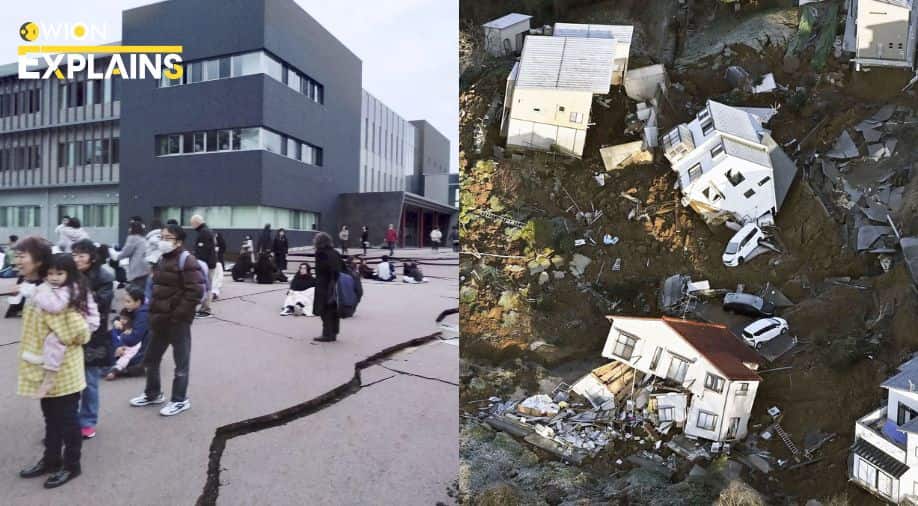
Japan was hit by a 7.6 magnitude earthquake on Monday (Jan 1).
Japan, a nation well-acquainted with the earth's seismic temperament, found itself grappling with the aftermath of a powerful 7.6 magnitude earthquake on New Year's Day.The death toll now stands at 55, despite the strong tremors. Taking a global perspective, recent seismic events serve as a stark reminder of the destructive potential of earthquakes. The 7.8 magnitude earthquake in southeast Turkey last year claimed over 50,000 lives, while the 2015 Nepal earthquake, with a magnitude of 7.8, resulted in approximately 9,000 casualties. In October of the same year, a 6.3 magnitude earthquake struck Afghanistan, claiming the lives of more than 2,000 people.
But how did Japan manage to keep its quake death toll so low?The explanation can be found in the extensive earthquake resistance measures developed over the years, now ingrained as second nature for the nation's residents.
Japan's earthquake-prone reality

Japan's geographical location places it squarely within the seismic 'Pacific Ring of Fire',subjecting the country to approximately 20 per centof the world's earthquakes of magnitude sixor greater every year.
A staggering 2,000 quakes, perceptible to its population, remind Japan of its seismic vulnerability annually, though not all result in casualties.
&imwidth=180&imheight=135&format=webp&quality=medium)
Pakistan to head IMF, World Bank boards after 74 years amid persistent economic crisis
&imwidth=180&imheight=135&format=webp&quality=medium)
Group's fibre-optic drones pose new challenge for Israel
&imwidth=180&imheight=135&format=webp&quality=medium)
US midterms 2026: Ken Paxton may have Elon Musk to thank if he wins the Texas Senate race. Here's why
&imwidth=180&imheight=135&format=webp&quality=medium)
AI decodes Napoleon-era secret letter unsolved for more than 200 years. What was hidden in the ciphers?
&imwidth=180&imheight=135&format=webp&quality=medium)
Ankita Bhandari murder case: Parents meet CBI, seek impartial investigation
&imwidth=180&imheight=135&format=webp&quality=medium)
US budget deficit nears $2 trn as tariff refunds rise; debt crosses $40 trn
&imwidth=180&imheight=135&format=webp&quality=medium)
Gravitas | Iran threatens to hit key bridges in 7 countries if US resumes strikes
&imwidth=180&imheight=135&format=webp&quality=medium)
Ukraine drone strike disrupts 22 Russian airports, over 200 flights

Not Khan but Pal: Why did Imran Khan choose his mother's surname over his father's? Family tree explained
&imwidth=180&imheight=135&format=webp&quality=medium)
Iranian woman, 23, handed death sentence for ‘blasphemy’ in social media post; appeals for help
&imwidth=180&imheight=135&format=webp&quality=medium)
A secret code, a midnight escape and 300 deaths: The Russian officer who turned on Putin
&imwidth=180&imheight=135&format=webp&quality=medium)
'Turns out the future does have flying cars': Musk's Tesla unveils 'flying' sports car with SpaceX technology | Watch
&imwidth=180&imheight=135&format=webp&quality=medium)
Oregon school shooting: 16-year-old shooter identified, used shotgun bought by mother; Trump praises bystander who shot gunman as 'great hero'
&imwidth=180&imheight=135&format=webp&quality=medium)
After ODIs, T20Is and Tests, cricket set to introduce a new format: All you need to know
&imwidth=180&imheight=135&format=webp&quality=medium)
China tells Israel to stop West Bank settlements, calls Palestine issue ‘historic injustice’
&imwidth=180&imheight=135&format=webp&quality=medium)
‘My president, I mean my husband’: Trump's new press secretary Katie Zacharia's first briefing goes off the rails in 14 minutes
&imwidth=180&imheight=135&format=webp&quality=medium)
China responds to Trump's Press Secretary Katie Zacharia after toilet remark: 'Visit China more often'
&im=FitAndFill=(700,400)&imwidth=180&imheight=135&format=webp&quality=medium)
Who left the White House podium the fastest? Press secretaries with the shortest stints
&imwidth=180&imheight=135&format=webp&quality=medium)
Vijay Deverakonda and Rashmika Mandanna's Ranabaali X Review: Netizens call it history-rich but overstuffed
&imwidth=180&imheight=135&format=webp&quality=medium)
Was Trump in danger at Alaska rally? Viral video shows Secret Service agents reacting
&imwidth=180&imheight=135&format=webp&quality=medium)
Israel examines Russia's Shahed-type drones sent by Ukraine to combat Iran | Gravitas
&imwidth=180&imheight=135&format=webp&quality=medium)
US midterms 2026: Alexandria Ocasio-Cortez donates $1 million to Abdul El-Sayed’s as Michigan race heats up
&imwidth=180&imheight=135&format=webp&quality=medium)
Here’s who is eyeing the White House press secretary role after Katie Zacharia’s exit
&imwidth=180&imheight=135&format=webp&quality=medium)
BCCI names India’s ODI squad for New Zealand tour, Gill and Iyer to share captaincy
&imwidth=180&imheight=135&format=webp&quality=medium)
Abhishek Sharma sets all-time record for most T20I sixes in a year
&imwidth=180&imheight=135&format=webp&quality=medium)
'I don’t trust anybody', says Trump when asked about Netanyahu
&im=FitAndFill=(700,400)&imwidth=180&imheight=135&format=webp&quality=medium)
Inside Tesla's Roadster: 10 features of Elon Musk's 'flying car' that push the limits of electric vehicles | In Pics
&imwidth=180&imheight=135&format=webp&quality=medium)
India’s naval priorities: Ex-Navy Chief calls for third aircraft carrier, more warships and submarines
&im=FitAndFill=(700,400)&imwidth=180&imheight=135&format=webp&quality=medium)
New Friday OTT releases (October 16, 2026): DC, Sacrifice, Aasha- 6 new movies and TV shows coming on Netflix, Zee 5, Prime Video and more

US ends automatic work permit extensions; Indian workers lose 540-day safety net: What it means
&im=FitAndFill=(700,400)&imwidth=180&imheight=135&format=webp&quality=medium)
Salman Khan-Karisma Kapoor reunion at Koffee with Karan season 9 sparks nostalgia: A look at their most loved films
&imwidth=180&imheight=135&format=webp&quality=medium)
BJP veteran LK Advani hospitalised in Delhi with chest infection
&imwidth=180&imheight=135&format=webp&quality=medium)
Did Trump just fire Katie Zacharia as his new press secretary? Here’s what he said
&imwidth=180&imheight=135&format=webp&quality=medium)
Iran rejects Saudi allegations of backing Houthi attacks, renews mediation offer
What is Japan's approach to minimise impact?
Japan's journey to becoming a global benchmark in earthquake preparedness is marked by a combination of geological understanding, meticulous planning, and continuous adaptation.
Japan sits at a crossroads where three major tectonic plates, including the Pacific Plate and the Philippine Sea Plate, interact. This geological reality places the nation at the epicenter of dynamic forces arising from the constant shifts in these colossal plates.
Building codes and retrofitting
Central to Japan's resilience is the enforcement of stringent building codes. Every home is designed and constructed to endure seismic activity, with an emphasis on two primary resilience levels.
The first level focuses on smaller earthquakes, aiming for undamaged structures, while the second level gears toward withstanding rare, extreme earthquakes. This adaptive approach acknowledges that, beyond a certain magnitude, damage may occur, but the paramount goal is to prevent human casualties.
Early warning system
Japan boasts a sophisticated early warning system, a critical component of its earthquake preparedness.
This system provides vital seconds to minutes of advance notice before strong shaking, empowering citizens and authorities to take immediate actions.
Each mobile phone in Japan is equipped with an emergency alert system for earthquakes and tsunamis.
Activated approximately five to ten seconds before the anticipated disasters, the purpose is to provide users with a brief window to take immediate protective actions if needed.
The system vocalises "Jishin desu! Jishin desu!" (translated as "There is an earthquake") until the earthquake subsides.
Also watch |Japan Earthquake: 7.6 Magnitude Earthquake strikes Japan, triggering tsunami warning
Education and drills
From childhood, Japanese citizens undergo comprehensive education on emergency procedures through regular drills.
This ingrained awareness ensures a population that is not only informed but ready to respond efficiently during seismic events.
Even Japan's trains, vital for daily commuting, are equipped with seismic sensors triggering a nationwide halt during earthquakes, ensuring passenger safety.
Earthquake survival kits and measures
The preparations made by households for earthquakes differ, but a common practice is having earthquake survival kits.
These kits typically include first aid supplies, bottled water, food provisions, gloves, face masks, insulation sheets, essential tools like flashlights, and radios for receiving regular updates.
All the required items for these survival kits can be obtained from various outlets such as drugstores or lifestyle stores like Don Quixote or Tokyu Hands.
Just a few months back, Japan expanded its natural disaster preparations to include vending machines that would provide free food and drink in the event of a major earthquake or typhoon.
The machines, which carry around 300 bottles and cans of soft drinks and 150 emergency food items, including nutritional supplements, have been placed near buildings designated as evacuation shelters.
As per the Japanese newspaperMainichi Shimbun, they are intended to "unlock" and make their contents available free of charge in the case of a severe rain warning or an evacuation order following a quake of an upper five or higher on the Japanese seismic intensity scale of seven.
Tsunami preparedness
Japan, acutely aware of the tsunami risk associated with earthquakes, has implemented robust coastal barriers, seawalls, and early warning systems. These measures work in tandem to protect coastal areas, reducing the potential impact of devastating waves.
According to the latest reports on rescue efforts, tens of thousands have been evacuated, seeking safety from the immediate threat. Approximately 1,000 peoplehave found refuge at a military base.
Prime Minister Fumio Kishida has swiftly directed emergency workers to provide essential supplies, including water, food, blankets, and heating fuel. The urgent focus is on addressing immediate needs and ensuring the well-being of those affected.
Japan's seismic resilience, shaped by years of meticulous planning and continuous adaptation, is being put to the test in the wake of this recent earthquake. While challenges persist, the nation's commitment to earthquake readiness serves as a global benchmark, offering lessons on mitigating the impact of seismic events and fostering a resilient society.
(With inputs from agencies)