Iran-backed militias deployed snipers in Iraq protests: Report

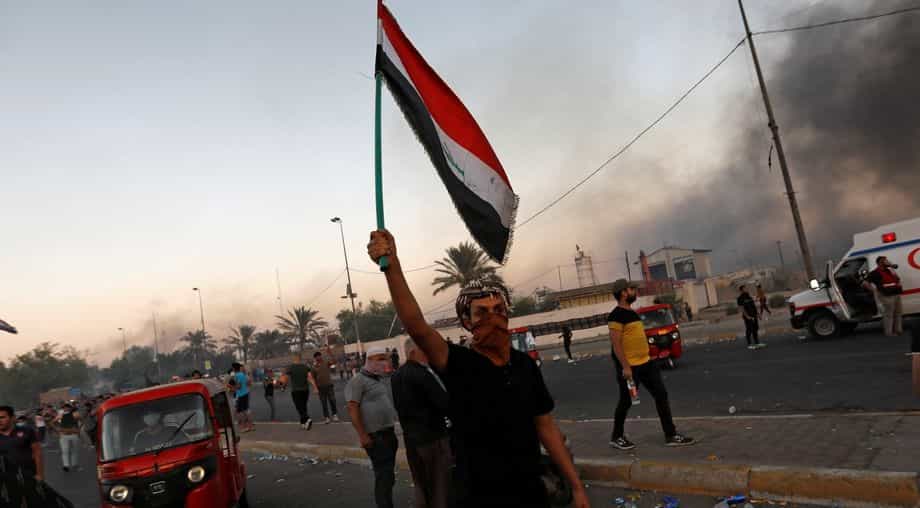
Iraq protest
Iran-backedmilitiasdeployedsniperson Baghdad rooftops during Iraq’s deadliest anti-governmentprotestsin years, twoIraqi security officials told Reuters.
The deployment of militia fighters, which has not been previously reported, underscores the chaotic nature ofIraqi politics amid massproteststhat led to more than 100 deaths and 6,000 injuries during the week starting October1. Suchmilitiashave become a fixture here withIran's rising influence.
They sometimes operate in conjunction withIraqi security forces but they retain their own command structures.
TheIraqi securitysourcestold Reuters that the leaders ofIran-alignedmilitiasdecided on their own to help put down the massprotestsagainst the government ofIraqi Prime Minister Adel Abdul Mahdi, whose one-year-old administration isbackedby powerfulIran-backedarmed groups and political factions.
“We have confirmed evidence that thesniperswere elements ofmilitiasreporting directly to their commander instead of the chief commander of the armed forces,” said one of theIraqi securitysources. “They belong to a group that is very close to theIranians.”
A secondIraqi security source, who attended daily government security briefings, said militiamen clad in black shot protesters on the third day of unrest when the death toll soared to more than 50 from about half a dozen. The fighters were directed by Abu Zainab al-Lami, head of security for the Hashid, a grouping of mostly Shi’ite Muslim paramilitariesbackedbyIran, the second source said. The Hashid leader was tasked with quashing theprotestsby a group of other senior militia commanders, the source said. Thesourcesdid not say how manysnipersweredeployedby militia groups.
A spokesman for the Hashid, Ahmed al-Assadi, denied the groups took part in the crackdown. “No members were present in the protest areas. None of the elements of the Hashid took part in confronting protesters,” Al-Assadi said in a statement to Reuters.
Iraqi Interior Ministry spokesman Saad Maal said state security forces did not fire directly at protesters and blamed unnamed “vicious” shooters for the mass deaths and injuries. The government has opened an investigation to determine who shot the protesters and who ordered it, Maal said in a news conference on October6.
The assertion that security forces did not participate in the violence seemed to contradict an earlier statement on October14 from theIraqi government, which admitted state security forces had used excessive force and promised to hold individuals accountable for violence against civilians.
An official with the prime minister’s office said in a statement to Reuters Wednesday that it would be “premature to lay the blame on any parties, whether from Hashid or other security forces before we end the investigation. Let’s wait and see who gave the order ‘shoot to kill.’”
Iran’s role in responding to the demonstrations was another reminder of Tehran’s reach inIraq, where a sizable number of former militia commanders are now members of parliament and support theIranian agenda. Stability of theIraqi government is in the best interests ofIran, which has been steadily amassing influence inIraqsince 2003 when the US-led invasion toppled the Islamic Republic’s arch-enemy, Saddam Hussein.IranisIraq’s biggest trading partner.
Iran's delegation to the United Nations did not immediately respond Wednesday afternoon to questions from Reuters about its support ofmilitiasand their involvement in the violence against protesters. Leaders ofmilitiasinIraqhave denied getting training and weapons fromIran.
Asprotestsentered their third day, on October3,snipersappeared on Baghdad rooftops. A Reuters cameraman who was covering the unrest near Baghdad’s Tahrir Square that afternoon said he saw a sniper, wearing a balaclava and dressed in black as he stood on top of an under-construction building that overlooked the demonstrations.
Protesters fled as the sniper opened fire.One protester who was shot in the head was carried away in a large crowd. Another who was shot in the head appeared to have died and was rushed off in a truck. When his phone rang, a friend recognized that the man’s brother was calling.
“Don’t tell him he died,” the friend said.
Theprotestsstarted October1 amid public rage over chronic shortages of jobs, electricity and clean water.Iraqis blame politicians and officials for systemic corruption that has preventedIraqfrom recovering after years of sectarian violence and devastating war to defeat Islamic State.
Any vacuum of power could prove challenging for the region, given that Baghdad is an ally of both the United States andIran, who are locked in their own political standoff. Thousands of UStroops are stationed in the country in positions not far from those ofIran-backedShi’itemilitias.
The second security source told Reuters that thesniperswere using radio communications equipment that was provided byIranand is difficult to intercept, giving the groups an essentially private network.
A group of senior commanders fromIran’s Revolutionary Guards travelled toIraqon the second day of theprotestsand met withIraqi intelligence and security officials, according to a diplomat in the region familiar withIran’s decision-making process. After the meeting, senior Revolutionary Guard officers with experience in curbing civil unrest continued to advise theIraqi government, the diplomat said, although noIranian soldiers weredeployed.
A senior commander of one of theIran-backedmilitias- who said his group was not involved in efforts to stop theprotestsor the resulting violence - said Tehran consulted closely with forces trying to quell the demonstrations.
“After two days, they jumped in and supplied the government andmilitiaswith intelligence,” the militia leader told Reuters. “Iranian advisors insisted on having a role and warned us that the ongoingprotests, if not reversed, will undermine the government of Abdul Mahdi.”