
&imwidth=800&imheight=600&format=webp&quality=medium "India aims for 200-ship Navy by 2035 to counter China and Pakistan | Gravitas")
As China continues to expand the world’s largest navy and Pakistan strengthens its underwater warfare capabilities with advanced Chinese-built submarines, New Delhi is responding with a clear strategic objective—a 200-ship Indian Navy by 2035.
And this is not just about increasing numbers.
It is about building a stronger, more self-reliant naval force capable of safeguarding India’s interests across the Indian Ocean.

As per defence experts, that vision is taking shape with the recent commissioning of two indigenous warships: INS Mahendragiri, a stealth frigate, and INS Malvan, an anti-submarine warfare vessel.
Experts say their induction reflects India’s growing confidence in domestic naval construction.
Because INS Mahendragiri, for example, is designed by the Indian Navy’s warship design bureau and built by Mazagon Dock Shipbuilders with nearly 75 per cent indigenous content—a strong example of the Atmanirbhar Bharat push in the defence sector.
Trending Stories
)
Why asking questions could be more important than memorising answers
)
BRICS Summit 2026 full schedule: Day-wise agenda, timings and key issues - All you need to know
)
BRICS Summit 2026: Iran's Pezeshkian praises PM Modi at BRICS
)
BRICS rejects EU carbon tax as ‘punitive’, ‘discriminatory’; warns of burden on Global South
)
'Iran won't surrender': Pezeshkian sends blunt message to US while attending BRICS Summit in India
)
Why dehydration is the hidden cause of travel fatigue on long flights
)
Top 5 places to visit in Goa beyond its famous beaches
)
'He is popular...': Malaysian PM Anwar Ibrahim's praise for PM Modi during bilateral meeting | WATCH
)
BRICS Summit 2026: 30+ countries seek BRICS membership
)
Frustrated man demolishes his kitchen after thousands flock to see Mother Mary his wife spotted on the wall
)
BRICS Summit 2026: PM Modi, Xi reach key consensus on ties, China to assume BRICS chairmanship in 2027
)
Trump says Canada eager to reach a deal, it could come ‘fairly soon’ if Ottawa treats US farmers better
)
From drones to KAAN fighters: Turkey outlines 229% surge in defence spending amid regional shifts
)
‘Partners, not rivals’: Xi outlines four point plan for stronger India-China ties
)
Could staying indoors all day affect your health?
)
Bigg Boss 20: Uditi Singh reacts to ex Karan Wahi’s possible wildcard entry
)
Why going digital does not always mean becoming more efficient
)
800 million years old - Scientists discover 'fingerprints' of supercontinent Gondwana in ancient rocks
)
Israel spent nearly $470,000 on PM's hair, makeup since 2019, data shows
)
From severe mobility problems to recovery: Madhuri the elephant’s journey of wildlife care
)
BRICS Summit day 1: New Delhi declaration adopted with full consensus, big diplomatic win for India
)
From India, Putin warns Europe against sending troops to Ukraine, Zelensky expresses willingness to meet him at G20 Summit
)
Did Iran President Pezeshkian touch feet of Hindu spiritual leader at Delhi event as shown in viral video?
)
9-year-old Chennai prodigy clears Cambridge IGCSE grade 10 exams
)
Reacher actor Alan Ritchson, wife Catherine part ways after 20 years of marriage
)
Why does your body need time to adjust after a long journey?
)
Baba Vanga's first prophecy for 2027 is out, and straight out of science fiction
)
Why does your skin need protection from UV rays?
)
How does the loss of forests affect the way wildlife lives and moves?
)
IND vs AFG, 1st T20I: When and where to watch live streaming in India?
)
Anthropic is giving Claude to schools free, and the reason is not philanthropy
)
BRICS Summit: China resumes Guangzhou-New Delhi flight, issues 'good-neighbourliness' remark ahead of Xi-Modi meet
)
Why do wild animals need quiet places to survive?
)
Humans may lose control of AI: Anthropic CEO calls for slowdown, Altman, Musk back him
At present, the Indian Navy operates over 140 vessels, including destroyers, frigates, and submarines, while another 50 warships are under construction.
Throughout this year, a new Indian warship on average is reportedly entering service roughly every six weeks.
In the past month and a half alone, the Navy has commissioned five indigenous vessels.
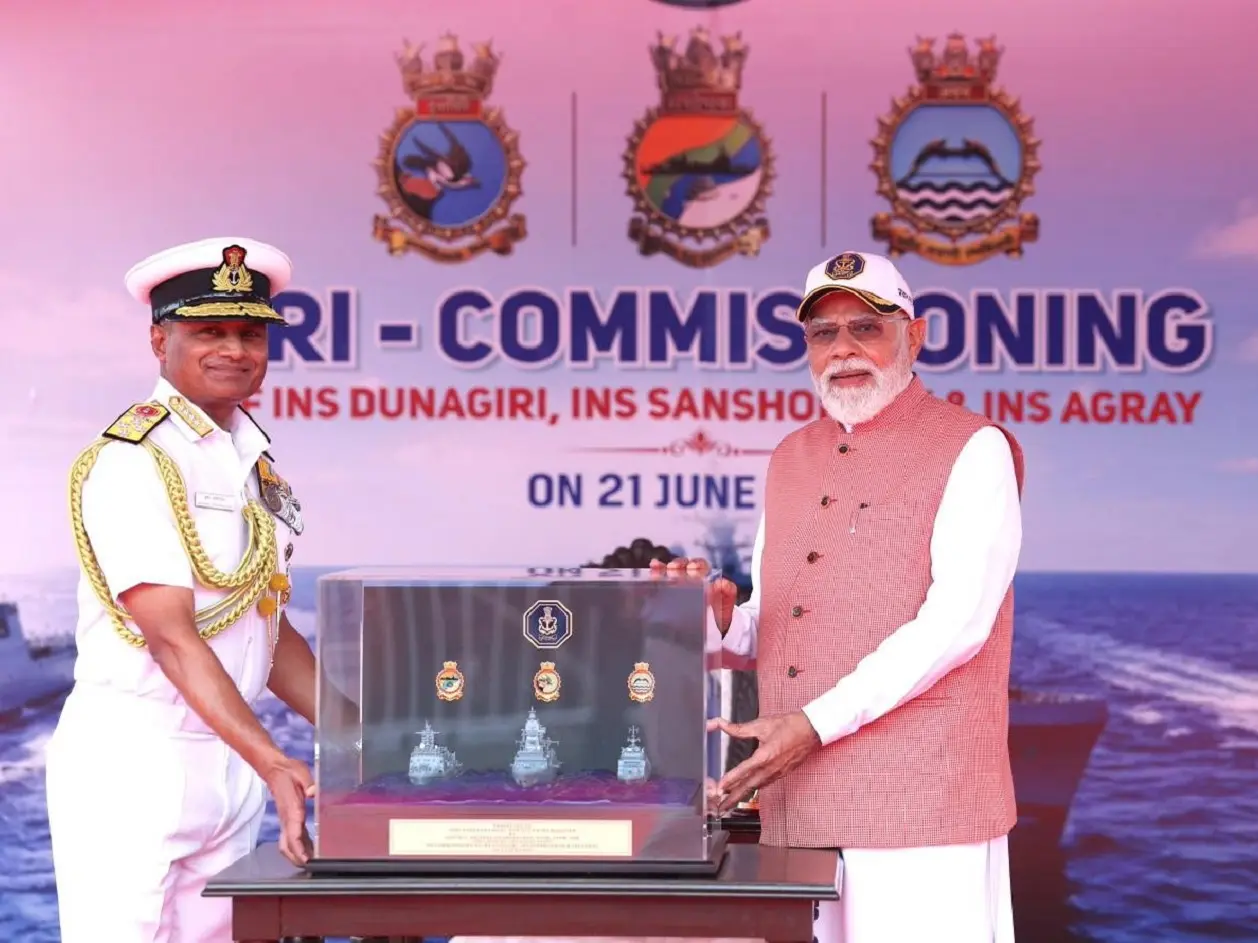
In late June, for example, Prime Minister Narendra Modi commissioned three indigenously built warships in Kolkata, including INS Dunagiri, a stealth frigate packed with advanced weapons and sensors, like the BrahMos missiles and modern air defence systems, massively boosting the Navy’s combat capabilities.
INS Sanshodhak was also commissioned on the same day.
One of India’s latest survey vessels, the ship is designed to map the oceans and collect crucial hydrographic data.
Equipped with autonomous underwater vehicles, it further strengthens maritime domain awareness.
Completing the trio was INS Agray.
Built to detect and neutralise underwater threats in shallow waters, its advanced sonar systems and torpedoes make it a key asset against enemy submarines.
According to defence experts, the recent launches by the Indian Navy indicated that the 200-ship target is steadily moving towards reality.
As per reports, the seventh and final ship of the Nilgiri-class frigate class INS Vindhyagiri is also expected to join the fleet within months.
Beyond that, seven next-generation Project-17 Bravo warships are also in the pipeline, highlighting India’s long-term commitment to modernising its fleet.
In fact, PM Modi recently said the launching of new ships is proof that India no longer wants to remain merely a buyer in the global defence market.
India has also set an even bigger milestone—achieving complete self-reliance in naval shipbuilding, including critical components by 2047, while also becoming one of the world’s top five shipbuilding nations by the centenary of independence. But experts say challenges remain.
For example, India still imports specialised steel and several high-end technologies, while according to experts, supply-chain gaps and ageing shipyard infrastructure continue to slow progress.
To overcome these, India is taking several steps, including forming key strategic partnerships.
India and Japan have already signed an agreement to jointly develop the unicorn stealth mast for future warships, while discussions on co-producing Japan’s Mogami-class frigates reflect New Delhi’s focus on technology collaboration without compromising self-reliance.
The regional backdrop makes these efforts increasingly important.
China already operates more than 370 warships and continues to project power across the Indo-Pacific.
Pakistan is reportedly set to receive eight Chinese-built Hangor-class attack submarines.
For India, strengthening the navy is not simply a military objective.
It is essential for protecting sea lanes, securing trade, deterring potential threats, and reinforcing India’s position as a major maritime power in the Indian Ocean Region.