
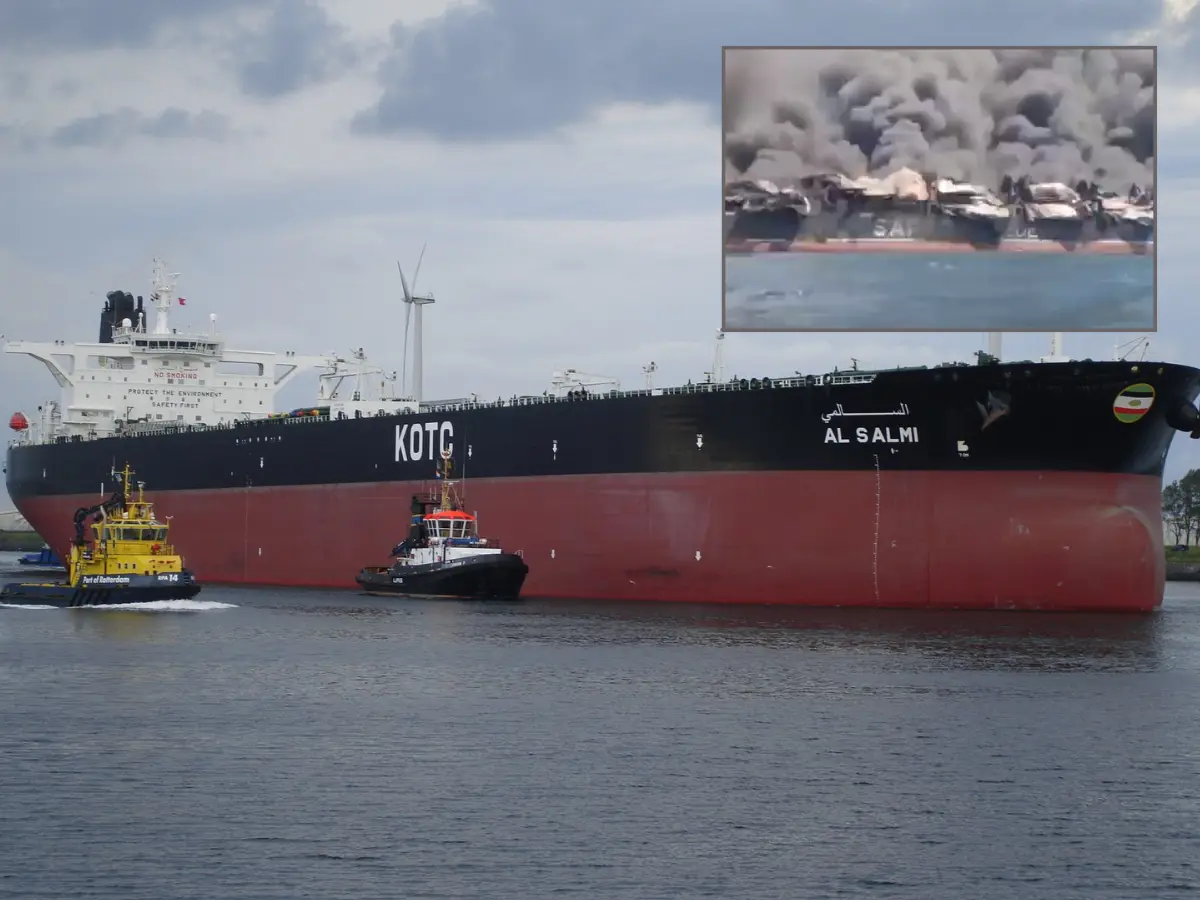
&imwidth=800&imheight=600&format=webp&quality=medium "Gulf tensions explode as Iran hits, sets ablaze Kuwaiti oil tanker Al-Salmi near Dubai | Watch video")
Iran struck and set ablaze a fully loaded Kuwaiti crude tanker near Dubai on Monday (Mar 30) in what may be one of the most serious maritime attacks since the US-Israel war against Iran began on February 28. The vessel, the Al-Salmi, transiting the waters under a Kuwait flag, was hit while anchored in Dubai's port area. The attack may have resulted in an "oil spill in the surrounding waters," warned Kuwait Petroleum Corp (KPC) in a statement. Here's all we know.
Iran attacks fully loaded oil tanker near Dubai
According to reports, the vessel, the Al-Salmi, flagged by Kuwait, was hit while anchored in Dubai's port area. The strike damaged the hull and ignited a fire onboard. Dubai authorities later confirmed the fire had been extinguished, but Kuwait Petroleum Corp flagged the possibility of an oil spill in surrounding waters, warning that emergency and firefighting teams had been scrambled to contain the situation.

"Emergency response and firefighting teams were immediately mobilised and are currently working to contain and control the situation in close coordination with the relevant authorities," said KPC, warning of an "oil spill in the surrounding waters". Videos from the scene show the oil tanker engulfed in flames, with thick black smoke billowing high into the sky.
This was not an isolated incident. Since late February, a string of merchant vessels have come under attack by missiles and explosive drones, both aerial and maritime, across the Gulf and the Strait of Hormuz. Monday's strike, however, felt different in scale. Al-Salmi was fully laden, and hitting it this close to Dubai, a major commercial and logistical hub, marks a geographic escalation.
Where was Kuwaiti tanker Al-Salmi headed?
According to Reuters, Al-Salmi crossed the Strait of Hormuz in late February, around the time the first strikes on Iran took place. It later called at Saudi Arabia's Khafji port and Kuwait's Mina Al Ahmadi terminal before heading east to the UAE, fully loaded and reportedly bound for China's Qingdao — at times flagging Chinese cargo.
The attack happened the same day Trump issued his most explicit threat yet against Iranian infrastructure, warning he would "completely obliterate" Iran's electrical plants, oil wells, Kharg Island, and possibly desalination facilities if a deal to reopen the Strait of Hormuz isn't reached soon. Global oil prices have already been climbing steadily since the conflict began, and news of Monday's tanker strike pushed markets further.
Disclaimer: WION takes utmost care to accurately and responsibly report ongoing conflicts in West Asia involving Israel, Iran, US, Gulf nations and non-state actors like Hezbollah, Hamas, Houthis, Islamic State, and others. Claims and counterclaims, disinformation and misinformation are being made online and offline. Given this context, WION cannot independently verify the authenticity of all statements, social media posts, photos and videos.

