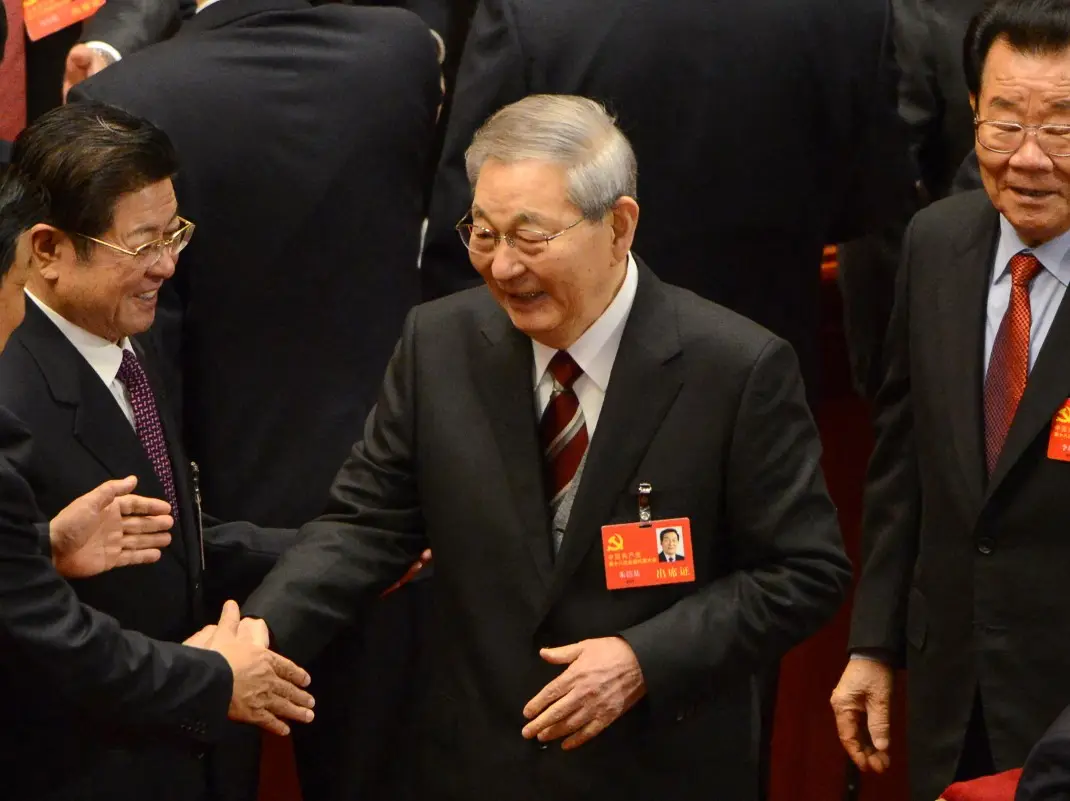
&imwidth=800&imheight=600&format=webp&quality=medium "Zhu Rongji dies at 97: How the former Chinese premier reshaped China’s economy")
Former Chinese Premier Zhu Rongji died on Wednesday at the age of 97 in Beijing. According to Chinese News agency Xinhua, he died of an unspecified illness at around 11:06 am in local time. Chinese state media honoured him in an obituary as a "loyal communist fighter" and an "outstanding leader," remembering his life as one of "revolution, struggle, and glory."
He is widely regarded as the “free-marketeer” among the Chinese Communist Party and had been purged twice under Mao Zedong for criticising irrational economic planning. Western media celebrates him as a neo-liberal stalwart in the CCP who brought China into the World Trade Organisation in 2002 through gruelling negotiations. But he was more of a statist rather than a capitalist. He is widely recognised as the chief architect of modern Chinese state capitalism, shifting the country away from a traditional Soviet-style planned economy. He introduced the policy of "Zhuge Fangxiao", which meant selling off or closing smaller, inefficient local factories and moving local tax powers to the central government. He pushed government enterprises to act like a private one, to show profitability and punished those who failed to do so. He is remembered in China as a tough, pragmatic leader who delivered double-digit growth and rarely minced his words.

His four volumes of speeches, which came out in 2011, had shocking references to "tofu dregs" flood dykes built by "parasites", and erring bankers labelled as "half-wits". It became a bestseller in the country. "Our country faces many potential crises that could erupt at any time," Zhu said early in 1998 as he was becoming the premier. “Ordinary people are discontent about us in many ways. Especially, there is corruption among officials, the gulf between rich and poor, and the way some local officials act like tyrants.” It provides a window into the deeper anxieties coursing through China as it approached a transition that ushered in Xi Jinping as leader.
Zhu's tenure was not an unalloyed success. He was praised for fostering economic hyper-growth, but criticised for leaving structural imbalances, local debt issues, and factory closure fallout for his successors. However, the massive, state-controlled monopolies Zhu preserved formed the exact foundation that President Xi Jinping later used to strengthen state control over the economy.