Explained: What is Greensill lobbying scandal which overshadows David Cameron's political career?

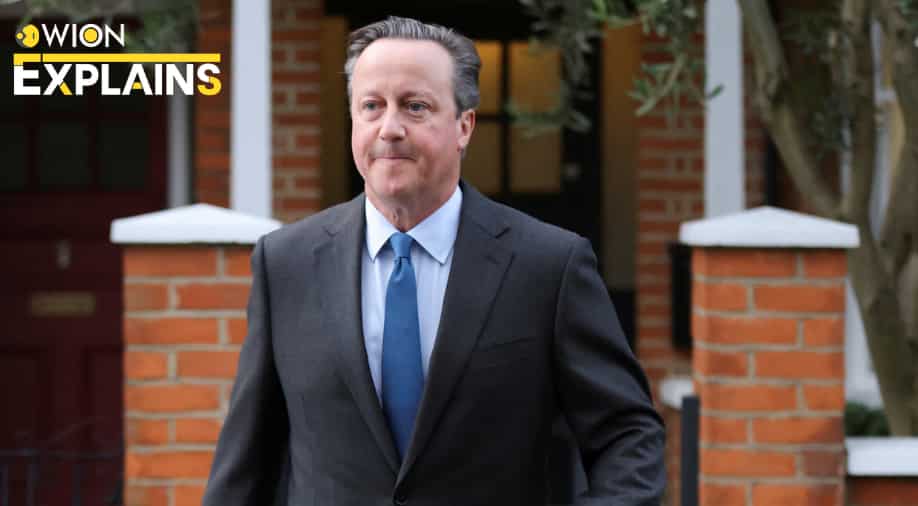
Britain's Foreign Secretary David Cameron leaves his home in west London, Britain.
United Kingdom's former prime minister David Cameron's shocking comeback to the country's frontline politics as foreign secretary has refreshed the memories of the Greensill lobbying scandal which still continues to overshadow his political career.
Seven years earlier, Cameron had lost the Brexit referendum and stepped down as the country's prime minister immediately. The leader, who had also resigned as a Tory MP in September 2016, was in a sudden turn of events given life peerage on Monday (Nov 13) because of which he has taken up the role in Prime Minister Rishi Sunak’s Cabinet.
After remaining out of the spotlight for seven years, the dramatic cabinet reshuffle saw Cameron at the centre of media gaze making more headlines than at any point since the Greensill lobbying scandal came into light in 2021.
This surprise comeback of Cameron as the foreign secretary happened just two years after he was found to have a “significant lack of judgment” in a parliamentary inquiry over a bank's lobbying campaign in which his personal economic interests were vested.
How did Cameron lobby for Greensill Capital?
Greensill Capital, which was established by Australian financier Lex Greensill and specialised in supply chain finance, started seeking government work at a time when Cameron was prime minister.
In 2016, after Cameron left office, he became an adviser to Greensill Capital and received share options which were worth tens of millions of pounds, as reported.
After joining the firm, the former prime minister started sending intensive rounds of text messages to high-ranking civil servants and ministers on behalf of Greensill Capital at a time when the pandemic was at its height. The following year saw the collapse of Greensill Capital.
In July 2021, the Treasury select committee stated that it was inappropriate of Cameron, who had once held the position of prime minister, to send 62 messages to ministers and high-ranking officials pleasing them to extend their help to the controversial bank.
In the text messages sent to ministers, Cameron allegedly appealed to them to provide Greensill access to the coronavirus loan support scheme of the government.
The former minister sent nine WhatsApp messages to the then chancellor Rishi Sunak, 12 texts to Sir Tom Scholar, the then permanent secretary to the Treasury, two WhatsApp messages to Richard Sharp, then adviser to Sunak and multiple texts, emails, phone calls to the ministers Michael Gove, Matt Hancock, Nadhim Zahawi, John Glen and Jesse Norman.
In the messages, Cameron often signed off as “Love Dc” or typed a simple thumbs-up emoji. In a text message sent on 6 March 2020 to Scholar, Cameron said: “I am riding to the rescue with supply chain finance with my new friend Lex Greensill.” At this time, the financial markets were in freefall because of the start of the pandemic.
He further questioned the response of the Bank of England to the mounting crisis and said that he “never quite understood how [interest] rate cuts help a pandemic”. He stated that he hoped to “see you with Rishi’s for an elbow bump or foot tap. Love Dc.”
What is Greensill Capital?
Greensill Capital was founded by an Australian banker from farming stock Lex Greensill. It specialises in supply chain finance in which money is borrowed by the businesses to pay their suppliers.
The efforts made by Cameron were wasted as the firm failed to receive any money from the coronavirus scheme and hence, collapsed in March 2021. It was estimated that the bank's failure in 2021 is likely to have cost UK taxpayers up to £5 billion ($6.21 billion).
Watch:David Cameron return: Greensill lobbying scandal overshadows Cameron's return
The company got involved in controversy because of its links to the steel and commodities trader Sanjeev Gupta, for giving huge sums to his steel and energy empire. Since 2021, the Gupta Family Group Alliance, which is a collection of companies led by Gupta, has remained under investigation being carried out by the Serious Fraud Office.
In the investigation of the Treasury committee, it was found that Cameron used a private jet of Greensill for various flights to Newquay airport in Cornwall. While working with Greensill, Cameron lobbied for the chancellor and went camping in the desert with Saudi Crown Prince Mohammed bin Salman.
What did Treasury Committee’s report find?
In the report prepared by the Treasury committee it was found that no lobbying rules were broken by Cameron, but said “that reflects on the insufficient strength of the rules”. It stated that the behaviour of Cameron in the saga highlighted a “strong case for strengthening [the rules]” for preventing the country's former prime ministers from lobbying serving ministers for any kind of personal economic gain.
“Cameron’s use of less formal means to lobby government showed a significant lack of judgment, especially given that his ability to use an informal approach was aided by his previous position of prime minister,” the report stated. “Cameron appears to accept that, at least to some degree, his judgment was lacking,” it added.
Reacting to the committee's report, Cameron stated, “While I am pleased that the report confirms I broke no rules, I very much take on board its wider points. I always acted in good faith, and had no idea until the end of last year that Greensill Capital was in danger of failure.”
Now, as Lex Greensill is being banned as a director of UK companies, Foreign Secretary David Cameron has once again come under scrutiny.
(With inputs from agencies)