Explained | What are cluster bombs which US is set to provide to Ukraine? Why is it facing opposition?

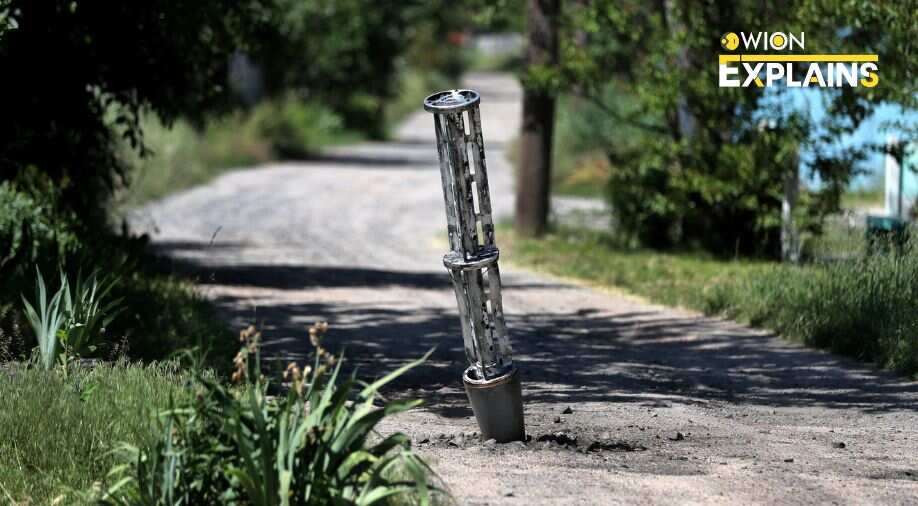
An emptied cluster munition container is seen stuck in the ground following a military strike.
The United States has agreed to hand over cluster munitions to Ukraine, said the White House on Thursday, as human rights groups continued their calls for putting a stop to the use of the controversial weapons known to cause civilian casualties in large numbers.
What is a cluster munition?
Cluster munitions, which are also known as cluster bombs, are canisters that contain tens to hundreds of smaller bomblets, also calledsubmunitions. The canisters can be launched using missiles, dropped from aircraft, or fired from naval guns, artillery, or rocket launchers.
At a prescribed height, the canisters break open depending upon the intended target, and the bomblets inside it spread out over that area. The bomblets fuse with a timer and explode closer to or on the ground and spread shrapnel that is designed to take out armoured vehicles such as tanks and kill troops.
How dangerous are these bombs?
The bomblets, which are designed in a way that they detonate when they hit the ground, have a high chance of killing or seriously injuring anyone in the area. Apart from the initial damage which the munitions cause upon impact, many bomblets do not detonate at all.
Around 40 per cent of bomblets have not exploded in some recent conflicts, as per the ICRC. Hence, these cluster bombs, like landmines, carry a grave risk to the lives of civilians, long after they are used inwartime. These unexploded bomblets can kill and maim civilians years after the munitions were used.
Hence, human rights groups have been opposing the use of cluster bombs by the army in populated areas, stating that it is a violation of international humanitarian law since the weapons can cause indiscriminate destruction.
As per a Reuters report, 60 per cent of casualties due to cluster bombs are people who get injured while undertaking everyday activities.
Is using cluster bombs a war crime?
The use of cluster bombs cannot be considered as a violation of international law, however, using them against civilians can be seen as a grave violation. As happens in any strike, calling an action a war crime requires understanding if the target was legitimate and if the precautions were adopted to prevent any civilian casualties.
“The part of international law where this starts playing (a role), though, is indiscriminate attacks targeting civilians,” said Human Rights Watch’s associate arms director Mark Hiznay, while speaking to The Associated Press. “So that’s not necessarily related to the weapons, but the way the weapons are used," he added.
More than 120 countries joined a convention which banned the use of cluster bombs and agreed not to produce, use, stockpile or transfer the weapons and to clear them after they have been used. The convention has not been signed by Ukraine, Russia and the US.
Have cluster bombs been used before?
The cluster munitions were most notably used by Armenia and Azerbaijan last year amid their war over the disputed region of Nagorno-Karabakh. Since 2012, Syria has continued using cluster munitions.
Human Rights Watch arms advocacy director Mary Wareham said that the use of cluster munitions in 2020 was extremely reduced compared to previous years. She stated that the treaty’s success was also seen in the destruction of stockpiles.
"We know that at least 1.5 million cluster munitions and more than 178 million submunitions have been destroyed from stocks," stated Wareham.
"That goes to show that this convention is truly lifesaving because every single one of those explosive submunitions could take a life or a limb," he added.
Why are cluster bombs considered more controversial than other bombs?
The impact of bomblets is on a wide area and can endanger non-combatants. As per the International Committee of the Red Cross, around 10 per cent to 40 per cent of munitions fail. The munitions, which failto explode, have the probability of getting detonated by civilian activity years or even decades later.
Activist group Cluster Munition Coalition has been trying for a ban on these weapons everywhere, and claims that potentially deadly cluster submunitions continue to lie dormant in Vietnam and Laos, even 50 years after their use.
On Friday, Human Rights Watch in a statement said that both Russia and Ukraine have killed civilians with the use of cluster munitions in the ongoing war.
WATCH |Gravitas: Will the US provide Ukraine with the 'controversial' cluster bomb?
“Cluster munitions remain one of the world’s most treacherous weapons. They kill and maim indiscriminately and cause widespread human suffering,” said Gilles Carbonnier, vice president of the International Committee of the Red Cross, while speaking at a conference on the munition in Switzerland last year.
“Any use of cluster munitions, anywhere, by anyone, must be condemned,” Carbonnier added.
Have troops used cluster bombs in Russia-Ukraine war?
Both the Russians and Ukrainians have used cluster bombs since Kyiv was invaded by the forces of Moscow in February 2022.
Recently, Ukrainian forces started use of Turkish cluster munitions on the battlefield. However, Ukrainian officials have been requesting cluster munitions from the US since last year.
Ukraine has stated that more ammunition would be provided by the US for Western-provided artillery and rocket systems, which will help in narrowing the numerical superiority of Russia in artillery.
(With inputs from agencies)
You cannow write for wionews.comand be a part of the community. Share your stories and opinions with ushere.
WATCH WION LIVE HERE