

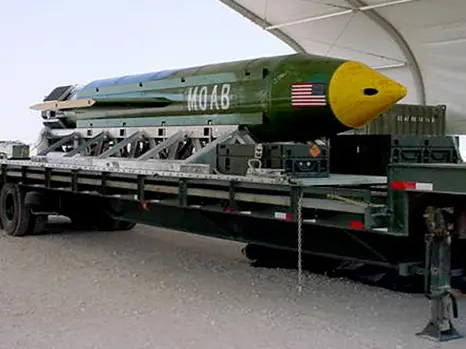
&imwidth=800&imheight=600&format=webp&quality=medium "Explained: 'Mother of All Bombs' US reportedly plans to use against Iran")
The US military has reportedly drawn up plans that could involve using its largest non-nuclear bomb, known as the "Mother of All Bombs", against Iran's energy infrastructure and nuclear sites if President Donald Trump orders a resumption of military operations.
According to a CNN report citing US officials familiar with the plans, the weapon under consideration is the GBU-43/B Massive Ordnance Air Blast (MOAB). Its potential use would mark a significant escalation in the conflict, although questions remain over its effectiveness against heavily fortified Iranian targets.
The report does not indicate that a final decision has been made to use the bomb.
What is MOAB?
The GBU-43/B Massive Ordnance Air Blast, commonly known as the "Mother of All Bombs", is a GPS-guided conventional weapon developed for the US military.
It was developed by the US Air Force Research Laboratory in collaboration with defence contractor Dynetics. The weapon was designed to destroy large areas and strike targets such as cave networks and tunnel complexes.
Trending Stories
The name "Mother of All Bombs" comes from the weapon's acronym, MOAB. It is the largest non-nuclear bomb in the US arsenal.
Specifications and deployment
The MOAB weighs approximately 21,600 pounds (9,800 kg) and measures about 30 feet (9.1 metres) in length. Its explosive payload weighs around 18,700 pounds (8,500 kg).
Because of its enormous size and weight, the bomb cannot be carried by conventional fighter jets. It is designed to be deployed from a specially equipped C-130 military transport aircraft.
The weapon uses GPS guidance to reach its intended target. Unlike bombs designed primarily to penetrate deep underground, the MOAB is built to produce a powerful blast over a large area.
What kind of destruction can it cause?
The MOAB can cause extensive destruction across a large area, with its blast effects reported to extend roughly 1,000 feet (300 metres) in all directions, depending on the terrain and conditions.
Its powerful explosion can damage buildings, destroy exposed military equipment and affect cave and tunnel networks. However, the bomb is not designed primarily to penetrate deep layers of earth and rock before detonating.
This could limit its effectiveness against Iran's heavily fortified underground nuclear facilities, as its ability to destroy deeply buried targets remains uncertain.
When was the MOAB first used?
The US military first used the MOAB in combat on April 13, 2017, during an operation against the Islamic State Khorasan Province (ISIS-K) in Afghanistan.
An MC-130 aircraft dropped the bomb on a cave and tunnel complex in the Achin district of Nangarhar province. The operation marked the weapon's first known use in combat since it entered the US military's arsenal.
If deployed against Iran, it would mark another use of the weapon in combat and a major escalation in the ongoing conflict.
