Explained: Can atmospheric river-induced floods help with California’s ‘exceptional’ drought?

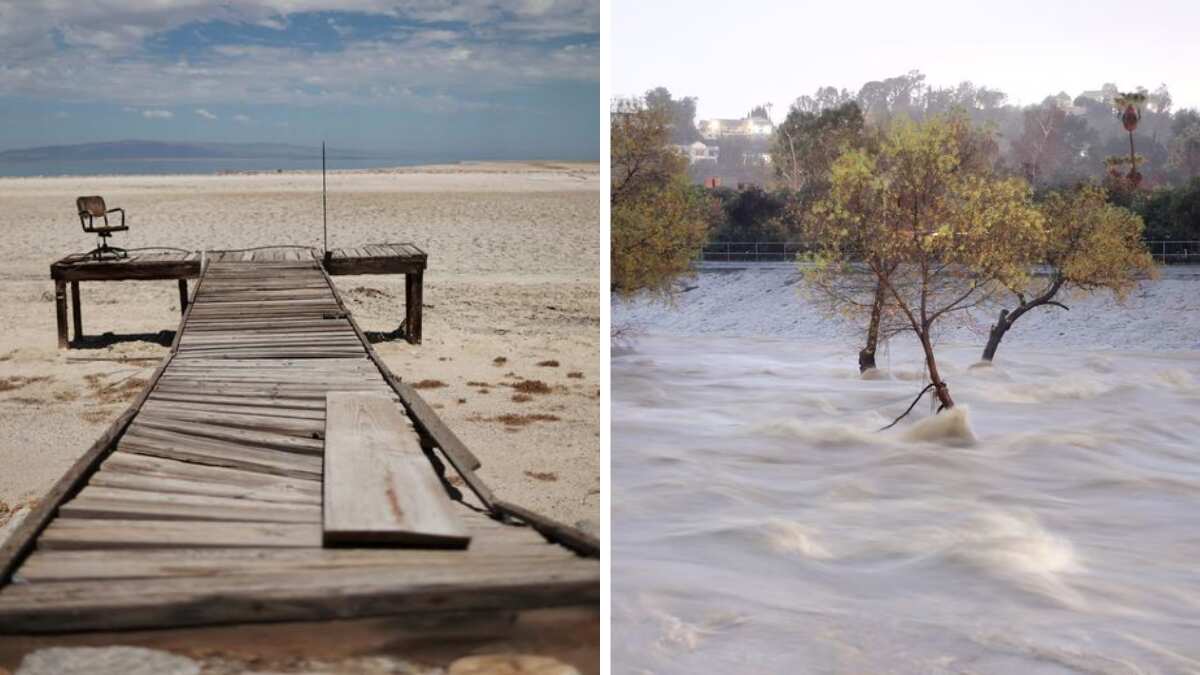
California drought and floods
The state of California in the United States has experienced a number of megadroughts over the years including just last month prompting officials to impose water restrictions across the state with limited supplies for vital farmland. In contrast, one of the driest states in the country, following a series of storms, is now witnessing deadly flash floods, landslides, and uprooting trees which have affected road travel and left thousands without electricity, due to heavy rains and strong winds. This has been attributed to an overlapping weather phenomenon called “atmospheric river” and “bomb cyclone”.
Until just last week, several counties across the state were suffering due to “exceptional” drought which is the most severe categorisation assigned by the country’s Drought Monitor. However, due to recent storms, at least 17 people have been killed since the beginning of this year, said California Governor Gavin Newsom, on Tuesday, while the state’s city San Francisco witnessed a hailstorm and the small town of Montecito experienced flash floods.
Has the rain helped the drought situation, sofar?
In recent weeks, the state has witnessed six atmospheric rivers in recent weeks and is poised to experience at least three more in the upcoming week, said the Newsom. According to the officials, Central California including San Francisco Bay Area and Sacramento Valley has seen the most amount of water and the precipitation is nearly 140 per cent higher than the average for this time of the year.
ALSO READ |Explained: What are ‘atmospheric rivers’, wreaking havoc with heavy rains, floods in the US?
This has led to many state reservoirs being filled which typically stayed below average this time of the year and will help with irrigation for farmlands and supply water to millions of water across the coastal cities. According to the US Drought Monitor, the storm appears to have lifted at least seven per cent of California out of the most severe categorisation.
Additionally, a hydrologist in charge of the California Nevada River Forecast Center, Alan Haynes, said that this amount of rain puts the state in a good shape at least for the next year or so, reported the Associated Press. However, it is still early to determine what the next few months would look like considering the storm has not poured as much water in northern California.
Since the atmospheric rains are not consistent and are not even striking everywhere. The reservoir at Lake Shasta had risen from 55 per cent during Christmas to 67 per cent as of earlier this week and while this is an improvement, it is still below historic averages given the prolonged water scarcity in the state, said Haynes.
Will this surplus in the water supply change anything in the long term?
Several reports citing experts and scientists said that the widespread drought in California will not be reversed due to these atmospheric rivers and bomb cyclones and it might also take consecutive years of similar weather trends of above-average rain and snowfall to actually have any lasting impact. This comes despite at least 90 per cent of the state’s population being affected by floods.
Notably, last year the state witnessed its third year of severe drought which was also the driest on record and while it is now soaking in some much-needed water, some experts say this amount of rain will help but not have a lasting impact. Additionally, they also indicated that this rain and snow won’t be enough to fix some of the long-term water problems that California along with much of the western US faces with unfavourable precipitation trends which are worsening due to climate change.
Speaking to BBC, Jay Lund, a professor of civil and environmental engineering at the University of California, Davis, said that while the current storm has certainly replenished some of the state’s water supply and it is always good to see rain in California. However, he noted that since the state’s weather is that of extremes and the upcoming years could witness more dry weather.
Why do these extremes not work?
While one might think that the drought-ridden state receiving huge amounts of water would be a good thing, it is in fact the opposite, as several reports suggest that a flood during a time of drought can make the situation worse. A report by Vox compares this phenomenon to overwatering a plant which after a while cannot handle soaking up so much water. Therefore, eventually, this rain turns into floods with the risk of uprooting trees.
During a press briefing, last week, California’s Director of the Department of Water Resources (DWR) Karla Nemeth, also explained that moving from one extreme weather event to the other has put the trees under stress as “after three years of intensive drought, the ground is saturated and there is a significant chance of downed trees that will create significant problems.”
Additionally, during these droughts, the roots of the trees that are supposed to absorb water become less sponge-like and with weaker roots, they are more likely to get swept away by the storm. The experts have also noted how California does not have the infrastructure to support the reservation of this much water due to its limited reservoir capacity, therefore, a lot of this water is going to the ocean.
Simply put, “The California system was built for a climate we don’t have anymore,” said Laura Feinstein who heads the work on climate resilience and environment at a San Francisco-based non-profit named SPUR. She also was also said in the context of the water coming from snowpack which is its own type of reservoir.
In this case, the snow typically melts into the reservoir and supplies residents with water during summer and fall, however, since the snowpack due to climate change now melts faster and the reservoirs are unable to capture enough water. Additionally, climate change has given rise to extreme weather events which is also creating drier, hotter conditions where the water is bound to evaporate faster.
So what can be done to mitigate this issue?
Climate scientists said that a part of the solution to these problems could be drawing levees back which would allow rivers to flood safely and not only collect more water but also do so while ensuring the safety of the land surrounding it.
Climate scientist, Peter Gleick who spoke to CNN, said that while levees have protected the communities in the past they are not designed for the climate change-induced extreme weather challenges today. Therefore, he suggests changes in infrastructure which would allow people to capture more floods and store them in underground aquifers when the water supply is running dry.
Additionally, Gleick also told CNN, “We have to design flood insurance policies to encourage people to move away from flood plains, so we can open up those floodplains, so when we get those floods they will be less damaging.”
However, to actually do so, many communities would have to relocate and also require a significant rebuilding of existing infrastructure which does not seem feasible. Notably, these underground aquifers to this day still remain vital for the state’s central valley and they are reportedly running dry.
(With inputs from agencies)
WATCH WION LIVE HERE
You can now write for wionews.com and be a part of the community. Share your stories and opinions with us here.