China sends military, doctors to Shanghai to test 26 million residents for Covid

shanghai
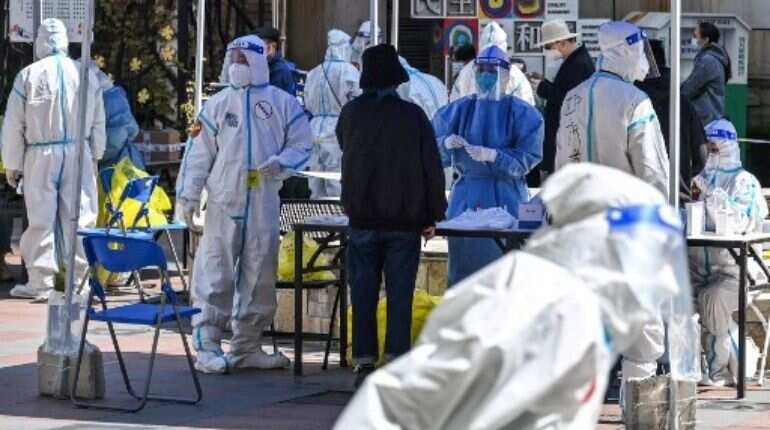
Chinahas sent themilitaryand thousands of healthcare workers intoShanghaito help carry outCOVID-19tests for all of its26millionresidentsas cases continued to rise on Monday, in one of the country's biggest-ever public health responses.
Someresidentswoke up before dawn for white-suited healthcare workers to swab their throats as part of nucleic acidtesting at their housing compounds, many queuing up in their pyjamas and standing the required two metres apart.
The People's Liberation Army (PLA) on Sunday dispatched more than 2,000 medical personnel from across the army, navy and joint logistics support forces toShanghai, an armed forces newspaper reported.
So far 38,000 healthcare workers from provinces such as Jiangsu, Zhejiang and the capital Beijing have been dispatched toShanghai, according to state media, which showed them arriving, suitcase-laden and masked up, by high-speed rail and aircraft.
It isChina's largest public health response since it tackled the initialCOVID-19 outbreak in Wuhan, where the novel coronavirus was first discovered in late 2019. The State Council said the PLA dispatched more than 4,000 medical personnel to the province of Hubei, where Wuhan is, at that time.
Shanghai, which began a two-stage lockdown on March 28 that has been expanded to confine practically allresidentsto their homes, reported 8,581 asymptomaticCOVID-19 cases and 425 symptomaticCovidcases for April 3. It also askedresidentsto self-teston Sunday.
The city has emerged as atestofChina'sCovidelimination strategy based ontesting, tracing and quarantining all positive cases and their close contacts.
The exercise inChina's most populous city takes place on the eve of whenShanghaiinitially said it planned to lift the city's lockdown.
The country has 12,400 institutions capable of processingtests from as many as 900millionpeople a day, a senior Chinese health official was reported as saying last month.
China's primarily uses pooltesting, a process in which up to 20 swab samples are mixed together for more rapid processing.
The city has also converted multiple hospitals, gymnasiums, apartment blocks and other venues into central quarantine sites, including theShanghaiNew International Expo Center which can hold 15,000 patients at full capacity.
On Monday,residentssaid they received the results on their personal health app about four hours after they were swabbed. But in other parts of the city some said they had yet to receive any notification on when theirtests would be.
Individuals who refuse to betested forCovidfor no justifiable reason will face administrative or criminal punishment,Shanghaipolice said on Saturday.
Watch |Amid COVID-19 battle, China discovers new Omicron subtype
Public Frustration
The surge in state support forShanghaicomes as the city is straining under the demands of the country's "dynamic clearance" strategy, with someresidentscomplaining of crowded and unsanitary central quarantine centres, as well as difficulties in securing food and essential medical help.
Some have begun to question the policies, asking whyCovid-positive children are separated from their parents and why mild or asymptomatic infections - the majority ofShanghai's cases - cannot isolate at home.
On MondayShanghaiofficial Wu Qianyu told a news conference that children could be accompanied by their parents if the parents were also infected, but separated if they were not, adding that policies were still being refined.
AShanghairesident, who declined to be named for privacy reasons, told Reuters he had been transported to a central quarantine facility on Sunday night after reporting a positive result on a selftestmore than a week ago.
Another antigenteston Saturday showed he was no longer infected, but authorities insisted on sending him to quarantine, where he has been put in a flat where he has to share a toilet with two other patients, both of whom are stilltesting positive.
"How is this isolation?," he said, adding that he was now afraid of being re-infected. "I'm not in any mood to do anything right now, I can't sleep."
On Monday, videos circulating on the WeChat messaging app showed scores of people rushing to grab bedding and supplies from the dirty floor of what the poster said was a quarantine centre whose premises were still littered with construction materials.
Reuters could not independently verify the footage.
Workers under strain
The pressure on the city's healthcare workers and Communist Party members has also been great, as they work around the clock to manage the city's lockdown and deal withresidents' frustrations.
Photos and videos have gone viral on Chinese social media of exhausted workers and volunteers sleeping in plastic chairs or on the grass outside housing compounds, or being berated byresidents.
On Saturday, the city's Pudong Chinese Center for Disease Control said it was investigating a leaked recording of a call between a staff member and the relative of a patient, who was perplexed by his father'sCovidtestresults.
The CDC staff member, who local media identified as infectious disease expert Zhu Weiping, could be heard saying exasperatedly that she herself had raised concerns over the current quarantine andtesting rules and that the virus had become a "political" one.
Reuters was not able to independently verify the recording which went viral on Chinese social media.
Users of the Weibo social media platform started a hashtag "protect Zhu Weiping," which by Monday had 2.9millionviews, amid concerns that she could face punishment for speaking out against the official line.
Chinese President Xi Jinping has urged the country to curb the momentum of the outbreak as soon as possible while sticking to the "dynamic-clearance" policy.
On Saturday, Vice-Premier Sun Chunlan, who was sent toShanghaiby the central government, urged the city to "make resolute and swift moves" to curb the pandemic.
The eastern city of Suzhou said it had detected a version of the Omicron BA.1.1 subvariant that doesn't match any others in the domestic database or the international variant tracking database GISAID, state television reported.
The state-backed Science and Technology Daily said it remains unclear whether the virus is a new sub-branch of Omicron and that the emergence of one or two new versions is normal given the spread of Omicron inChina, citing an unidentified expert with a national database.