China says 'extremely low' risk of damage from rocket debris

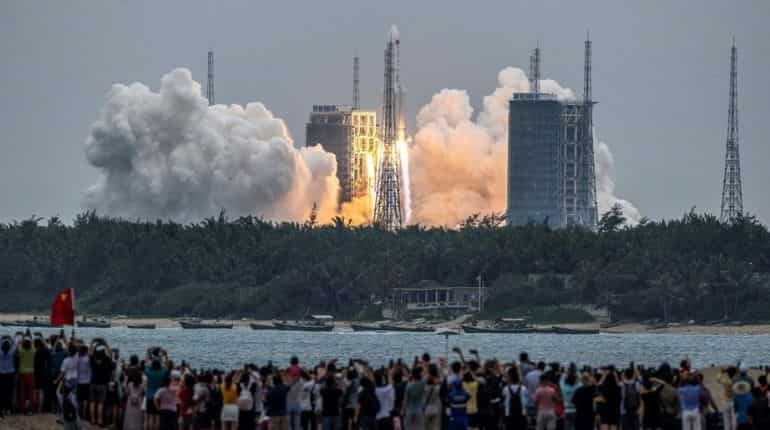
People watch a Long March 5B rocket, carrying China's Tianhe space station core module, as it lifts off from the Wenchang Space Launch Center in southern China's Hainan province on April 29, 2021.
Chinasaid Friday theriskofdamagefromarocketfalling back toEarthwas "extremelylow" after the United States warned it could crash downonto an inhabited area.
Military experts in the US expect the body of the Long March 5Brocket, which separatedfromBeijing's space station, to come down sometime around Saturday or Sunday, but warned it was difficult to predict where it will land and when.
But Beijing downplayed theriskof danger.
"The probability of causing harm to aviation activities or (onpeople and activities)onthe ground isextremelylow," foreign ministry spokesman Wang Wenbin said.
Most of therocketcomponents would likely be destroyed uponre-entryinto the atmosphere, he added, saying authorities "will inform the public of the situation in a timely manner".
Chinahas poured billions of dollars into space exploration in efforts to reflect its rising global stature and growing technological might, following in the extra-terrestrial footsteps of the United States, Russia and Europe.
As fevered speculation over therocket's trajectory back toEarthpinballed across social media, US Defense Secretary Lloyd AustinonThursday said the US military had no plans to shoot it down.
"We have the capability to do a lot of things, but we don't have a plan to shoot it down," Austin told journalists.
Hopefully, he said, therocketwill land "in a place where it won't harm anyone... the ocean, or someplace like that".
Even if therocketor parts of it do fallfromthe sky, without breaking uponre-entry, there is a good chance it will just splash down into the oceanona planet made up of 70 per cent water.
But Austin suggested that the Chinese were negligent in letting therocketbody fall out of orbit, saying those who were in the "space domain" should "operate in a safe and thoughtful mode".
'Nation of science'
Space has become the latest theatre for the big power play betweenChinaand the United States.
The launch ofChina's first module of its "Heavenly Palace" space station in April,housing life support equipment and living space for astronauts,was a milestone in Beijing's ambitious plan to establish a permanent human presence in space.
President Xi Jinping called it a key step in "building a great nation of science and technology".
With the retirement of the International Space Station after 2024,China's could become the only space station inEarth's orbit.
Although Chinese space authorities have said they are open to foreign collaboration, the scope of that cooperation is as yet unclear.
The European Space Agency has sent astronauts toChinato receive training in order to be ready to work inside the Chinese space station once it is launched.
Chinaalso said in March it was planning to build a separate lunar space station with Russia.
The facility, planned for either the surface or in the orbit of the Moon, would house experimental research facilities and would be Beijing's biggest international space cooperation project to date.
The Long Marchrocketis not the first timeChinahas lost control of a spacecraft as it returns toEarth.
The space laboratory Tiangong-1 disintegrated uponre-entryinto the atmosphere in 2018, two years after it had stopped working, though Chinese authorities denied they had lost control of the ship.