China launches first unmanned spacecraft to moon to collect lunar rocks

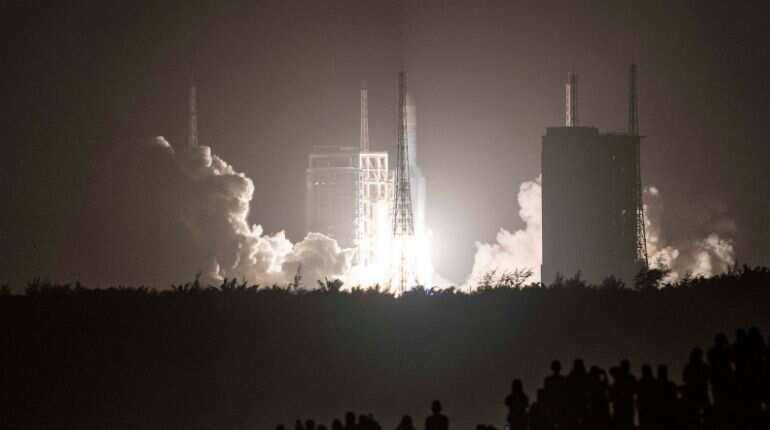
China launches first unmanned spacecraft to moon
In a first, China has launched an unmanned spacecraft to bring samples of lunar rocks back to the Earth, making it the first country to do so in nearly four decades.
A Long March 5 rocket has been launched carryingthe Chang'e-5 probe. It was launched from theWenchang Space Center on the southern island province of Hainan at 4:30 am.
The aim of the mission is to bring back lunar rocks and soil so that the scientists can learn about the Moon's origins, formation and volcanic activity on the lunar surface.
This mission was supposed gt be launched in 2017, but was delayed due to an engine failure in the Long March 5 rocket. It is expected to land in late November and will be collecting material in one lunar day — which is equivalent to 14 Earth days.
Before this, onlythe United States and the Soviet Union in the 1960s and 1970s respectively have been able to bring back such lunar rocks. So, if China is successful in its mission, it will the third country overall and first in nearly four decades to bring back lunar rock samples.
The experts will collect nearly two kilograms (4.5 pounds) of surface material in an area known asOceanus Procellarum(or "Ocean of Storms") which mainly consists of lava plain.
After being picked, the samples will be brought back to the Earth in a capsule that will land in northern China'sInner Mongolia region in early December.