Alaska Airlines Boeing 737’s cockpit voice recorder data erased, says US NTSB

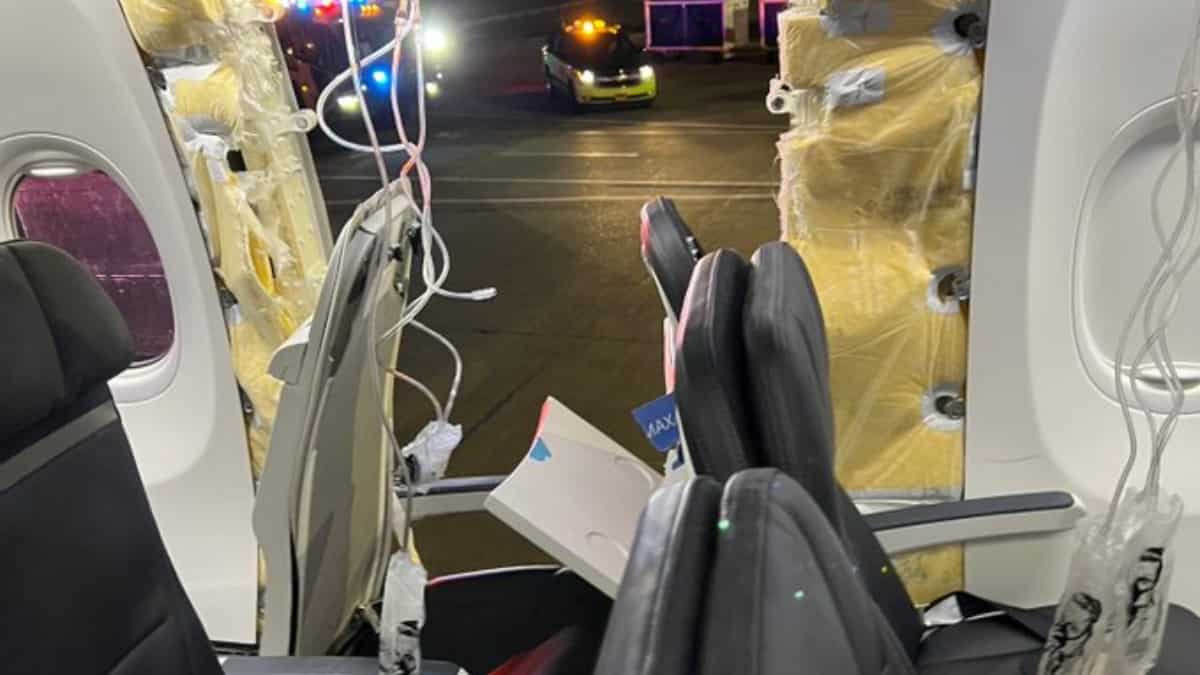
The image of door ripped off from the Alaska Airlines plane.
The United States National Transportation Safety Board (NTSB), said on Monday (Jan 8) that data on the cockpit voice recorder (CVR) in the Alaska Airlines Boeing 737 Max was overwritten. The NTSB chair said that no data was found as the recorder starts erasing previous data after two hours and the CVR was not retrieved within two hours.
"There was a lot going on, on the flight deck and on the plane. It's a very chaotic event. The circuit breaker for the CVR (cockpit voice recorder) was not pulled. The maintenance team went out to get it, but it was right at about the two-hour mark," said NTSB chair Jennifer Homendy as quoted by Reuters.
The Alaska Airlines aircraft lost a panel mid-flight on Friday last week. The loss of part of the fuselage caused the cabin to depressurise and objects to get sucked outside the plane while it was in the air.
There were 171 passengers in the plane when the incident took place.
Watch | US grounds 171 Boeing planes after Alaska Airlines window blows out mid-air
In the United States, rules mandate that cockpit voice recorders should record two hours of data as opposed to 25 hours as required in Europe for aircraft made after 2021.
Homendy said that Alaska Airlines plane's cockpit voice recorder and flight data recorder were sent for analysis but no voice recording could be obtained.
Both, flight data recorder and cockpit voice recorder are essential during investigation of any plane crash or a major mishap as it helps investigators recreate the situation when the plane was in jeopardy.
'Change the rulemaking'
The NTSB has long been vocal in its demand that rules in US be changed to mandate 25-hour recording. On Monday, it made a same demand.
"I'm calling on the FAA to change the rulemaking," Homendy said
A month ago, US Federal Aviation Administration (FAA) said it was proposing 25-hour recording but only for new planes.
Also Read | A loud boom, guts of wind: Alaska Airlines passengers recall the moment door of plane fell off
Homendy on Monday told Reuters that all aircraft, including the old ones, should have 25-hour recorders.
"If that communication is not recorded, that is unfortunately a loss for us and a loss for the FAA and a loss for safety because that information is key not just for our investigation but for improving aviation safety," she said.
What's the holdup?
Recording cockpit conversations for the period of 25-hours may sound like a logical solution but the pilots union oppose such a move.
"(It) would significantly infringe upon the privacy rights of pilots and other flight crew members, as well as drastically increase the likelihood that CVR recordings will be misused or disseminated without authorisation," said a union representing pilots of Atlas Air, an air-freight company.
What's the deal with Boeing 737s anyway?
Airplanes from Boeing 737 series have long been in the crosshairs of regulators around the world as these planes have suffered major crashes and other safety issues.
Also Read | Alaska Airlines emergency: iPhone survives 16,000-ft fall after plane's door blows out mid-air
Boeing 737 Max were grounded across the world in 2020 after crashes in 2018 and 2019. Even after the latest Alaska Airlines incident, the FAA has ordered grounding of all Boeing Max 9 planes as investigation progresses.
The constant association with hazards has marred 737s and also Boeing whose shares have tanked by nearly 40 per cent since March 2019 while rival Airbus' shares have shot up by 25 per cent.
(With inputs from agencies)