

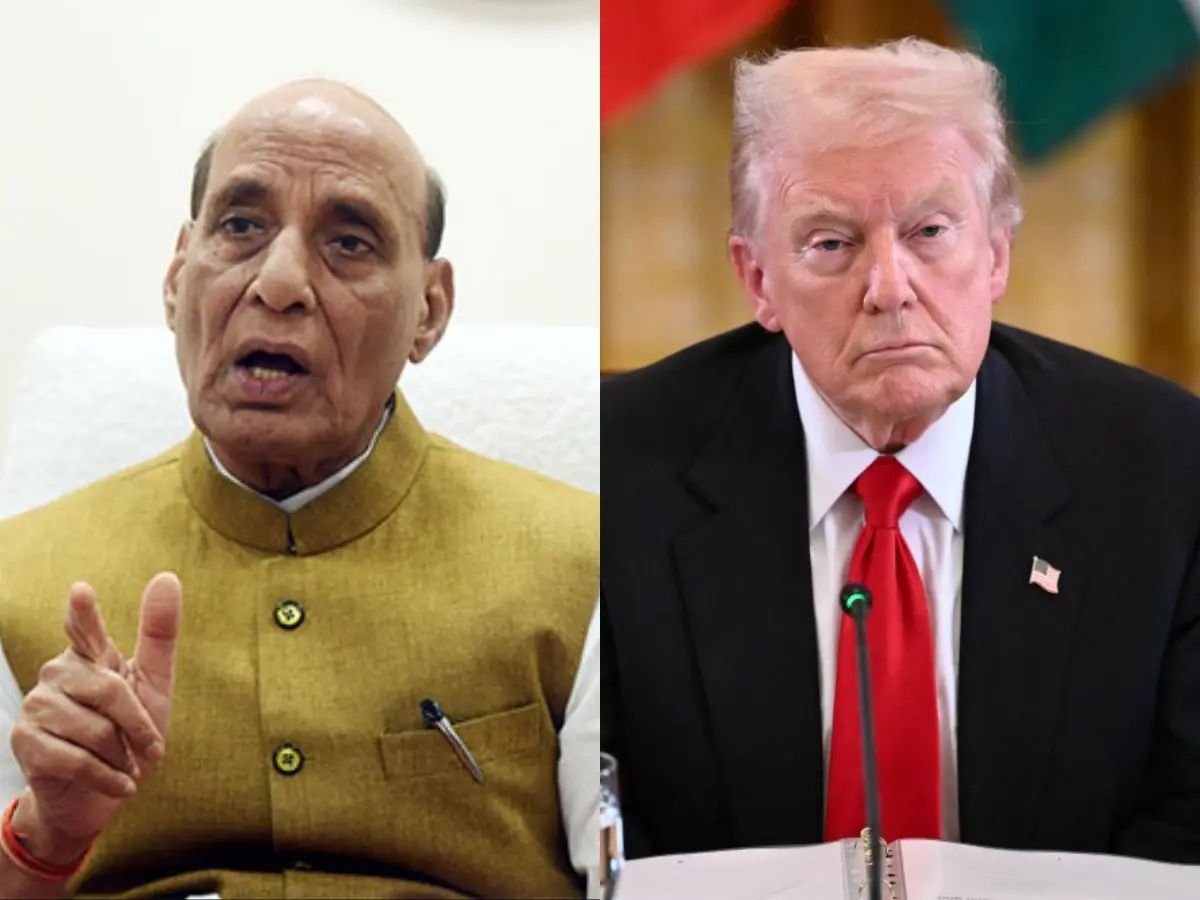
&imwidth=800&imheight=600&format=webp&quality=medium "'Whether it's Pakistan or America...' Rajnath Singh reacts to Trump's claims")
In a recent interview on Friday (Nov 7), India’s Defence Minister Rajnath Singh responded to Donald Trump’s claims about many countries testing their nuclear capabilities, and the list included Pakistan, Russia, China and North Korea. Speaking to the news media group Network18, Singh said, “Let them do it if they want to. Only the future will tell what India will do; we have nothing to say in this regard. Whether it's Pakistan or America, whoever wants to do it, is doing it. India does not take any step out of fear or pressure.”
This was his reaction to the US president’s comments in news outlet CBS's show ‘60 Minutes’. Trump said, “Russia's testing, and China's testing, but they don't talk about it. We're going to test because they test and others test. And certainly North Korea's been testing. Pakistan's been testing.”
India has maintained a clear stance that it will not work under duress. The leadership has been rather focused on enhancing the country's defence capabilities with a huge impetus on homegrown equipment. ‘Make In India’ has been New Delhi’s mantra and has seen remarkable results during Operation Sindoor, the four-day cross-border fighting with neighbouring Pakistan. The nation was forced to take action against Islamabad as it chose to ignore the dastardly terror attack orchestrated by a terror organisation operating from its soil. On April 22, Kashmir's Pahalgam witnessed the worst bloodshed in years that claimed 26 innocent lives, an incident that shook the entire nation. Foreign Secretary Vikram Misri, in one of the initial briefings to the nation, said, "It was deemed essential that the perpetrators and planners of the 22 April attack be brought to justice. Despite a fortnight having passed since the attacks, there has been no demonstrable step from Pakistan to take action against the terror infrastructure on its territory or territory under its control."
He added, "Instead, all it has indulged in are denials and allegations. Our intelligence monitoring of Pakistan-based terrorist modules indicated that further attacks against India were impending. Thus, there was a compulsion both to deter and to preempt."

