Sun chops off 1,396-year Comet Lemmon's tail in rare occurrence - Video

&imwidth=600&imheight=450&format=webp&quality=medium "Sun chops off 1,396-year Comet Lemmon's tail in rare occurrence - Video")
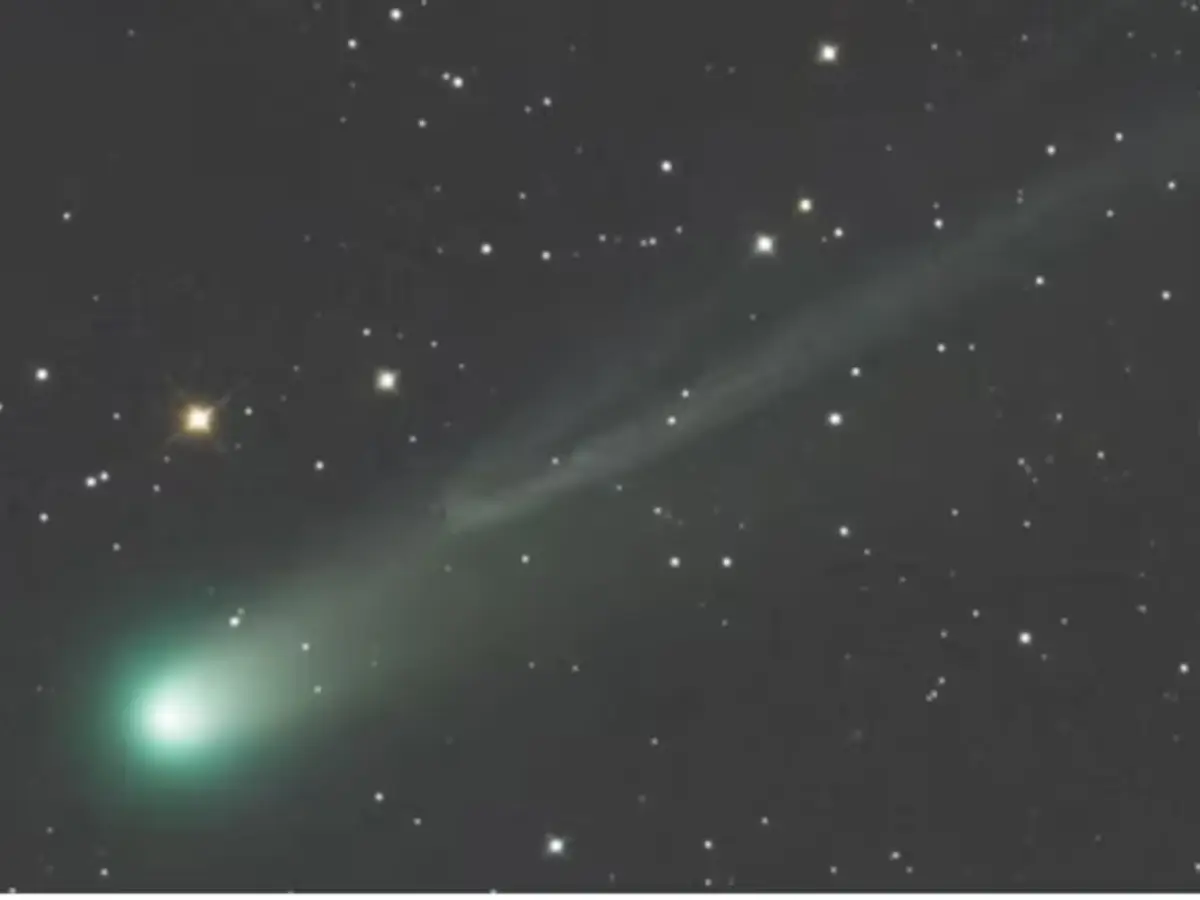
Comet Lemmon's tail was snipped by solar winds. Photograph: (Brennan Gilmore)
Comet Lemmon faced the fury of the sun as solar winds cut through its tail in a rare occurrence. The event was caught on camera by astrophotographer Brennan Gilmore. The comet will soon become extremely bright in the night sky.
Comet Lemmon's bright tail was cut off by solar wind on camera. An astrophotographer captured the rare cosmic sight as a huge portion of the comet's tail came off. This created a dazzling spectacle in the night sky, as visible in the video. Brennan Gilmore recorded the solar wind chopping off Comet C/2025 A6 (Lemmon)’s tail as it races towards the inner solar system. Comet Lemmon is set to become one of the brightest objects in the sky soon. It is getting brighter before its date with Earth on October 21. The time-lapse footage of the rare “disconnection event" from October 2 shows charged particles from the Sun running towards the comet and severing its tail from the body. This gouged a gap in Lemmon's tail.
As comets approach the Sun, the solar winds and the heat lead the comet to undergo a process known as outgassing. The dust, debris and ice around the comet start being released, creating a tail that is hundreds of kilometres long. This can also happen because of the gravitational force and the speed of the comet itself as it comes near the Sun. A glowing green coma around Comet Lemmon’s nucleus can be seen in Gilmore's images. A long luminous tail stretches behind it, and the charged particles soon cut into it. The comet was in the constellation Leo Minor near the bright star TW Leonis Minoris when the solar winds snipped its tail.
Also Read: Three comets are coming near Earth this year. Visibility, dates of arrival and other details
Comet Lemmon is expected to become extremely bright and might become visible to the naked eye in areas with minimal light pollution. Right now, its current brightness is at magnitude +5.1. It will reach perihelion (closest point to the Sun) on November 8. It was discovered on January 3 by telescopes on Mount Lemmon in Arizona. According to NASA, the comet has a 1,396-year orbit around the Sun. It last visited Earth in the year 629 and will return in the year 3421.
How to find Comet Lemmon?
Comet Lemon's closest approach to Earth is on October 21. To locate it, find the constellation Boötes, the Herdsman, using a telescope or a skygazing app. Before October 21, Comet Lemmon will be positioned high above the northeastern horizon just before dawn. It will then move to the evening sky as it comes near Earth. At this time, it will appear low on the northwestern horizon.

