Heartbreaking! Humpback whale mother filmed staying beside her stillborn calf in rare behaviour

&imwidth=600&imheight=450&format=webp&quality=medium "Heartbreaking! Humpback whale mother filmed staying beside her stillborn calf in rare behaviour")
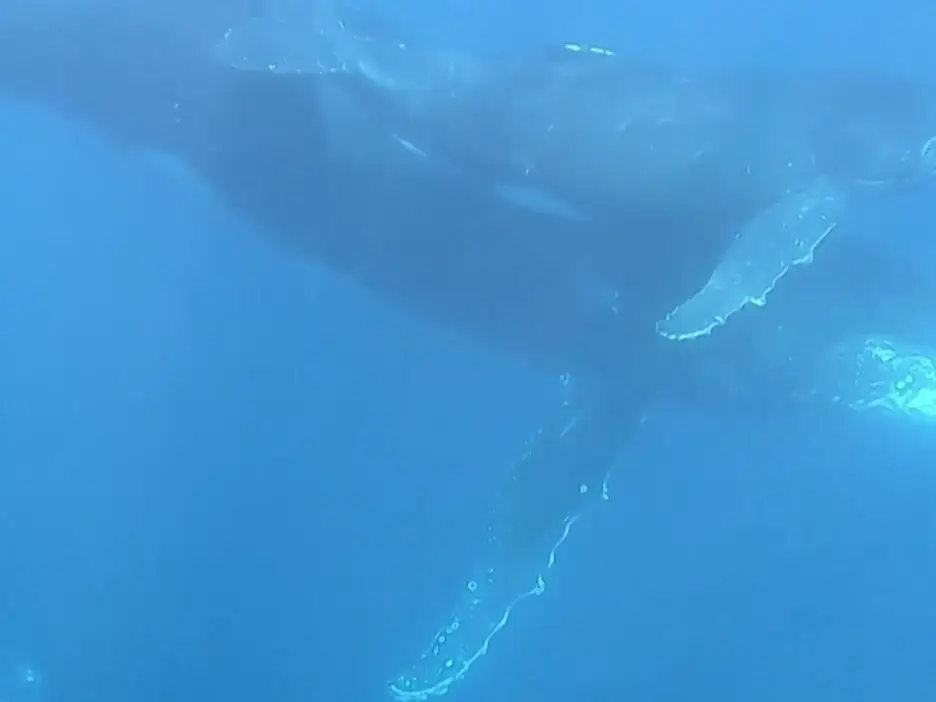
Screenshot taken from the video Photograph: (X)
A mother humpback whale was filmed staying beside her stillborn calf, offering rare insight into maternal attachment and death-related behaviour
Scientists have filmed a mother humpback whale displaying what appears to be grief-like behaviour after the death of her stillborn calf, in what researchers believe could be the first recorded video of such behaviour in a baleen whale. The mother was observed off Australia’s southern Gold Coast after giving birth to the stillborn calf. Rather than leaving the body, she remained close to it for an extended period, repeatedly positioning herself alongside the calf and appearing to maintain eye contact.
Dr Olaf Meynecke, of Griffith University Whales and Climate Research Programme, said: “She remained close to the calf over several hours, maybe even days. “These observed behaviours were consistent with caregiving or nurturing actions and post-mortem attentive responses documented in socially complex mammals, and indicated an inherent strong maternal attachment to the calf.”
Researchers believe the footage may represent the first video documentation of this type of response in a baleen whale, a group that includes humpback and blue whales. Similar behaviours have previously been observed in toothed cetaceans such as dolphins and killer whales. Humpback whales inhabit oceans around the world and undertake long migrations, often travelling thousands of miles between colder polar feeding grounds and warmer breeding waters.
Watch the video here
The species is also among the whales most frequently encountered by people because it often travels close to coastlines. Humpbacks are well known for breaching, launching much of their bodies above the surface before crashing back into the water.
Adult humpback whales can reach around 60ft in length and weigh as much as 40 tonnes. Calves are already about 13ft to 16ft long when they are born.
Although the inner workings of whale minds remain difficult for scientists to study, research has found evidence of sophisticated learning and social behaviour. Humpback whales appear capable of copying feeding techniques from one another, while males produce complex songs that can spread across ocean populations in ways researchers have compared with cultural trends.
Meynecke said the observation could help scientists investigate “the cognitive and emotional dimensions of death-related responses” in baleen whales. Andrew Mulville, a Sea World Foundation rescue boat captain who witnessed the episode, said: “At first sight, I thought it was two whales resting on the surface, but their behaviour was unusual. “It was definitely not what I was expecting to see out at sea that day.”

