

&imwidth=800&imheight=600&format=webp&quality=medium "Scientist suggests 3I/ATLAS is trying to 'gain speed rather than slow down' - An 11th anomaly emerges")
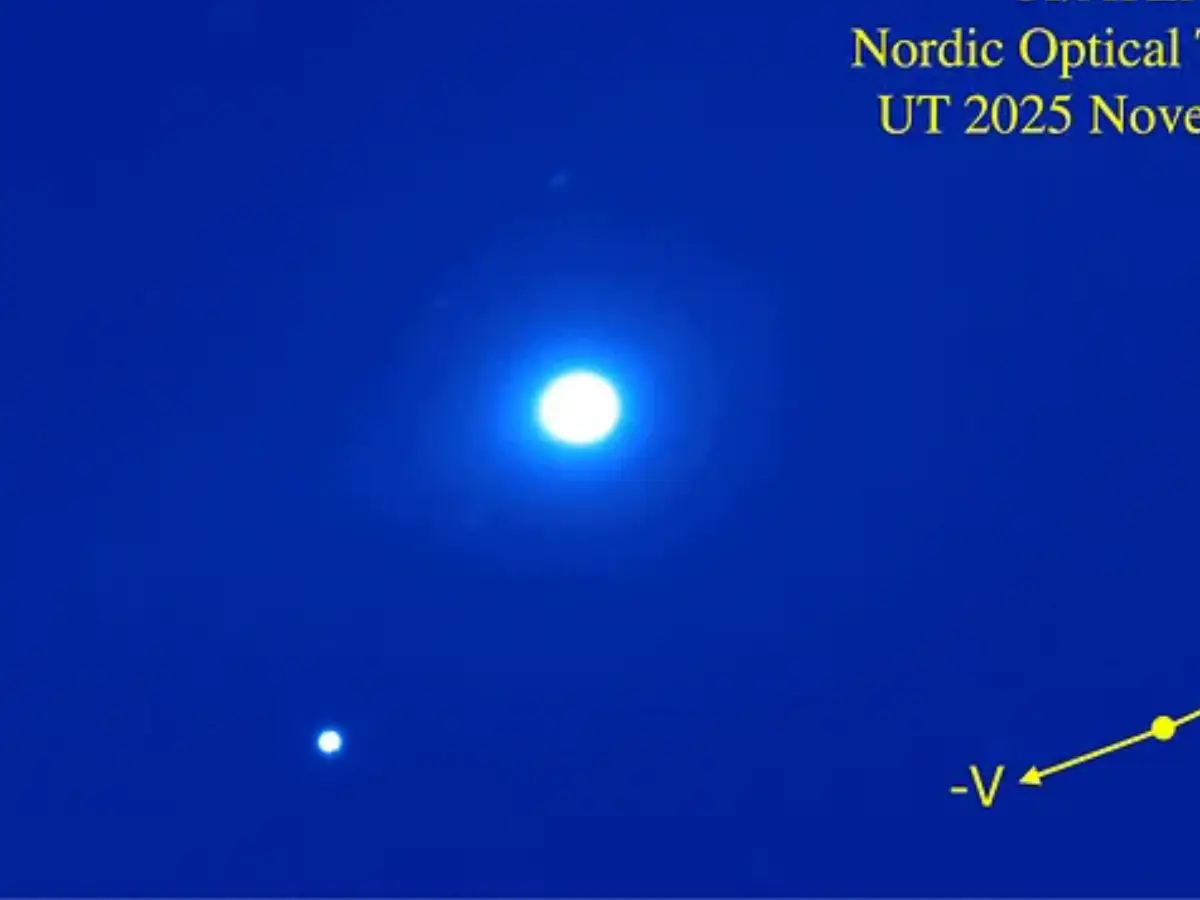
3I/ATLAS is baffling astronomers with dual behaviour, making one kind of appearance and then soon looking like something completely different. On November 8, it showed a "complex tail structure" captured by M. Jäger, G. Rhemann and E. Prosperi. Then the very next day, Michael Buechner and Frank Niebling saw what they termed "nice tail structures", including the "antitail" and the "smoking" tail. Now, David Jewitt and Jane Luu captured 3I/ATLAS on the Nordic Optical Telescope, looking like a ball of light and "an anti-tail pointing towards the Sun." Harvard scientist Avi Loeb pointed out the anti-tail while sharing the latest images of the interstellar comet. A few days back, he had also stated that it likely exploded into several fragments near the Sun, which would explain why it suddenly brightened. However, pictures show that it is still perfectly intact. This Loeb says is another anomaly, something not normal for a regular comet.
Also Read: 3I/ATLAS hiding pristine material, but is no longer a relic of its past — Study examines NASA data
Anti-tail pointing towards the Sun is present, Loeb says
He says the latest image of 3I/ATLAS taken from the Canary Islands resembles the image obtained by the Hubble Space Telescope on July 21, 2025, which showed an anti-tail pointing towards the Sun. He further talked about how it is still a whole body, despite showing complex jet structures in other photos. "Given the large-scale jets reported recently, the fact that 3I/ATLAS remains a single body is surprising for a natural comet. An earlier image measured jets towards the Sun, measuring approximately 1 million kilometres. He says the jets also offer insights into the size of the interstellar comet, based on which the numbers don't add up to prove that it is a natural comet while still being "a single body that maintained its integrity and did not break up into numerous fragments."
Loeb says that an anti-tail indicates that the object is "trying to pick up speed through the gravitational assist from the Sun." He says, "Technological thrusters which point their exhaust towards the Sun would accelerate away from the Sun. This post-perihelion manoeuvre might be employed by a spacecraft that aims to gain speed rather than slow down through the gravitational assist from the Sun." Meanwhile, almost everyone else is of the view that 3I/ATLAS is a comet and nothing else. Loeb has challenged them to explain the several anomalies, including the latest one, if it is a natural body.

