
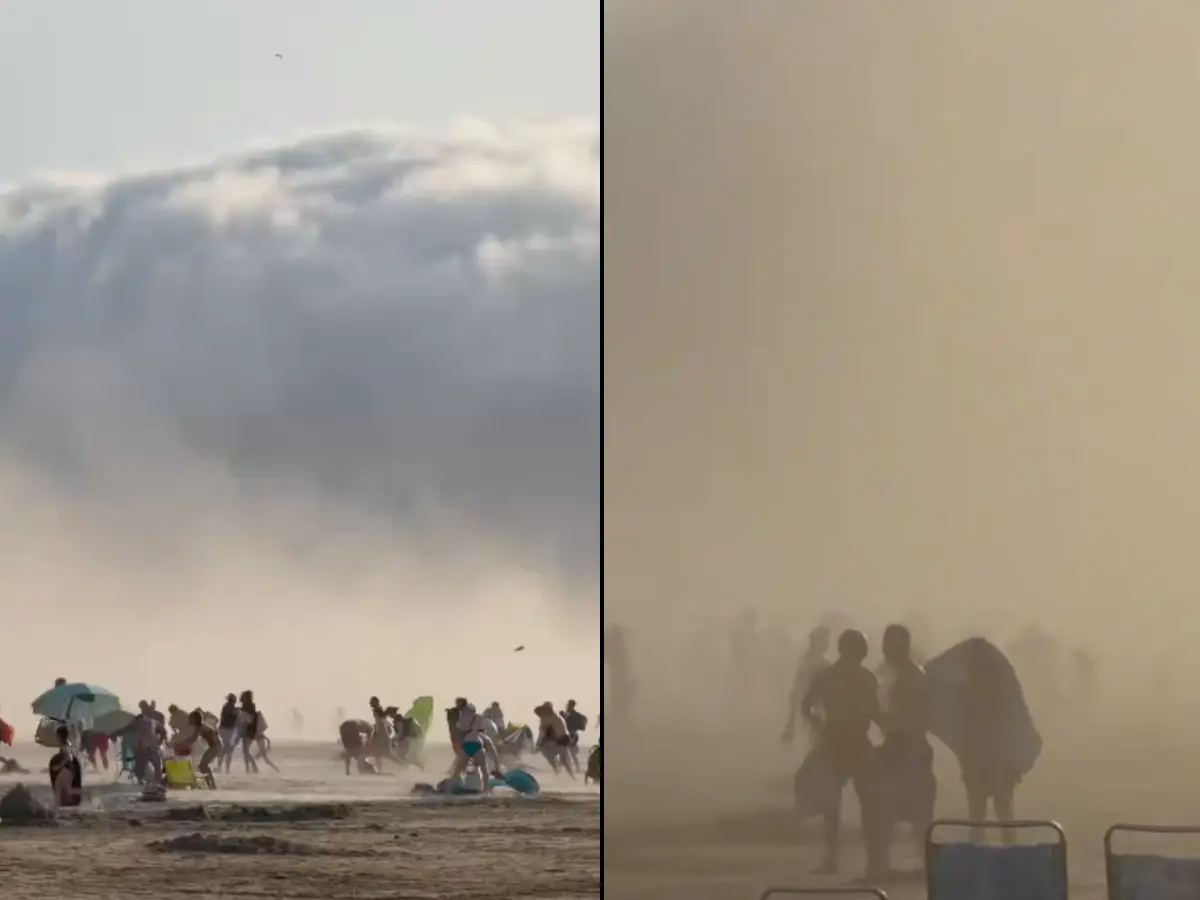
&imwidth=800&imheight=600&format=webp&quality=medium "11C in 6 minutes: 'Tsunami cloud' slams French beach, wind speeds touch 100 kmph")
A giant tsunami cloud slammed a beach in France, as temperatures fell by 11 degrees in just six minutes. Beachgoers described the scene "like a tornado" as day turned to night, with extreme wind speeds. It got "clouded over and turned misty," a woman told Franceinfo. The weather phenomenon was reported from the Basque coast on Sunday afternoon. The "galerne storm" was "unlike anything we’d ever seen," a man said. Europe is in the grips of a heatwave with temperatures touching 38C in this area. The same thing happened in Biarritz recently, where a record temperature of 42.9C was recorded. A powerful westerly wind brought down the temperature to 23C within minutes.
Photos and videos show a large cloud looking over the shoreline, similar to a tsunami wave in appearance, hence lending it the name. Sébastien Léas, a forecaster at Météo-France, said that a wall of humidity was visible coming in from the open sea, but you can only see it ten minutes before the storm, and not before. Galernes occur when cold maritime air from the Bay of Biscay arrives over warmer land, triggering violent wind gusts of up to 94 kmph.
Léas explained that the wind became oceanic in Hendaye. This cooler and humid air caused a sudden shift from dry heat to humid coolness. As the wind howled through the beach, people gathered their belongings and ran to safety.

Heatwave and record wildfires grip France
Europe is in the clutches of its third heatwave this summer. Temperatures in Sardinia, Italy, are expected to reach 45 degrees Celsius between Thursday and Friday. The heatwave has triggered wildfires, and firefighters are battling a blaze in a forest near Paris. Scientists say controlling wildfires is becoming extremely difficult due to climate change.
Interior Minister Laurent Nunez said that two blazes, one in Fontainebleau and the other nearby, had scorched 1,300 hectares of land. A6 highway linking the capital with Lyon and the south had to be closed, disrupting high-speed services. Nunez said it could be a historic year for fires in France, as 32,000 hectares of land have already burned this year. "We'll probably have a record year. We expected this with this major drought," he said.

