Opinion: If Pakistan Army wants, Hafiz Saeed will be a free man

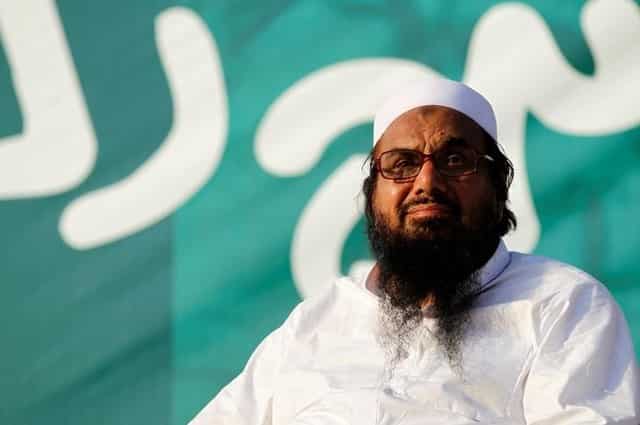
Hafiz Saeed
The judges have repeatedly asked the government for evidence to ensure Saeed's continued captivity but the authorities has been unable to satisfy the courts
The Lahore High Court on Wednesday ordered the release of Jamat-ud-Dawa (JuD) chief Hafiz Saeed, who has been under house arrest since January this year.
During the nine months of his detention, the Pakistani government’s efforts at pursuing the case were at best lacklustre and seemed more cosmetic than anything, just like his house arrest during which he continued with his activities, and ran his charity organisation which many believe acts as a front and a reincarnation of the Lashkar-e-Taiba.
The JuD chief even managed to launch a political party by the name of Milli Muslim League (MML), but I will come back to that later. First, more on the court case.
The judges hearing the petition – filed by Hafiz Saeed’s lawyer who pleaded that there was no justification for Saeed’s arrest – repeatedly asked the government's representatives, prosecutors, and law enforcement officials to present evidence that would ensure Saeed's continued captivity but the federal and provincial authorities failed to satisfy the courts.
Does the government have this evidence? From what we know, India claims to have provided enough evidence against Hafiz Saeed for his involvement in the Mumbai attacks of 2008, which left 166 people dead.
Even the United States of America has put him on the Global Terrorist List.

However, in Pakistan, Indian claims are rejected outright while American labelling is also seen as India managing to convince the US through successful propaganda and nothing more.
But there is another side to why the government has not pursued this case as it should have – its hands are tied by a powerful military establishment that does not want to share intelligence with its civilian counterparts.
In Pakistan, it is the military agencies that are thought to be responsible for domestic security affairs, especially when they concernintelligence gathering about a group like the JuD that has involvements in regional conflicts and affects Pakistan’s foreign policy (which is also controlled by the establishment).
But the military has even larger goals for the JuD – the MML (which I had mentioned earlier).
A few months ago, when the MML was being formed, a recently retired military general confided to the media that there was a plan by the Pakistan Army to mainstream militant groups into politics. While the idea was initially pushed with the clarification that this was the only way to de-radicalise such groups, it now seems the motives of the architects of the plan are quite different.
The general elections in Pakistan are near and Nawaz Sharif has been on the warpath with the Pakistan Army ever since he was disqualified over the Panama Papers allegations.
Sharif alleges the military engineered his ouster and that there was no fair trial, and many agree with him.
Given that Sharif has been the one who is a big proponent of normalising relations with India, experts say the army does not want this, since no-conflict-with-India will reduce the relevance the military enjoys as the defender of Pakistan from a perceived Indian threat.
And so to stop Sharif’s party – the Pakistan Muslim League-Nawaz (PML-N) – from being re-elected, the MML has been launched. The MML shares a voter-base with PML-N and will definitely dent its vote bank.
We saw an example of this in the recent Lahore city by-elections in NA-120, the seat where Sharif was disqualified from. The MML's performance was exceptional, and PML-N's Kulsoom Nawaz, Sharif's wife, did not win by the same percentage margin that Sharif did the last time.
For now there are indications that the provincial government will make an attempt at issuing fresh orders of detention for Saeed but even if they manage to contain him, it is only a matter of time before the next order of freedom comes because there are power centres in the country that are more powerful than the civilian government. And if those powers want him out, no one can stop him from being a free man.
(Disclaimer: The author writes here in a personal capacity).