Earning Nepal' trust is India's best bet to counter China

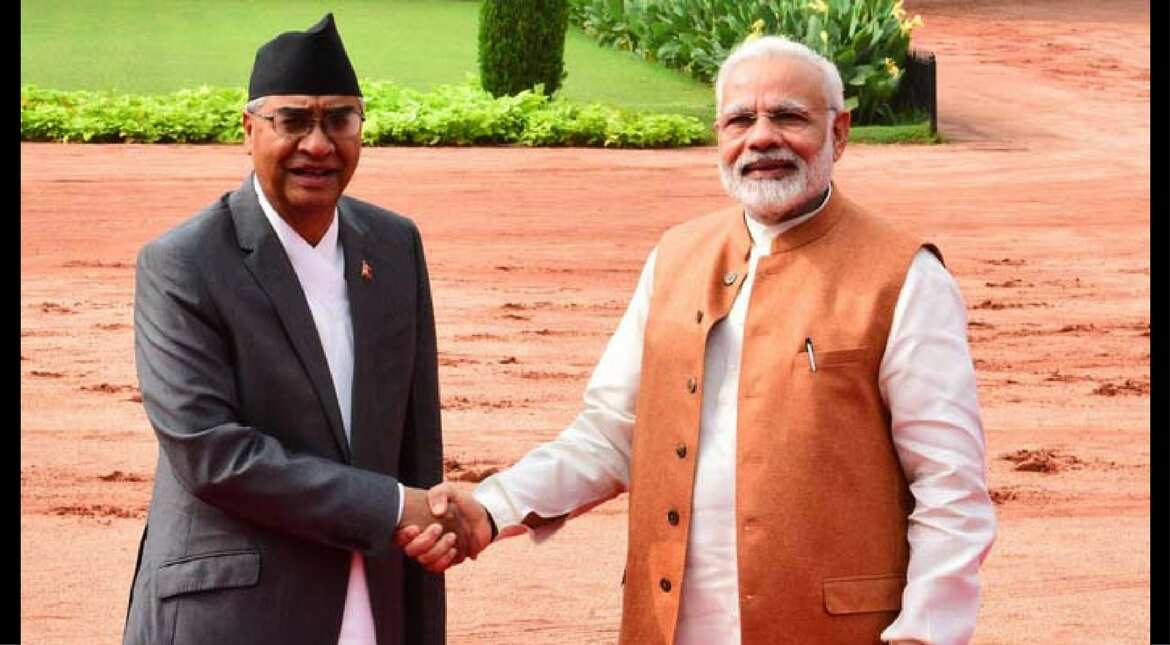
PM Sher Bahadur Deuba and PM Modi
Doklam crisis indicates that India can only earn the support of Nepal by being respectful to the country.
Prime Minister Sher Bahadur Deuba’s five–day official visit to Delhi from August 23, 2017, comes at a crucial time in theIndia-Nepal bilateral relationship. PM Deuba led a high-level delegation, including minister of foreign affair, minister of finance, and minister of culture as well as members of parliament and of the business communities of Nepal. Considering this visit was thefourth high-level visit from Nepal to India in the last one-and-half years, it indicates political instability in the region and, more importantly, Nepal’s political dependency on India as well as the fragile turn the diplomatic relationship between the two countries has taken in the post-constitution period.
Deuba's recent visit can be looked upon as an attempt from both the sides to reduce the trust deficit emanated due to non-acknowledgement of the new Nepali constitution by India. Since long, Kathmandu-based elites and political parties have assumed that India has been using minority rights issue to derail the constitution-making process.
Deuba's recent visit can be looked upon as an attempt from both the sides to reduce the trust deficit emanated due to non-acknowledgement of the new Nepali constitution by India.
The ongoing visit has coincided with the border face-off at Doklam area since June 2017 between Nepal’s two giant neighbours. It is known that China has formally briefed Nepal about developments at Doklam. China also discussed that issue during Chinese Vice–Premier’s visit to Nepal early this month. Nepal, in fact, responded to the situation by making its stand clear that it would take a neutral position, in case tension escalates in future.
The visit has also come at a time when Deuba is facing a great challenge to address the demands of the minority groups of Nepal and amidst intra-party factionalism in the Nepali Congress (NC). Both these issues are equally important for India, as it has been trying to consolidate liberal democratic forces in Nepal as well asminimise anti-India sentiments propagated by ultra-nationalist parties like the CPN-UML and the RPP-Nepal. It would be pertinent to mention that China seems to favour a Left-coalition government with the support of the RPP after provincial and parliamentary elections, which is going to be held in November 2017.
There are mixed reactions on the visit both in Nepal and India. Certain sections in both the countries feel that the visit has been extremely successful. First, in comparison to two earlier visits, PM Modi had two unscheduled one-on-one meeting with PM Deuba before the formal delegation-level meeting on August 24. Indian PM also crossed the protocol and invited Deuba to his residence for a discussion. Later, both the leaders at the press briefing agreed that they had comprehensive talks on all aspects of the bilateral relationship.
Some Nepali delegations, in fact, felt that the meetings were held in an atmosphere of utmost cordiality and tone and tenor was impressive. That indicated that both the leaders had managed to reduce the trust deficit at the highest-level, which was missing since September 2015. Second, a detailed joint statement (JS) with 46-points was issued after the delegation level meeting. Both the countries also signed eight MoUs which emphasised on earthquake reconstruction, border infrastructures and bilateral trade. The JS stated that, both the leaders agreed to enhance cooperation on flood management, defence and security cooperation, cross border energy, electricity transmission and connectivity infrastructure, cultural tourism and affirmative action to address Nepal’s growing trade deficit with India.
It is estimated that the Indian investment in Nepal might go up to $5 billion in areas of cross border transmission lines, tourism, education, hydropower development and agriculture.
Thirdly, after a decade, for the first-time Indian business houses were enthusiastic to invest in the Nepali market after their meetings with PM Deuba on August 23. During the business delegation meeting, PM Deuba invited Indian companies to invest in Nepal. He argued that Nepal has brought major changes in its investment rules and that much political stability will be ensured under the new constitution. Indian business houses, in fact, responded to PM Deuba’s invitation positively. It is estimated that the Indian investment in Nepal might go up to $5 billion in areas of cross border transmission lines, tourism, education, hydropower development and agriculture. Fourth, the body language of both the leaders looked warm and comfortable. Both the leaders inaugurated two cross border transmission lines which would add another 100 MW to existing 350 MW3 power supply to Nepal from India.
PM Modi, in fact, accepted PM Deuba’s invitation to visit Nepal and inaugurate the Arun-III hydro project. During the visit, PM Deuba also called on India’s President and Vice-President and held meetings with the minister of external affairs, minister of finance and the Opposition leaders.
However, some observers have labelled the visit as routine and ceremonial one which did not bring much substance to the bilateral relations. First, like previous two visits, this visit might also fail to reduce anti-India sentiments in Nepal as India did not acknowledge the new constitution. This small gesture could have immensely helped the liberal democratic forces of Nepal to perform better in the forthcoming elections. A large number of Nepali people thought that given the personal rapport of Deuba with PM Modi, he might convince Delhi to mention that issue in the JS. Back home, the Opposition parties might take advantage of this.
Second, before departing for Delhi, PM Deuba had consulted former policy makers and academicians. Theysuggested PM Deuba to have a discussion in India on issues pertaining to the national interest of Nepal, such as border disputes with India, exchange of old Indian currency, delay in implementation of projects and restrictions on Nepali agro products, etc. Although many of those issues were already mentioned in the JS, it appeared that clarity was missing on certain issues.
Third, and most importantly, a large number of Deuba’s business delegation members felt that some of the major projects assured by India in the JS might not be implemented on time and others might not be completed on time. Privately, they expressed lack of trust on Indian funded projects.
If India wants liberal democratic forces to remain in power, then it has to work on war footings to implement the projects and issues discussed in the JS.
Clearly, the implementation of the agreements inked during this visit remains a major challenge before both the Deuba government and India. Nepal government has already declared both provincial and parliamentary elections in November and December respectively. If India wants liberal democratic forces to remain in power, then it has to work on war footings to implement the projects and issues discussed in the JS. That would help liberal democratic forces like the NC to regain voters’ confidence along with India. The opposition parties and anti-India forces could project India as an interventionist power and the NC as a pro-India party. Therefore, both the NC and India must work together to make some people-centric projects successful before the elections. At the same time, India should take note of Nepali sentiments. The impression in Delhi is that everything is achievable in Nepal by giving more aid, funds and maintaining the LoC. That, in fact, brings negativity in the relationship. Nepal does not look for resources from India always. Given the changing situation, a large section of the Nepalis expects India to respect Nepal’s sensitivity as an independent country.