'Zoom in more it spells GOD': NASA spots peculiar cloud hovering over Caspian Sea

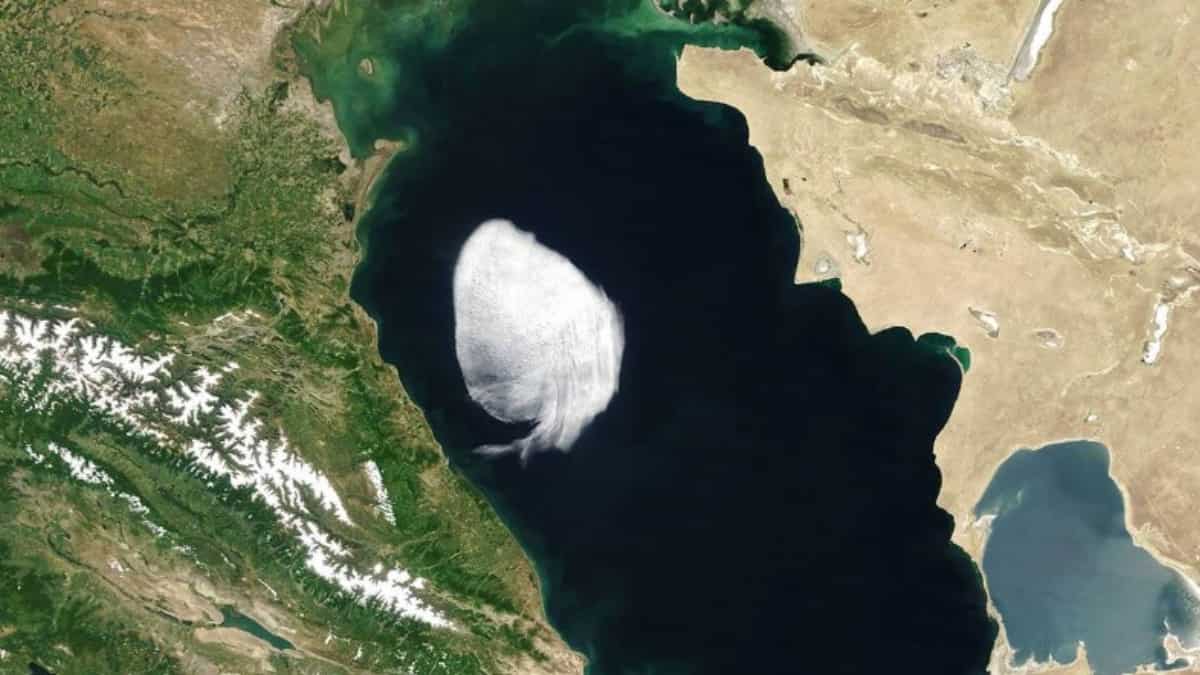
NASA’s Moderate Resolution Imaging Spectroradiometer (MODIS) has spotted a peculiarly-shaped cloud hovering over the largest inland body of water on the planet, the Caspian Sea.
In sharp contrast with the typical diffused and dispersed cloud cover, this particular cloud had well-defined edges resembling something from a cartoon or something painted onto the scenery.
The cloud, which resembles what can be called a white smudge of paint, is a small stratocumulus cloud according to Bastiaan van Diedenhoven, who is an atmospheric scientist at SRON Netherlands Institute for Space Research.
Usually found during good weather conditions, cumulus clouds are detached “heaps” of “cauliflower-shaped” clouds and form at low altitudes, generally between 600 and 2,000 metres.
Spanning a layer about 100 kilometres, the stratocumulus cloud in the picture is hovering at an altitude of about 1,500 metres.
The image of the cloud, which has gone viral on social media, has garnered hundreds of likes and has been shared multiple times.
While a Twitter user commented “Google, the eye in the sky," another wrote “Zoom in more it spells GOD."
“Sharp edges are often formed when dry, warm air coming from land collides with colder moist air over the ocean, and the cloud forms at that boundary. You often see this off the west coast of Africa but at much larger scales," said Diedenhoven.
He believes that the cloud drifted to the coast of Makhachkala from the Caspian Sea during the afternoon and dissipated when it reached land.
It comes after there were reports that cosmic cannibalism is taking place in space as a dead star is ripping apart its planetary system.
Using the archival data from the Hubble Space Telescope, NASA scientists have found that a White Dwarf star called G238-44 is responsible for the phenomenon which is happening for the first time.
(With inputs from agencies)
Watch WION's live TV here:
×