
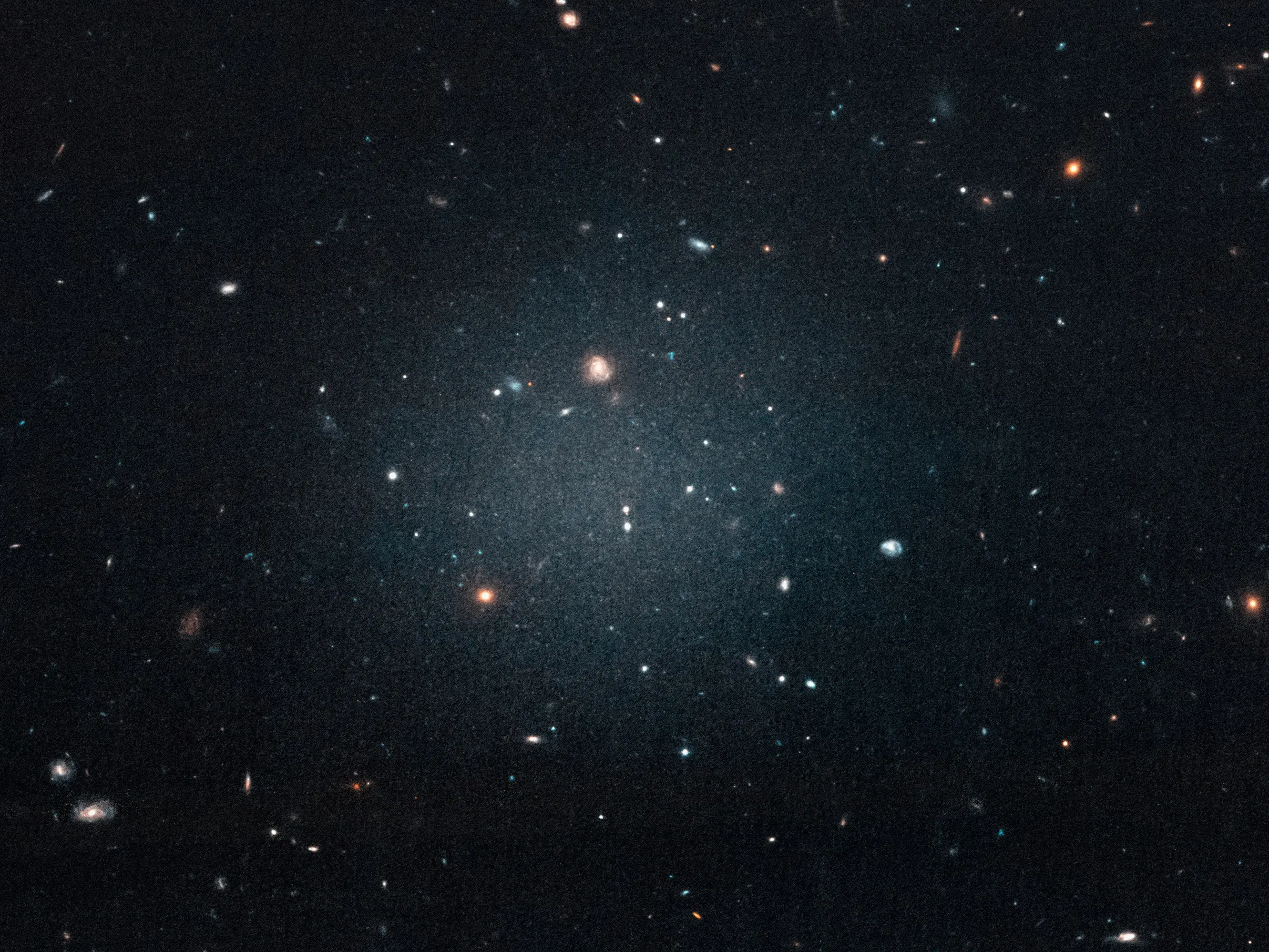
&imwidth=800&imheight=600&format=webp&quality=medium "Why haven't we found dark matter yet? Because it doesn't exist, one scientist claims")
Dark matter and dark energy are two things that scientists strongly believe exist in the universe, yet they have never been able to find them. They are believed to be the driving force behind the expansion of the universe. However, Professor Rajendra Gupta of the University of Ottawa has given a simple reason why dark matter has remained elusive till now - because it simply doesn't exist. His theory has raised eyebrows in the astronomy community, but Gupta claims the effects that have been attributed to dark matter till now have another explanation. He says that as the fundamental forces of the universe change over time, the cosmos witnesses things that scientists assume are happening because of dark matter. But that isn't the case. Gupta offers an alternate reason for why everything that we think is happening because of dark matter is actually happening. He says that constants, such as the speed of light and the force of gravity, govern the laws of physics. But some physicists think that they are not "constant" in reality, and in fact, evolve and change as the universe ages.
Gupta wrote in the study, "Dark matter and dark energy...may be considered emerging from the weakening of the forces of nature in an expanding Universe." In his paper, he tried to explain everything that dark matter currently does, without assuming that these particles exist. He says the varying "covarying coupling constants" can be taken and put into Einstein's equations for cosmic expansion. This results in two mathematical terms - alpha–matter and alpha–energy. Both these behave just like dark matter and dark energy. What makes this theory really interesting is that the amount by which the constants vary changes depending on how much matter is concentrated in one place. Also Read: 'NASA is currently closed' - Space agency shuts down its website indefinitely | Details
Theory explains why outer stars are moving faster

Under Gupta's theory, the amount by which the constants vary changes depending on the concentration of matter in one place. It states that at the centre of a galaxy, lots of normal matter is present and so physics acts just like it should. But in far-off regions, the matter reduces, the constants become weaker and alpha–matter and alpha–energy effects start becoming visible. Gupta says this explains why the outer regions of galaxies and the universe seem to be moving faster compared to stars in the inner core.
Scientists seriously started considering the possibility that dark matter is real in the 1970s. Astronomer Vera Rubin noticed that galaxies' outermost stars were rotating a lot faster than they should. This led to the hypothesis that galaxies had a lot more mass than the visible matter could account for. This led to the assumption that dark matter occupied the space between cosmic bodies in the universe. However, no proof of its existence has ever been found.

