Water on Mars! Early morning frost spotted on volcanoes in breakthrough discovery

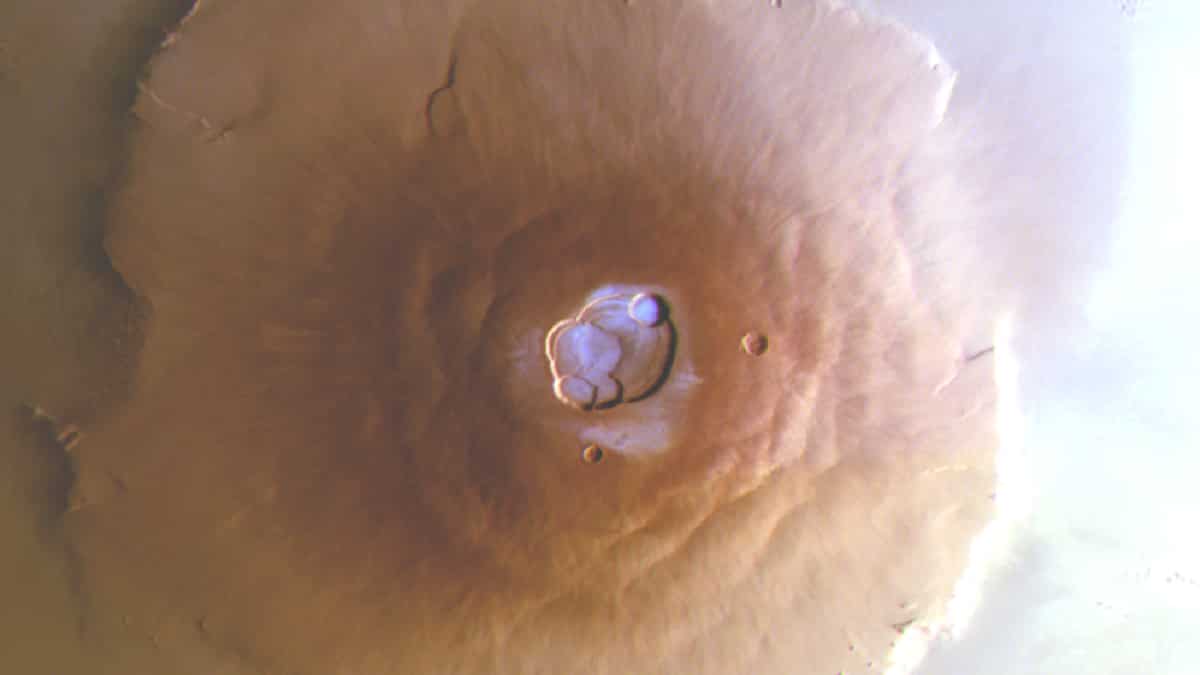
Image of morning frost on Olympus Mons, the tallest volcano on Mars. (Courtesy: ESA)
Scientists have been hunting for one sign of life on Mars and even the slightest presence of water can prove to be a breakthrough.
In this hunt for alien life, scientists have now made a discovery by detecting the patches of water frost equal to "60 Olympic-size swimming pools" on the Martian volcanoes.
The scientists spotted thin and widespread layers of water frost which were spotted atop three of Tharsis volcanoes in Mars, as per a new study published in the journalNature Geoscience.
The volcanoes are located on a plateau at the equator of the planet. The Tharsis volcanoes, which are a series of 12 large peaks, are the tallest volcanoes present in our solar system, as per the study.
The study further emphasised that the water frost was discovered on the volcanoes Olympus, Arsia Ascraeus Mons, and Ceraunius Tholus.
In a press release, researchers from Brown University said, "The researchers calculate the frost constitutes at least 150,000 tonnes of water that swap between the surface and atmosphere each day during the cold seasons. That's the equivalent of roughly 60 Olympic-size swimming pools."
European Space Agency's missions capture water frost
The European Space Agency's Mars Express and ExoMars missions clicked 30,000 images of the water frost while orbiting the planet and a team of international researchers then analysed the planet, as per the study.
The thin layer of frost found was approximately "one-hundredth of a millimetre thick or about the width of a human hair," as per the study. The study added that they are formed during sunrise and eventually evaporate amid daylight hours.
In a press release, lead author of study and postdoctoral fellow at Brown University Adomas Valantinas said, "We thought it was impossible for frost to form around Mars' equator, as the mix of sunshine and thin atmosphere keeps temperatures during the day relatively high at both the surface and mountaintop — unlike what we see on Earth, where you might expect to see frosty peaks."
Speaking about the frost discovery to AFP, Paris-Saclay University's Frederic Schmidt said, "We saw a shiny, blue deposit there, a particular texture that we only see in the early morning and during the cold seasons."
Watch:Gravitas: Is China practicing placing payload in space?
"What we're seeing may be a remnant of an ancient climate cycle on modern Mars, where you had precipitation and maybe even snowfall on these volcanoes in the past," he added,
As per the study, the water frost is present on the calderas of the volcanoes which are huge depressions present at the top of the summit that were formed after eruptions in the past.
Speaking about the presence of water on Martian Earth ESA scientist Colin Wilson said, “Finding water on the surface of Mars is always exciting, both for scientific interest and for its implications for human and robotic exploration."
(With inputs from agencies)