THIS strange, alien world is boiling hot and completes one year in just half Earth day

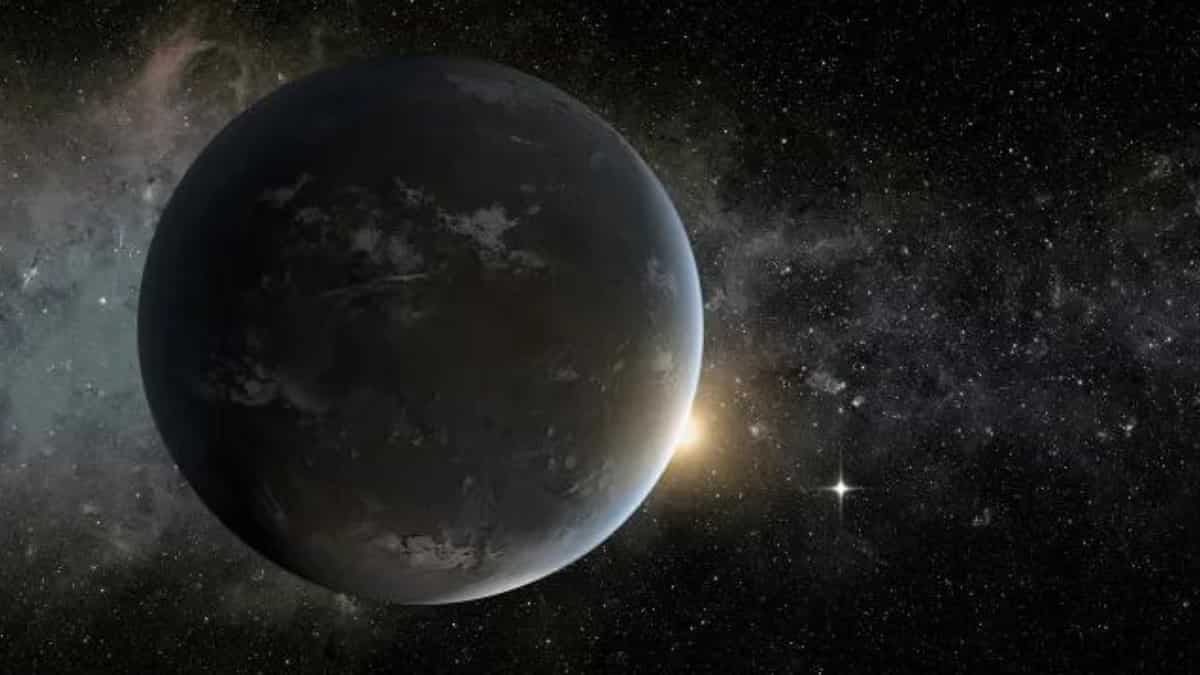
Image of hellish exoplanet TOI-1798. (Courtesy: NASA)
A new catalogue of 126 strange worlds was published by NASA which in detail talked about these alien planets and how they are different from Earth.
Multiple papers were published related to this survey which specified some of the features of these alien planets.
The most extreme planet amongst them was TOI-1798 which was looked into by Alex Polanski, a physics and astronomy graduate student from the University of Kansas.
In the paper, lead author Polanski explained that this planet's orbit makes it travel very close to an orange dwarf star in a span of less than 12 hours.
What was more interesting was to find that one year on this planet is equal to less than half a day on planet Earth. The planet is also boiling hot as it gets more than 3,000 times the radiation Earth gets from the Sun.
TOI-1798 is not just a planet but a system which has two planets. In this system, the inner planet is like a Super-Earth which is near its star and one year lasts about half an Earth day.
All about other alien exoplanets catalogued by NASA
In another paper, which was authored by UCR graduate student Michelle Hill, the discovery of two planets was mentioned which were spotted orbiting a star which is like our Sun that is almost 479 light years away.
Amongst the two, one was planet TOI-1386 b which is a “sub-Saturn” planet whose radius and mass are between that of Neptune and Saturn.
This planet needs just 26 days to orbit its star. Meanwhile, its neighbour TOI-1386 c is a gas giant which is as big as Jupiter, however, has a mass closer to Saturn’s and takes 227 days to complete a roundabout of the same star.
Watch:Mercury's Diamonds: What lies beneath the planet's crust?
UCR graduate student Daria Pidhorodetska mentioned another planet in the paper which is half the size of Neptune and has a 19-day orbit around a star which is similar to our Sun.
“Planets smaller than Neptune but larger than Earth are the most prevalent worlds in our galaxy, yet they are absent from our own Solar System," said Pidhorodetska, in anews release.
(With inputs from agencies)