'Supercharged' black holes birthed and died in a split second after Big Bang

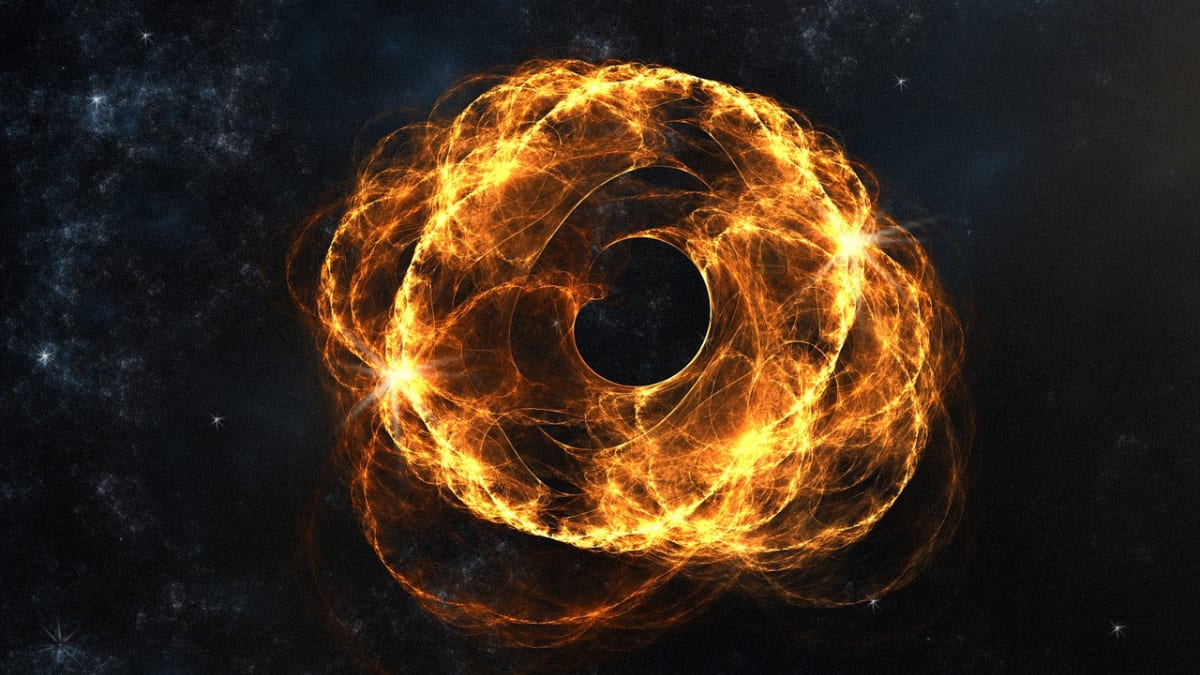
Representational image of black holes.
In a stunning discovery, a team of scientists has found that tiny primordial black holes were formed in the first few seconds after the Big Bang.
These black holes were smaller in size and "supercharged" and had the mass of a rhino which rapidly evaporated.
According to the researchers, these tiny "rhino"black holes represented an entirely new state of matter and were packed with "colour charge" to the brim.
This is a fundamental particle's property known as quarks and gluons which is related to their strong force interactions with each other and this is not related to "colour" in the everyday sense.
Such supercharged black holes are likely to have been born with primordial black holeswhen there was a collapse of microscopic regions of ultradense matter in the first quintillionth of a second after the Big Bang.
Although these newly theorized black holes are said to have evaporated in a fraction of a second after they were created, they may have affected key cosmological transition, which is the first atomic nuclei's forging.
How did 'super-charged' black holes affect the universe?
According to the research, the team believes that super-colour-charged black holes are likely to have impacted the balance offusing nucleiwhich took place in the infant universe.
“Even though these short-lived, exotic creatures are not around today, they could have affected cosmic history in ways that could show up in subtle signals today," said study co-author David Kaiser, a professor of physics at the Massachusetts Institute of Technology (MIT),in a statement.
"Within the idea that alldark mattercould be accounted for by black holes, this gives us new things to look for," he stated while speaking about the mysterious substance which makes up nearly 85 per cent of the material universe.
Watch:Scientists unveil Black Hole's plunge, bizarre region around black holes found
These black holes are present at the heart of galaxies and dominate the surroundings. They are created by a chain ofmergers of larger pairs of black holes.
The stellar-mass black holes, which have masses tens or hundreds of times that of the sun, are most common in the universe.
"People have studied what the distribution of black hole masses would be during this early-universe production but never tied it to what kinds of stuff would have fallen into those black holes at the time when they were forming," stated Kaiser.
(With inputs from agencies)