Study reveals how rings of Saturn were formed

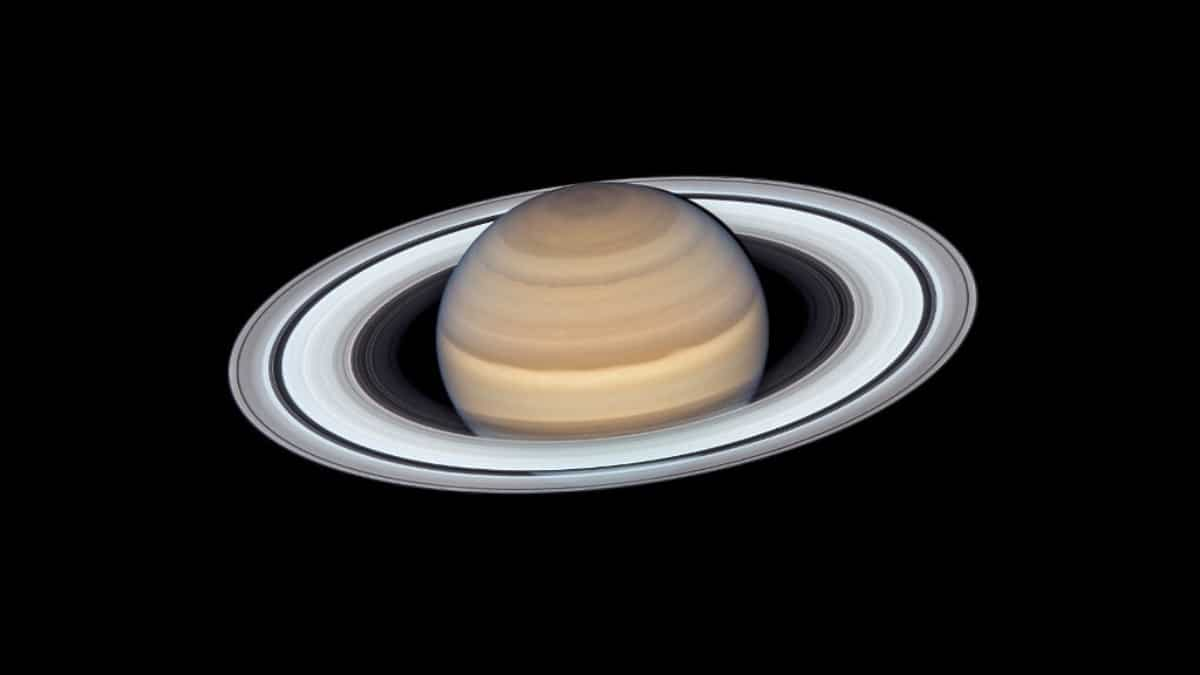
Saturn
A new study, published in the prestigious journal Science, reveals how the rings of Saturn were formed.
After getting a little too close to the gas giant, an icy moon they named Chrysalis broke up between 100-200 million years ago.
Some of its fragments broke into small icy chunks that form the planet's signature rings while most of it made an impact with Saturn.
According to the lead author of the study, Jack Wisdom, professor of planetary sciences at MIT, "It's nice to find a plausible explanation."
At the beginning of the solar system, the planet Saturnformed four and a half billion years ago but its rings appeared only approximately 100 million years ago.
After orbiting Saturn from 2004 to 2017, the Cassini probe made similar observations but the recent study has reinforced them.
Allowing them to better understand another characteristic, Wisdom and colleagues found an explanation by constructing complex mathematical models.
Although Saturn is a gas giant, it has a tilt of 26.7 degrees and one of its largest moons called Titan is migrating away from the planet.
Astronomers believe that this will impact the rate at which Saturn's axis of tilt loops around the vertical.
Creating a powerful gravitational interaction called "resonance," this wobble frequency came into sync with Neptune's wobbly orbit.
Likening the emergence of Saturn's rings to a butterfly emerging from a cocoon, the missing Moon was baptised Chrysalis by MIT's Wisdom.
(With inputs from agencies)
Watch WION's live TV here: