Six red dwarf stars ate rocky worlds like Earth. The 'fingerprints' exposed them

&imwidth=600&imheight=450&format=webp&quality=medium "Six red dwarf stars ate rocky worlds like Earth. The 'fingerprints' exposed them")
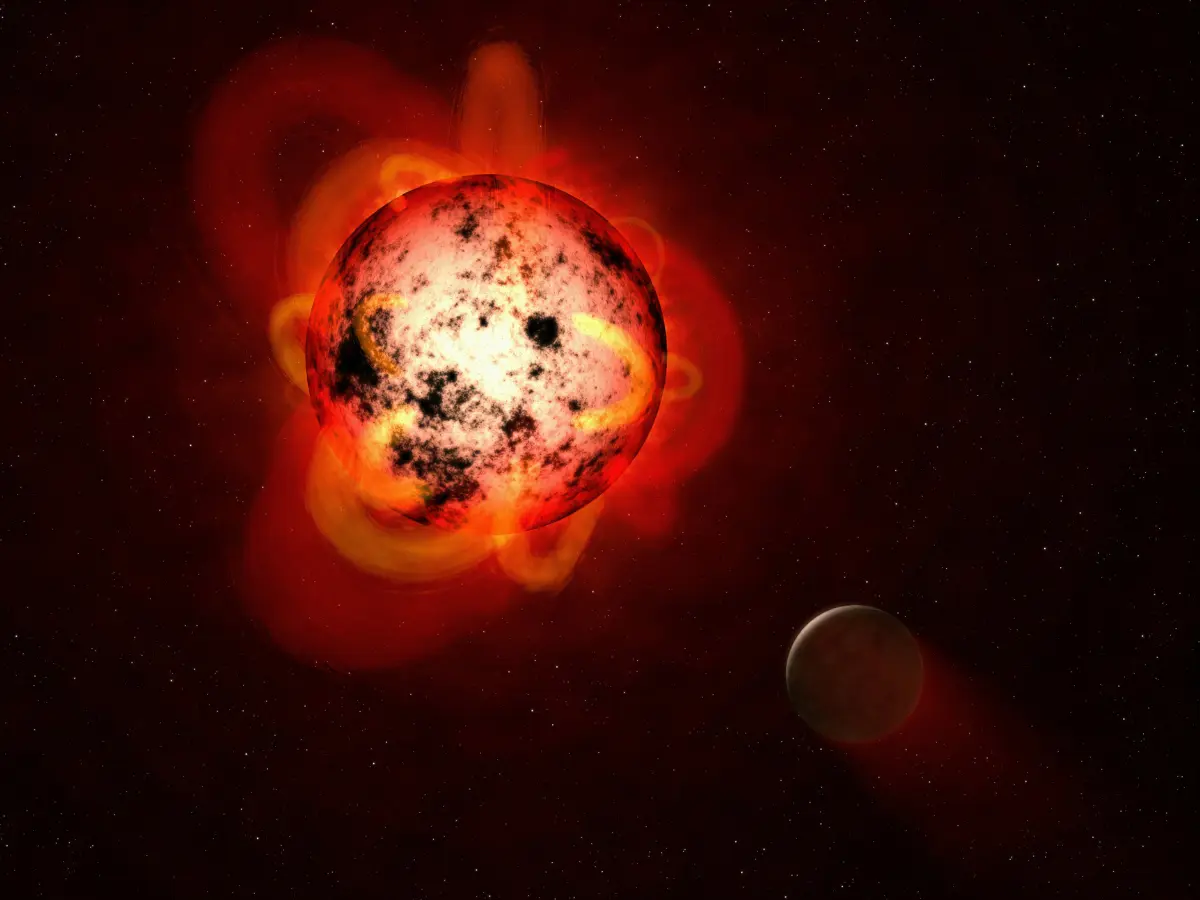
Red Dwarf stars cat eat their own planets, a study has seen. (Artist's illustration) Photograph: (NASA)
Scientists studied thousands of stars born at the same time from the same initial gas cloud and found that six red dwarfs had much higher lithium content. This gave away their past activity, where they had swallowed nearly 10 Earth-like planets.
We have all heard that one day our Sun will expand to such a massive size that it will gobble up Earth and every other planet in the solar system. Scientists have now actually found proof that this happened in other places in the universe, to be precise, six different red dwarfs in three separate clusters. Researchers from Keele University and the University of Exeter state in their study that they have found proof that young stars are capable of eating nearby worlds as planetary systems form. Published in Monthly Notices of the Astronomical Society, the study presents six cases where they found that six different red dwarfs had swallowed Earth-like rocky planets. Their ages were 50 to 200 million years, right around the Zero Age Main Sequence (ZAMS). Lead author, Professor Robin Jeffries, from Keele University, said the team detected the chemical fingerprint which gave away the red dwarfs as planet eaters. “We found that a few of the red dwarf stars we studied contained lithium, a chemical element that should not be there,” he said.
Red dwarfs are cool on the outside and extremely hot on the inside. They are smaller than even our Sun, but have the potential to consume planetesimals. The nuclear reactions going on inside a red dwarf would destroy all the lithium right after they are born. Identifying hints of lithium in their atmosphere would mean that they likely engulfed lithium-rich material from a surrounding planetary system. Scientists went through the data on thousands of stars gathered by the Gaia-ESO Spectroscopic (GES) survey and found that six red dwarfs have much higher lithium content. These sibling stars were born at the same time from the exact same initial gas cloud. Most of them had no lithium, while six early M-dwarfs had anomalous, high-abundance "fingerprints" of lithium.
Also Read: Scientist says THIS dark comet could be a 38-year-old human probe - What Avi Loeb told us
The study states that this is proof that they either dramatically “swallowed” surrounding Earth-like planets or chomped down three to 10 Earth masses of planetary material, which led to a fresh lithium infusion. Earlier papers have theorised that similar events could be common in early planetary system formation, and our solar system was likely no exception. If this explanation is correct, it opens a new window into the youth of planetary systems, letting us investigate how often and when planetary engulfment occurs.

