Scientists resolve the mystery behind sudden dimming of supergiant Betelgeuse star

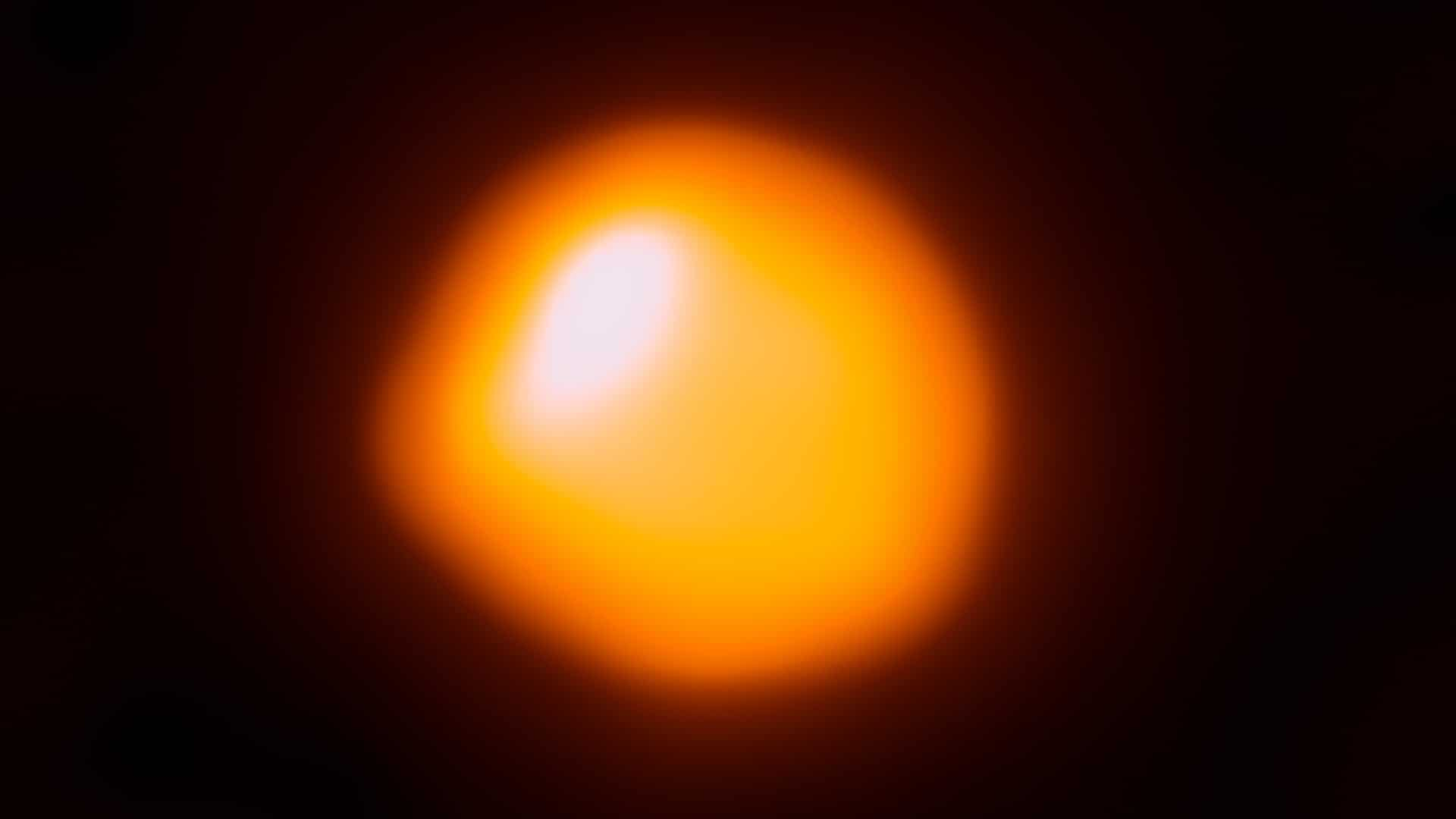
Betelgeuse is a lumpy clump of boiling gas
Scientists now have established why the red supergiant star Betelgeuse turned dim between 2018 and 2020, dismissing theories that suggested that the star might be entering the last stage of its evolution—Supernova or the ultimate explosion.
According to a team of scientists from France’s Université Côte d’Azur, the dimming was caused by a burst of dust on the star’s surface.
The team reportedly used MATISSE (Multi Aperture mid-Infrared Spectroscopic Experiment) instrument on the European Southern Observatory’s Very Large Telescope Interferometer in northern Chile to snap high-resolution pictures of the star from 2018 to 2020.
Images released on Monday (Oct 23) by the European Southern Observatory (ESO) revealed that the star had returned to its original form, from our point of view.
The cause of the dimming revealed
The French team also observed that while the star appeared dim during these years, its photosphere actually brightened up.
This led the team to believe that the dimming was due to a burst of dust, in the form of silicon monoxide, coming from the star.
The burst might have been caused by a sudden cooling of the star's surface.
Watch:Aliens: Are we looking in the wrong place?
"The changes in the structure of the photosphere and the silicon monoxide are consistent with both the formation of a cold spot on the star’s surface and the ejection of a cloud of dust," the statement by the French team reads.
Theory supports 2021 study results
If the hypothesis holds true, it would align with the findings of a 2021 study concerning Betelgeuse, which suggested that the star had essentially expelled a bubble of gas. Astronomers who observed the star during that period had concluded that a sudden temperature drop had caused some gas to erupt from its surface.
According to the 2021 results, this abrupt cooling would have been sufficient to cause the departing gas to condense into solid dust. This dust would then have dispersed to create a shroud in front of the star, causing it to appear dimmer from our perspective.
The MATISSE images, therefore, provide support for this theory. Furthermore, these images indicate that dust, the same dust that can eventually contribute to the formation of new star systems, can actually form in close proximity to stars.
(With inputs from agencies)
WATCH WION LIVE HERE