Scientists locate two black holes closest to Earth in cosmic backyard

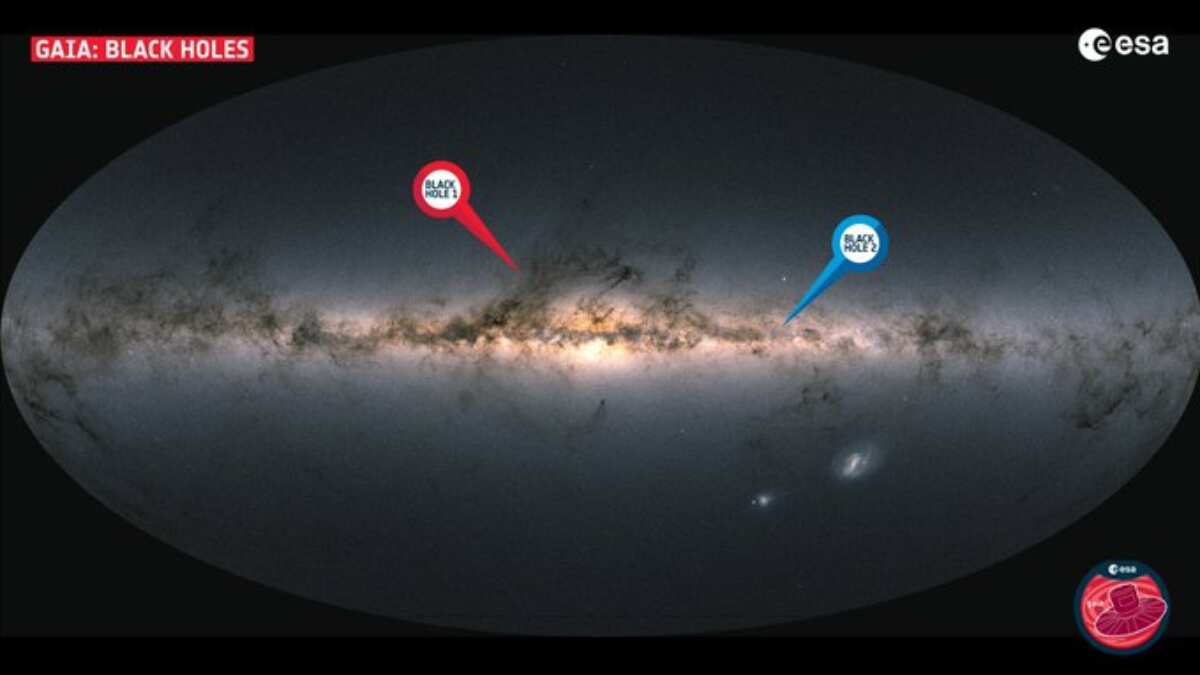
The European Space Agency, with the help of Gaia mission’s data, discovered a new family of black holes which are unique in nature. The two black holes discovered are the closest ones to the Earth till date.
Black hole Gaia BH1 is at a distance of 1560 light-yearsfrom Earth in the direction of the constellation Ophiuchus and Gaia BH2 is located 3800 light-years away in the constellation Centaurus.
In cosmic terms, the distance is not far and scientists have stated that two black holes are just in our cosmic backyard.
The wobbles, which were created in their companion stars’ movement, picked the two black holes.
The presence of wobble meant that the stars were not alone and proved that they were orbiting a huge object, which is ten times bigger than our Sun.
Scientists claimed that the space objects were totally invisible, and black and can only be detected because of the gravitational effects.
“What sets this new group of black holes apart from the ones we already knew about is their wide separation from their companion stars. These black holes likely have a completely different formation history than X-ray binaries," said Kareem El-Badry, who discovered the new black holes, in a statement.
The discovery of black holes was part of the analysis carried out on data which was beamed back by the Gaia mission, which was measuring the motions and positions of billions of stars present in our universe.
WATCH | NASA mission to Saturn's moon Titan may unravel secrets behind origin of life
The changing position of stars against the sky can provide essential clues about objects which influences these stars gravitationally.
Although Gaia data revealed massive objects’ presence around the stars, Chandra X-ray Observatory and the South African MeerKAT radio telescope’s observations failed to detect any emission, which is a characteristic found in black holes.
"There are a lot of particles coming off the companion star in the form of stellar wind. But because we didn't see any radio light, that tells us the black hole isn't a great eater and not many particles are crossing its event horizon. We don’t know why that is, but we want to find out,” said Yvette Cendes, who assisted in the discovery of the second black hole.
(With inputs from agencies)
You cannow write for wionews.comand be a part of the community. Share your stories and opinions with ushere.
WATCH WION LIVE HERE