Perseverance: NASA's Mars rover close to completing its first set of objectives

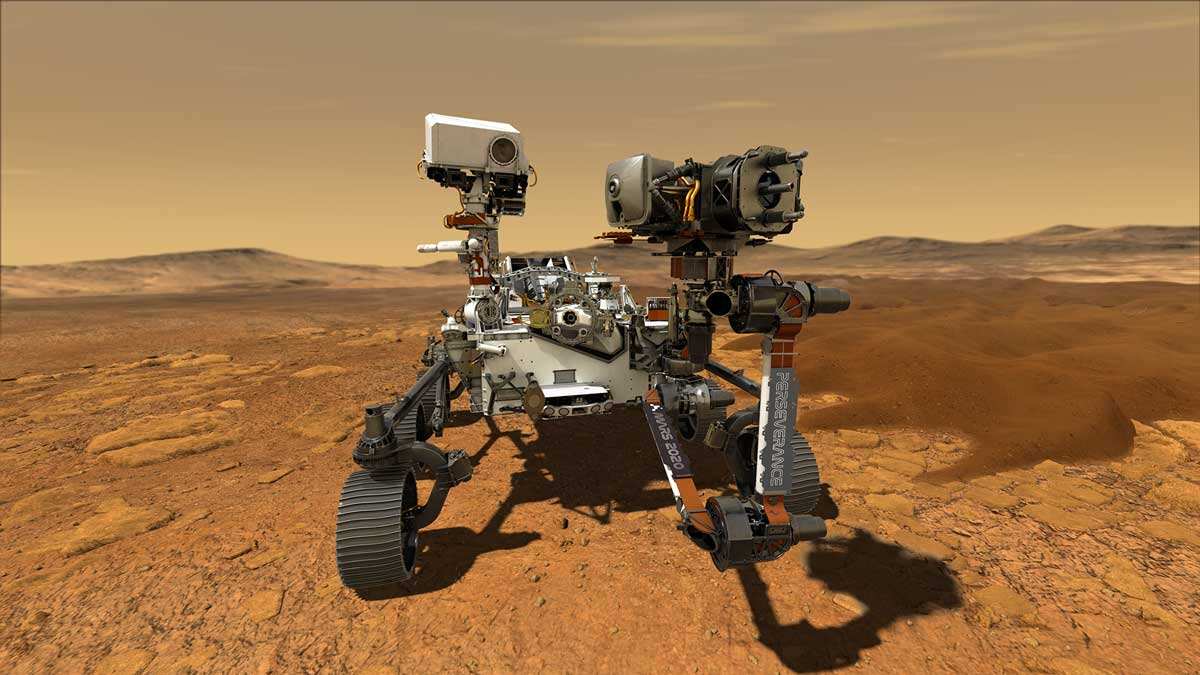
Nasa Mars rover
The first set of goals set for the US space agency's Perseverance rover on Mars are almost finished.
The NASA robot has gathered a wide variety of rock samples, which it will shortly deposit on the surface in anticipation of being brought back to Earth by subsequent missions.
The vehicle was lowered underneath a rocket crane and transported to a location known as Jezero Crater 17 months ago.
The rover is in the ideal location to look for life, as evidenced by everything "Percy" has seen since.
The hostile atmosphere on Mars makes the existence of living things there exceedingly doubtful, hence it is not searching for any of them. Instead, the robot is looking for the remnants of a biology that may have existed when Jezero was populated with a life-form billions of years ago, as reported by the BBC.
"If [Jezero's ancient] conditions existed pretty much anywhere on Earth at any point in time over the last 3.5 billion years, I think it's safe to say, or at least assume, that biology would have done its thing and left its mark in these rocks for us to observe," said David Shuster, a Perseverance mission scientist from the University of California, Berkeley.
A strategy to rescue the rock cache is being developed by NASA and the European Space Agency. Another landing mechanism, a few helicopters, a Martian rocket, and an interplanetary cargo will all be used in this bold scheme.
The samples are expected to return to Earth in 2033.
Some samples of the igneous, or volcanic, rocks that Perseverance extracted from the crater bottom will be included in the delivery. These will mostly tell the history of Jezero prior to the lake's water intrusion.
Importantly, the samples come from a form of rock that can be precisely dated. Ages on Mars may currently only be estimated indirectly.
It is the kind of geological formation that may have contained remnants of ancient microbial life.
The second portion of the cache will contain sedimentary rocks that Perseverance has recently been gathering from the delta deposits in the western section of the 45 km wide crater.
A delta is a structure formed by the silt and sand that rivers deposit as they slow down as they enter larger bodies of water.
It is the kind of geological formation that may have contained remnants of ancient microbial life.
One of the sedimentary samples came from the "Wildcat Ridge" rock, which was created when muds settled in the Jezero lake after it evaporated. It's salty to the core. However, Wildcat Ridge also contains a significant amount of organic, or carbon-rich, molecules, according to the rover's instruments.
Although intriguing, this observation has some key limitations.
Perseverance has been working on the 40-meter-high scarp that symbolises the delta's edge for the past four months.
The rock samples, in their protective titanium tubes, can be laid down on the ground on a nearby flat area of the crater floor when the robot soon drives off this slope.
Engineers at NASA have been practising how the tubes, which are presently in Perseverance's belly, will be expelled. Before sending commands to Mars to carry out the actual manoeuvres, they can practise on a full-sized replica of the rover at JPL.
NASAis anticipated to make a go/no-go decision following a meeting on October 19.
WATCH WION live here: