James Webb telescope helps NASA scientists discover how planets were formed

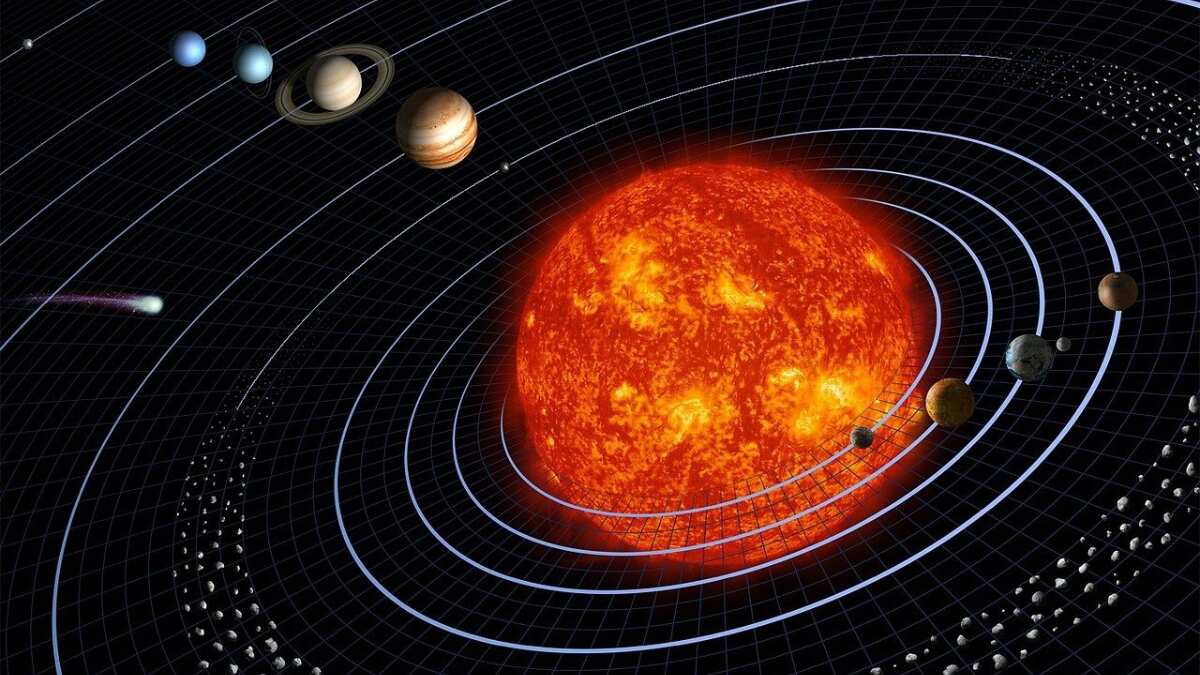
Representational image of planets revolving around Sun in solar system.
A major breakthrough was made by scientists in NASA, with the help of the James Webb Space Telescope, as they found out how planets came into existence.
The telescope observed the water vapour in protoplanetary disks, after which it confirmed a physical process which included the drifting of ice-coated solids from the disk's outer regions into the rocky planet zone.
For years, scientific theories have stated that the icy pebbles, which were formed in the protoplanetary disks' cold, outer regions were the fundamental element in the formation of the planet. This isthe same area from where the comets came into existence in our solar system.
These theories necessitated the drifting of pebbles inward towards the star because of friction in the gaseous disk, which will help in providing both water and solids to planets.
As per this theory, icy pebbles are likely to release large amounts of cold water vapour when entering into the warmer region within the “snowline”. This was what James Webbobserved.
“Webb finally revealed the connection between water vapour in the inner disk and the drift of icy pebbles from the outer disk,” stated principal investigator Andrea Banzatti of Texas State University, San Marcos, Texas, as quoted by NASA. He added, “This finding opens up exciting prospects for studying rocky planet formation with Webb!”
“In the past, we had this very static picture of planet formation, almost like there were these isolated zones that planets formed out of,” team member Colette Salyk of Vassar College in Poughkeepsie, New York explained.
“Now we actually have evidence that these zones can interact with each other. It’s also something that is proposed to have happened in our solar system,” he stated in a press release.
Solving the mystery of planets
When the data from observations first came in, the research team was left puzzled by the results.
“For two months, we were stuck on these preliminary results that were telling us that the compact disks had colder water, and the large disks had hotter water overall. This made no sense, because we had selected a sample of stars with very similar temperatures,” stated Banzatti.
WATCH |Remains of an ancient planet lie deep within earth
Banzatti said that when the data was overlaid by him from the compact disks onto the data collected from the large disks, the answer emerged clearly.
There was extra cool water inside the snowline in the compact disks, which is 10 times closer than the orbit of Neptune.
“Now we finally see unambiguously that it is the colder water that has an excess,” stated Banzatti, adding, “This is unprecedented and entirely due to Webb’s higher resolving power!”
(With inputs from agencies)