NASA's Hubble telescope spots stunning 'cloud of space rocks' made from asteroid-smashing DART mission

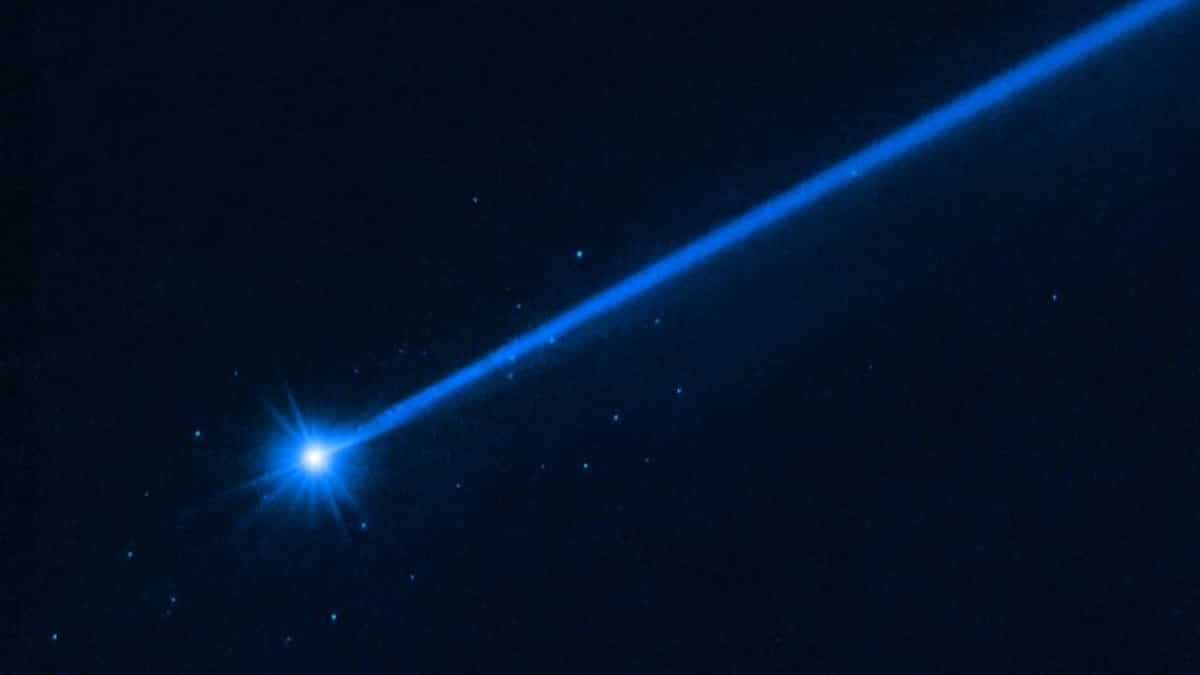
An image of the impacted asteroid Dimorphos.
A spacecraft was smashed into the asteroid Dimorphos by NASA last year. The debris, which resulted after the smashing of spacecraft, was now captured by the Hubble Space Telescope in stunning detail. The cloud of space rocks captured revealed a glittering field of boulders.
In the Double Asteroid Redirection Test (DART), a 600-kilogram spacecraft smashed Dimorphos, which circles around a bigger asteroid called Didymos. The asteroid was smashed to understand if the orbit of the space rock can be altered as a practice run to divert future dangerous asteroids. The mission to smash the asteroid was a success which decreased the length of Dimorphos’s orbit by around 33 minutes after the impact in September 2022.
In December 2022, a few months later, Hubble Space Telescope was used by David Jewitt at the University of California, Los Angeles and his colleagues to know more about the debris expelled by the collision. The team discovered 37 large boulders, which will range from 1 to almost 7 metres across, and appeared like small sparkles of light in the picture shared.
Hera spacecraft to study cloud of boulders
It is most likely that these rocks were tied loosely to the surface of Dimorphous, and not the shards released from the body of the asteroid itself. These clouds are moving relatively slowly compared to Dimorphous, at a speed of 0.8 kilometres per hour, and the total mass of the rock is around 0.1 per cent of their parent asteroid.
“This tells us for the first time what happens when you hit an asteroid and see material coming out up to the largest sizes,” said Jewitt, in a statement. “The boulders are some of the faintest things ever imaged inside our solar system," he added.
"This is a spectacular observation – much better than I expected. We see a cloud of boulders carrying mass and energy away from the impact target. The numbers, sizes, and shapes of the boulders are consistent with them having been knocked off the surface of Dimorphos by the impact," Jewitt stated.
WATCH |India's gateway to outer space at Satish Dhawan Space Centre
European Space Agency’s Hera spacecraft, which will depart from Earth in October 2024 and reach Didymos and Dimorphos at the end of 2026, will further study the cloud of boulders. By putting into use the Hubble observations which have been taken now and Hera observations made in future, astronomers might be successful in pinning down the exact trajectories of the boulders.
You cannow write forwionews.comand be a part of the community. Share your stories and opinions with ushere.
WATCH WION LIVE HERE