NASA to launch drone-like Dragonfly rotorcraft to explore Saturn's moon Titan

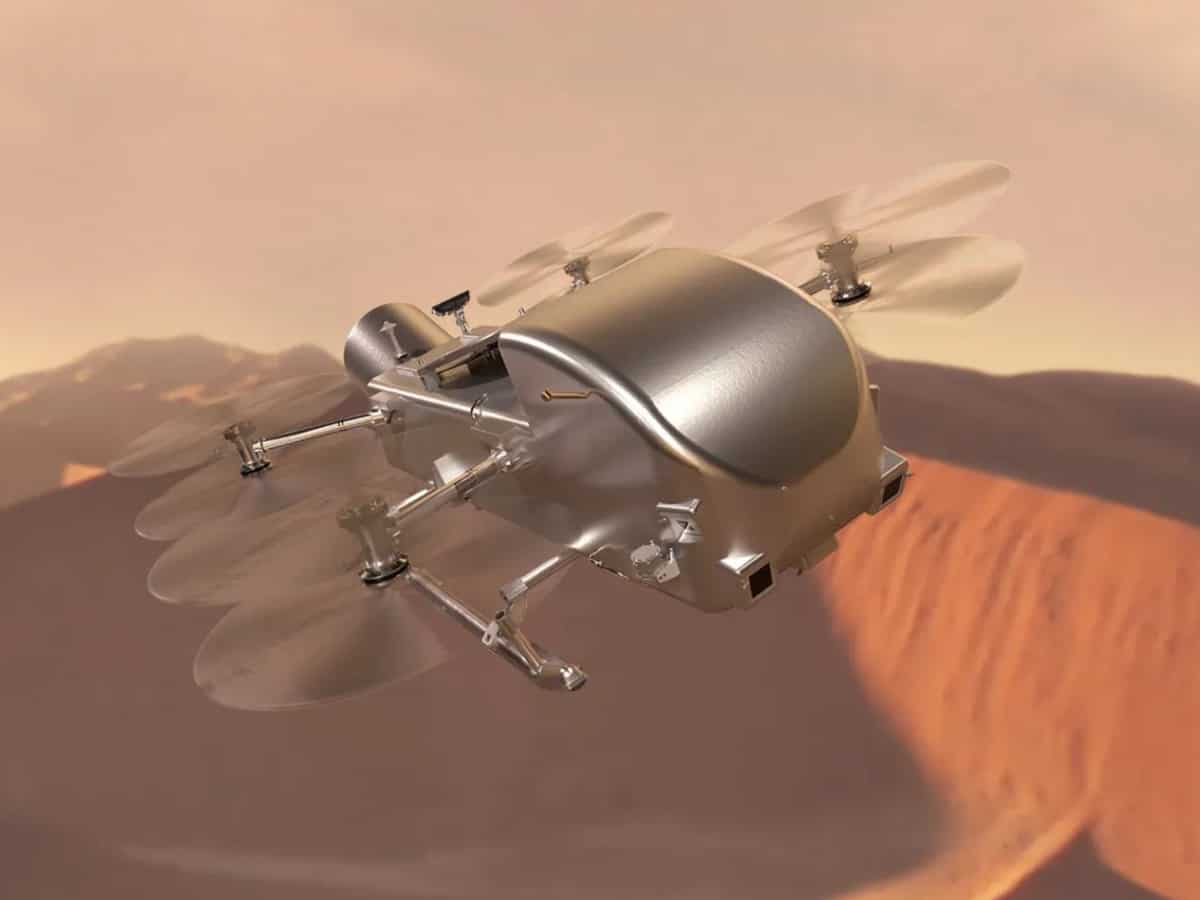
NASA's Dragonfly Rotorcraft mission
NASA is gearing up for the launch of an exploration mission of Saturn’s largest moon, Titan. The Dragonfly Rotorcraft Mission is set to launch in July 2028 to study the “diverse locations to characterise the habitability of Titan’s environment”, said NASA in its newsletter.
Titan is often called one of the most “organic-rich moons” of the ringed planet, and it is also the only moon known to have an atmosphere denser than Earth’s. Exploration of the moon is crucial for the scientific community as it is the only known celestial object other than Earth on which clear evidence of stable bodies of surface liquid has been found.
“Dragonfly is a spectacular science mission with broad community interest, and we are excited to take the next steps on this mission," said Nicky Fox, associate administrator, of the Science Mission Directorate at NASA Headquarters in Washington.
"Exploring Titan will push the boundaries of what we can do with rotorcraft outside of Earth.”
Dragonfly mission: Cost, duration, objectives and what we know so far
NASA said on Tuesday that the total lifecycle of the Dragonfly mission will cost $3.35 billion. The mission will be launched in 2028 and is expected to reach the surface of Titan in 2034 to explore a dozen locations on the moon.
The current cost of the mission is two times more than the original proposed cost and the launch date of the mission is delayed by two years.
Also Read |Scientists believe Uranus and Neptune are 'ice giants,' but a new study hints at something else
During the COVID-19 period, the mission went through multiple overhauls due to constraints in fiscal years 2020 through 2022.
“To compensate for the delayed arrival at Titan, NASA also provided additional funding for a heavy-lift launch vehicle to shorten the mission’s cruise phase,"NASA said in its official statement.
With the Dragonfly mission, the American space agency aimed to look for “prebiotic chemical processes on both Titan and the early Earth”, before life was developed.
"Dragonfly marks the first time NASA will fly a vehicle for science on another planetary body," the government agency said. "The rotorcraft has eight rotors and flies like a large drone."
Dragonfly Rotorcraft is being designed and developed by the Johns Hopkins Applied Physics Laboratory (APL), which also manages the mission for NASA.
(With inputs from agencies)