Mushroom found growing on frog’s side in India’s Western Ghats baffles scientists

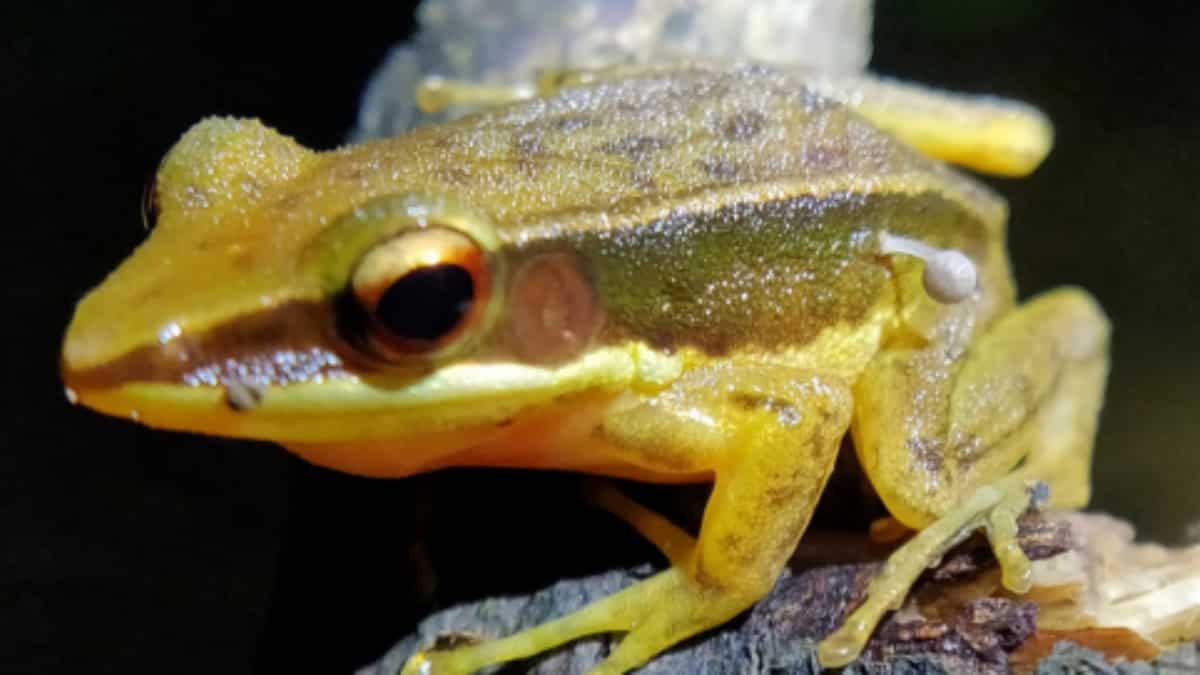
Mushroom growing on frog’s side
A team of Indian scientists has stumbled upon something that has left many in the scientific community baffled and intrigued – a mushroom sprouting from a frog.
The researchers affiliated with the World Wildlife Fund (WWF) describing their discovery in the journal Reptiles and Amphibians said this is the first time that a mushroom has been spotted growing on live animal tissue.
What did the researchers find?
The Indian scientists were on a nature walk through the foothills of the Western Ghats when they found the frog, identified as Rao’s Intermediate Golden-backed Frog (Hylarana inter-media).
Since the species is native to the region, the creature itself was not what surprised the researchers, rather it was the extraordinary feature it was sporting, the mushroom.
Experts have identified the mushroom as a Bonnet Mushroom, which is known to typically grow as a saprotroph on rotting wood. A saprotroph is an organism that feeds on nonliving organic matter.
However, the frog which was among 40 others on a small roadside pond did not seem to be bothered by the unusual appendage, said the researchers, but the same cannot be said for the scientists.
“To the best of our knowledge, never has a mushroom sprouting from the flank of a live frog been documented,” the team wrote in their report.
Notably, the type of mushroom found on the frog’s hind leg thrives on decaying organic matter, which is why scientists were baffled since the amphibian was alive and well.
The discovery raises a number of questions about ecological dynamics and a possible relationship between amphibians and fungi – which is largely unexplored.
What now?
Since the frog was not captured for further study, the exact nature of the mushroom growing on the frog and if it is infectious or not harmful to the amphibian remained unclear.
“The frog was not collected, so no prognosis is possible,” the authors wrote.
The research team suspects that the humid and monsoon-fed environment of the Western Ghats may have been ideal for mushroom growth.
The team said that they plan to continue monitoring the area and conduct research into the fascinating discovery.
(With inputs from agencies)