

&imwidth=800&imheight=600&format=webp&quality=medium "NASA’s Artemis II Launch to the Moon Live: Date, time, launch site and other key questions answered")
NASA's historic moon mission, Artemis II, is ready for launch. The launch date is April 1, and the targeted launch time is 6:24 pm with a two-hour margin. The space agency has started the countdown for the April 1 takeoff. Four astronauts will enter the history books when they fly to the moon, the first time humans will be doing so in nearly 60 years. Three American and one Canadian astronaut will board the Orion capsule and shoot into space for a 10-day mission. The mission will also be different from the Apollo missions because it will take the astronauts to the farthest point in space humans have ever been to. Here is everything you need to know about Artemis II.
NASA recently overhauled the Artemis moon mission. Previously, human landing was supposed to happen in 2027 with the Artemis 3 mission. But now this mission will act as a test flight. The astronauts will carry out several technology tests in Low Earth orbit. The landing will now happen in 2028 with the Artemis 4 mission.
No. The astronauts are not landing on the moon. The four crewmembers will check all systems in space to prepare for a future landing, which is not scheduled to happen for another two years. But the Artemis II astronauts will still make history since they will be the first ones to go to deep space in over 50 years.
Reid Wiseman, commander of the mission, is a single father to two teenage girls. He says his daughters understand the risks associated with a mission like Artemis II, but they also know the importance of exploration. Read his full story here.
The spacecraft Orion is one single open space. There is a small kitchenette, a gym, six windows that will offer them views of the world outside and later the Moon, and a stowage compartment that can be converted into a radiation shelter in case of emergency.
NASA has said that some people might be able to see the Artemis II rocket soaring in the sky from their backyards. According to the space agency, it might be visible from some places in Florida and southern Georgia.
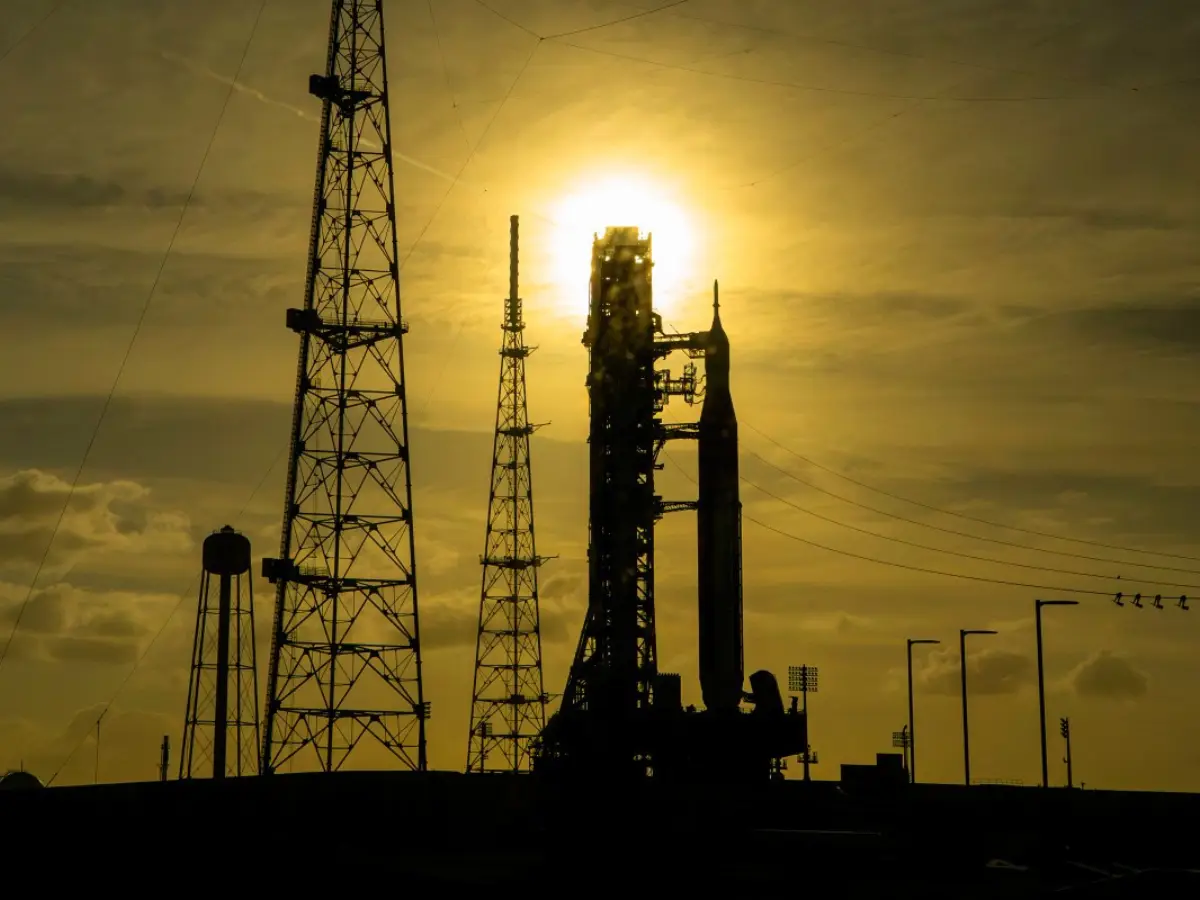
NASA Administrator Jared Isaacman shared a video of the Artemis II rocket SLS and Orion, ready for launch on April 1. He wrote, "Tomorrow, we launch. At sunset tonight, Artemis II waits on the pad, ready to carry astronauts potentially farther than any humans have traveled in more than half a century. The next era of exploration begins."
NASA has backup dates in case Artemis II is not launched on April 1.
The weather on Earth is not the only consideration to have a smooth and safe launch. Our Sun has been very active and unleashed X-class solar flares on Sunday. NASA is keeping one eye on the Sun and hopes it does not release more material as Artemis II takes off. Here is more on the Sun and Artemis II.
Artemis II will take humans to the farthest point in space anyone has ever been to. The Orion will travel several kilometres beyond the far side of the Moon, giving the four astronauts a glimpse of never-before-seen features of the Moon. This already means that Artemis II stands out from the Apollo missions.
Launch can only happen when an optimal window opens. This depends on the moon's position, and the need to align the spacecraft's trajectory with it. This leaves NASA with only a handful of dates for the Artemis II moon launch.
Orion is the spacecraft carrying Artemis II astronauts to the Moon. It has been built to protect against solar radiation. The high-tech "deep-space minivan" has been named Integrity by its crew. Here is everything you need to know about Orion.
In case NASA is forced to cancel the April launch due to some circumstances, the space agency has come up with other dates. Backup launch windows have been set from April 2 to 6 and on April 30, each with a two-hour launch period. However, it has said that April 1 offers the best weather conditions.
Preparations for Artemis II are underway at NASA’s Kennedy Space Center in Florida. Launch teams are completing a sequence of highly choreographed steps to ready the SLS (Space Launch System) rocket and Orion spacecraft, which will take the crew around the Moon on a 10-day journey.
Live views and audio commentary of tanking operations ahead of the launch begin at 7:45 am on April 1 on NASA’s YouTube channel. Teams will load propellant into the SLS rocket, which will be shown here. Full coverage for the mission launch will start on NASA+ at 12:50 pm.
7:45 am: Live coverage of tanking operations to load propellant into the SLS rocket begins.
12:50 pm: NASA+ coverage of launch begins.
6:24 pm: Launch from Kennedy Space Center in Florida at EDT on Wednesday, April 1.
Weather conditions will be crucial in deciding whether the Artemis II rocket will be launched on April 1. NASA and weather officers with the US Space Force’s Space Launch Delta 45 are keeping a tab on the weather conditions ahead of tanking operations. The weather forecast for launch day shows an 80% chance of favourable conditions. Cloud coverage and the potential for high winds in the area are the two main things they need to keep an eye on.
The Artemis II crew spent the final countdown phase getting through technical verification and checking readiness. They have been in quarantine for days, and their health is being strictly monitored. Medical checks were carried out to ensure fitness for launch. The astronauts followed a controlled sleep schedule and nutrition plan to ensure optimum energy and hydration for launch. They were also being given regular updates on the rocket’s configuration and weather conditions.
Artemis II is taking four astronauts to the Moon, three American and one Canadian. The Artemis crew includes NASA astronauts Reid Wiseman, Victor Glover, and Christina Koch, and CSA (Canadian Space Agency) astronaut Jeremy Hansen. They are currently at the Astronaut Crew Quarters inside NASA Kennedy’s Neil A. Armstrong Operations and Checkout Building.
The National Oceanic and Atmospheric Administration’s Space Weather Prediction Centre (SWPC) said that a cluster of sunspots called active region 4405 produced the X1.4 flare on Sunday. This means solar radiation has slammed Earth. Could the Artemis II launch be affected? Full story here
The countdown to the Artemis II mission has started at NASA's Kennedy Space Center in Florida. Team members are at their consoles inside the Rocco Petrone Launch Control Center. The launch is scheduled for 6:24 pm ET on Wednesday, April 1. The clock started ticking down at 4:44 pm ET.

